
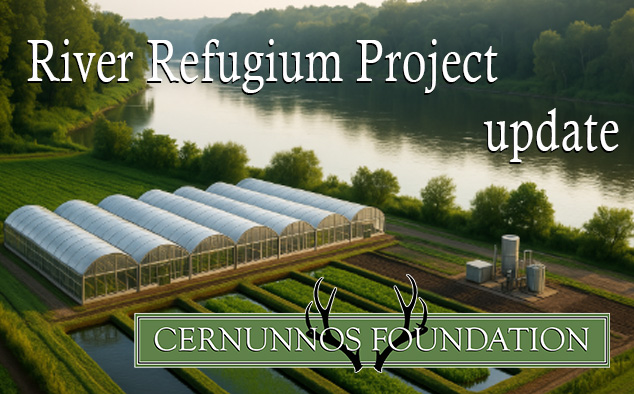
The River Refugium Project is entering its next phase of development, and this page exists to provide clarity for partners, researchers, funders, and any individual or organization exploring collaboration.
The foundational work — the modeling, design logic, site-selection criteria, and integrated greenhouse system structure — is complete. Over the past year, the project has grown into a comprehensive framework for nutrient remediation, agricultural production, and bio-derived energy precursors, all wrapped into one scalable system.
What the project needs next is a baseline demonstration at a meaningful scale.
The River Refugium model can’t be proven by table-top trials or single-tank home tests.
The biological and hydraulic systems only reveal their true performance at acreage scale.
Because of this, the next practical step is a properly funded, fully operational 10-acre pilot site, operated without HTL/HTC at first. The initial demonstration should focus on:
A smaller test would be visually interesting, but not scientifically meaningful.
At present, the project is in a holding pattern, not due to lack of readiness, but because the next stage requires land, operational budget, and a full growing season.
I am not able to operate a multi-acre grow on my own without proper support, staffing, and funding. A 10-acre pilot is the smallest scale that will produce reliable, defensible data — and it must be executed correctly.
Until that point, I am continuing to:
Available Now
If adequate operational funding is secured for a full-season grow, I can be on the ground or in a leadership role as needed.
With real acreage and production value, the project becomes self-sustaining.
That makes it viable for me to commit fully without external employment.
To support anyone evaluating the project, the Cernunnos Foundation is making the core materials available in one consolidated format:
These resources are offered freely to facilitate informed discussion, critique, and exploration.
The next stage requires:
This level of demonstration will validate the system’s agricultural, ecological, and economic performance — and determine its viability for scaled deployment.
I welcome conversation with:
Whether you simply want to understand the system more deeply or explore a pilot site, I’m available to assist however I can.
The River Refugium model sits at the intersection of ecology, engineering, and opportunity. I believe it can contribute to water remediation, community agriculture, and regional economic resilience. But this belief has to be proven on the ground.
If you have interest, resources, or alignment with this work, I’m happy to talk.
Thank you for your time and consideration.
Robert Smith
robert@brightmeadowgroup.com
Founder, Cernunnos Foundation
Systems Analysis & Solutions Consulting — Bright Meadow Group
post scriptum
If you’re reading this and thinking, “I might steal this idea and run with it,” let me save you the hesitation:
I double-dog dare you.
If you can build this faster, bigger, or cleaner than I can —
you don’t have a hair on your chest if you don’t try.
Take it.
Run with it.
Out-engineer me.
Out-organize me.
Out-plant me.
Go fix a river.
Godspeed, and do it well.
Because the death machine we’re currently running into the world’s oceans isn’t slowing down, and anyone who can help turn the tide should feel absolutely free — encouraged, even — to do it.
And for the record:
This system will work on any major river basin on Earth.
Anywhere.
If you have nutrient overload, sediment load, agricultural runoff, urban waste, or a broken water cycle, the River Refugium pattern will help.
Here are just a few river systems where this could make an immediate, measurable difference:
These places aren’t just “opportunities.”
They’re suffering.
And they’re all in desperate need of affordable, scalable, regenerative solutions.
If you can take this model and build something that spares a community, restores a river, feeds people, or keeps one more pound of nutrient sludge out of the sea?
Then I hope you do it — and do it proudly.
The world is wide.
The problems are real.
There’s room for all of us to get to work.