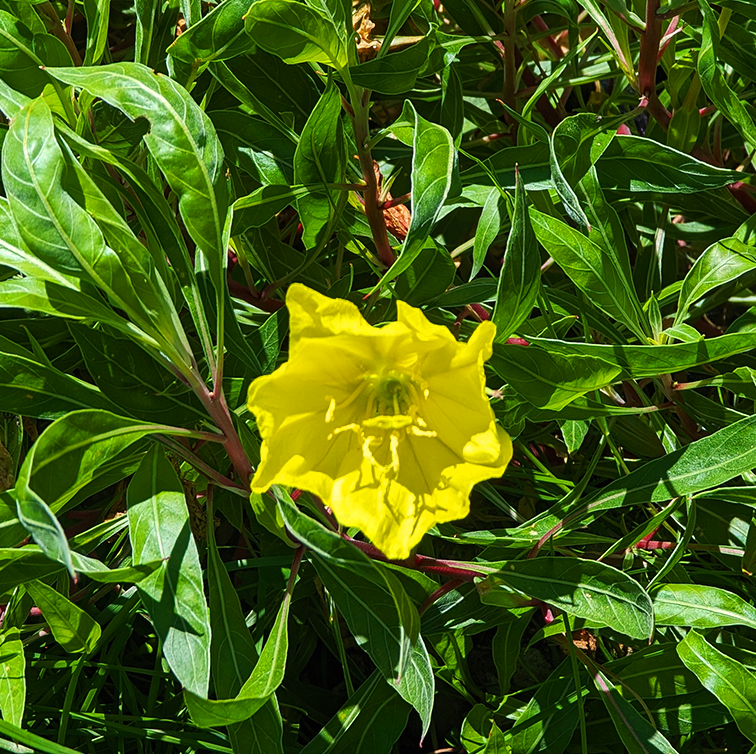
Missouri Evening Primrose
Taxonomy
- Kingdom: Plantae
- Clade: Tracheophytes
- Clade: Angiosperms
- Clade: Eudicots
- Order: Myrtales
- Family: Onagraceae
- Genus: Oenothera
- Species: Oenothera macrocarpa Nutt.
Common Names by Region
- General / North America: Missouri Evening Primrose
- Great Plains / Midwest: Ozark Sundrops, Bigfruit Evening Primrose
- Horticulture / Native Plant Trade: Missouri Primrose
Description
Growth Habit
Low-growing, perennial herb with a spreading, ground-hugging form.
Often forms broad mats or loose colonies that follow the contours of rocky ground.
Growth is steady rather than aggressive.
Size
- Height: Typically 6–12 inches (15–30 cm)
- Spread: 2–3 feet (60–90 cm) or more in open sites
Leaves
Leaves are long, narrow, and lance-shaped with smooth margins.
Color ranges from medium green to bluish-green.
Foliage often lies close to the ground, creating a soft, flowing texture over stone or soil.
Flowers
Large, showy flowers with four broad petals.
Bright, saturated yellow with a soft, silky appearance.
Blooms open in late afternoon or evening and remain open into the following morning.
Flowering period typically spans late spring through summer, with sporadic blooms later in the season.
Fruit
Produces large, winged seed capsules—one of the defining features of the species.
Capsules are elongated and angular, persisting after flowering and adding structural interest.
Known Range
Native Range
Native to the central United States, particularly the Great Plains and Ozark regions.
Commonly found in Missouri, Arkansas, Kansas, Oklahoma, Texas, and surrounding states.
Habitat Range
Occurs naturally on:
- Rocky prairies
- Limestone glades
- Open hillsides
- Gravelly or sandy soils
Adapted to exposed, well-drained environments with minimal organic matter.
Care / Habitat Requirements
Light
- Prefers full sun
- Tolerates light shade but flowers best with abundant sunlight
Water
- Low to moderate water needs
- Highly drought-tolerant once established
- Sensitive to poorly drained or waterlogged soils
Soil
- Requires excellent drainage
- Thrives in rocky, sandy, or gravelly soils
- Tolerates alkaline and limestone-based substrates
Temperature
- Hardy in USDA Zones 4–9
- Handles heat, cold, and wide temperature swings well
Humidity
- Well adapted to dry air and open landscapes
- Does not require high humidity
Propagation / Reproduction
- Propagated primarily by seed
- Can also be divided carefully in early spring
- Self-seeds lightly in suitable conditions but does not become invasive
Pests / Diseases / Threats
- Generally pest-resistant
- Occasional aphids or leaf-chewing insects may appear but rarely cause serious damage
- Root rot possible in poorly drained soils
Additional Notes
Special Features
- Evening-blooming habit supports nocturnal pollinators such as moths
- Long flowering season provides extended visual impact
- Distinctive seed pods add off-season interest
Ecological Value
- Supports native pollinators, particularly night-flying species
- Well suited to restoration of rocky prairies and glades
- Performs valuable ground-cover functions in harsh, exposed sites
Maintenance / Management
- Very low maintenance once established
- Avoid rich soils and overwatering
- Best used in rock gardens, native plantings, slopes, and xeric landscapes
Field Notes: A Plant That Knows Where It Belongs
Missouri Evening Primrose doesn’t soften a landscape—it follows it.
You’ll see it where soil is thin, stone shows through, and water never lingers long enough to pretend comfort. The leaves sprawl low, the flowers flare bright and brief, and then the plant settles back into the ground like nothing happened.
This is not a plant that asks for improvement.
It asks for honesty.
Put it where conditions are hard, and it thrives.
Put it where conditions are easy, and it complains.
That’s not fragility. That’s precision.
—
Blue Ribbon Team field notes are observations, not edicts. Learn the place first. Then decide what it needs.
Post Views: 232