
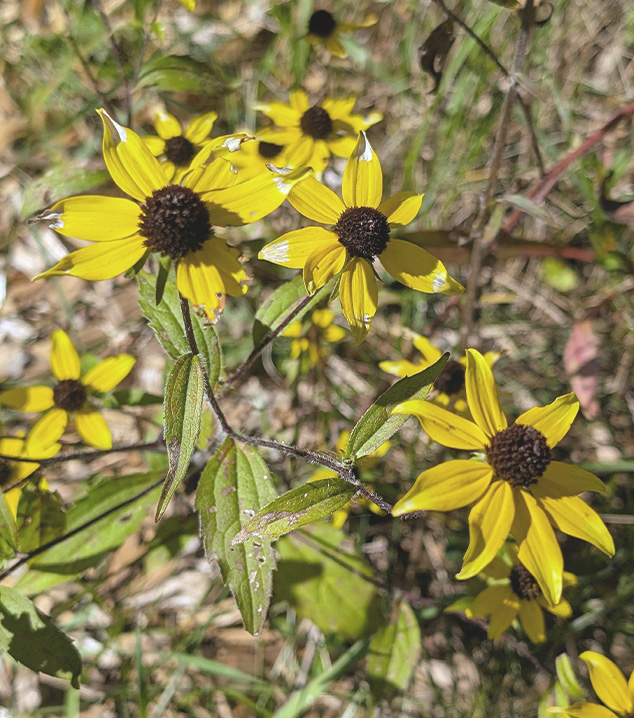
Brown-eyed Susan is a short-lived herbaceous perennial, often behaving as a biennial, that grows in an upright, branching form from a basal rosette in its first season. In its second and subsequent years, mature plants reach 2–5 feet in height, occasionally taller in rich, moist soil, with a loose, airy habit and a much-branched upper stem that can carry dozens to hundreds of flowers at peak bloom. Stems are slender, ridged, and covered in short stiff hairs. The plant establishes quickly from seed and, once settled, maintains itself in place through prolific self-sowing rather than through long individual lifespan.
Basal and lower stem leaves are the origin of the species name: they are typically three-lobed, with a larger central lobe and two smaller flanking lobes, borne on long petioles and reaching 3–6 inches in length. Upper stem leaves are simple, ovate to lanceolate, sessile or short-petioled, with toothed or nearly entire margins. Foliage is medium to deep green, rough-textured, and sparsely hairy on both surfaces, with prominent venation. The shift from lobed lower leaves to unlobed upper leaves on a single plant is itself a useful ID feature.
Flower heads are composite, 1–2 inches across — noticeably smaller than those of Rudbeckia hirta — and produced in enormous numbers on well-branched panicles from mid-summer into autumn. Each head bears 8–12 bright yellow ray florets surrounding a domed central disk of dark brown to purplish-brown disk florets. Bloom runs from July through October in most of the native range, with peak display in August and September. The sheer flower count and the long bloom window distinguish this species from its larger-flowered cousins.
Fruits are small, dark, four-angled achenes produced in the dried central cone after petals drop. Seed heads persist on the plant well into winter, turning dark brown to nearly black, and provide a significant late-season food source for American goldfinches, chickadees, and other small seed-eating birds. Dispersal is primarily by gravity and, to a lesser extent, by birds dislodging seeds while feeding. Germination the following spring is reliable and often abundant, which is the primary means by which the species persists and spreads in a garden or meadow setting.
Native to the central and eastern United States, with a core range extending from the lower Great Lakes and New England south through the Appalachian region and into the Ozarks, and west across the eastern Great Plains. Common throughout the Mid-Atlantic, Ohio River Valley, and Mississippi drainage. Occupies open woodlands, woodland edges, stream banks, moist meadows, prairies, old fields, and roadside clearings.
Widely cultivated well beyond its native range as a garden ornamental and as a component of naturalistic and pollinator plantings. Naturalized populations occur across much of temperate North America and in parts of Europe, where it is grown in perennial borders and prairie-style plantings. Not generally considered invasive, though it self-sows freely and will persist in disturbed ground.
Light: Full sun to part shade. Tolerates more shade than Rudbeckia hirta, and in the southern part of its range afternoon shade can improve performance.
Soil: Adaptable. Prefers moderately fertile, well-drained loam but grows in clay, rocky, and sandy soils. Not picky about pH.
Moisture: Average to moist. Moderately drought-tolerant once established but flowers most prolifically with consistent moisture.
USDA Zones: 4–8 (some sources extend to 3 and 9).
Typical Habitat: Open woods and woodland edges, moist meadows, stream banks, old fields, thickets, roadsides, and disturbed ground in full sun to light shade.
Low-maintenance in a naturalistic setting. Because individual plants are short-lived, the species relies on self-seeding to persist — gardeners who dead-head aggressively will lose the next generation. For tidier beds, leave a portion of seed heads standing through fall and winter for both bird forage and natural recruitment. Cut back in late winter or early spring before new growth emerges. Thin self-sown seedlings in spring to manage density. Tall plants in rich soil may benefit from light staking or from being grown among sturdier companions that provide mutual support.
One of the most valuable late-season pollinator plants in the eastern North American flora. The long bloom window — often ten to twelve weeks — supports native bees, honey bees, butterflies, and skippers during a period when many other summer-bloomers have finished. The seed heads then extend the plant’s ecological utility into the cold months, feeding finches and other granivorous birds. Culturally, Brown-eyed Susan has not accumulated the same folk associations as the more familiar Black-eyed Susan, but it has become a staple of the meadow-garden and prairie-restoration movements, valued for its generosity of bloom, its willingness to naturalize, and its compatibility with asters, goldenrods, grasses, and other native late-summer species.
All images and written content published on this site are provided freely for educational and artistic use. Attribution appreciated but not required. Knowledge grows when shared.