
Kingdom: Plantae
Clade: Tracheophytes
Clade: Angiosperms
Clade: Monocots
Order: Asparagales
Family: Asparagaceae
Subfamily: Agavoideae
Genus: Yucca
Species: Yucca filamentosa
Adam’s Needle
Common Yucca
Bear Grass
Spanish Bayonet (sometimes incorrectly applied)
Needle Palm Yucca
Thread Yucca
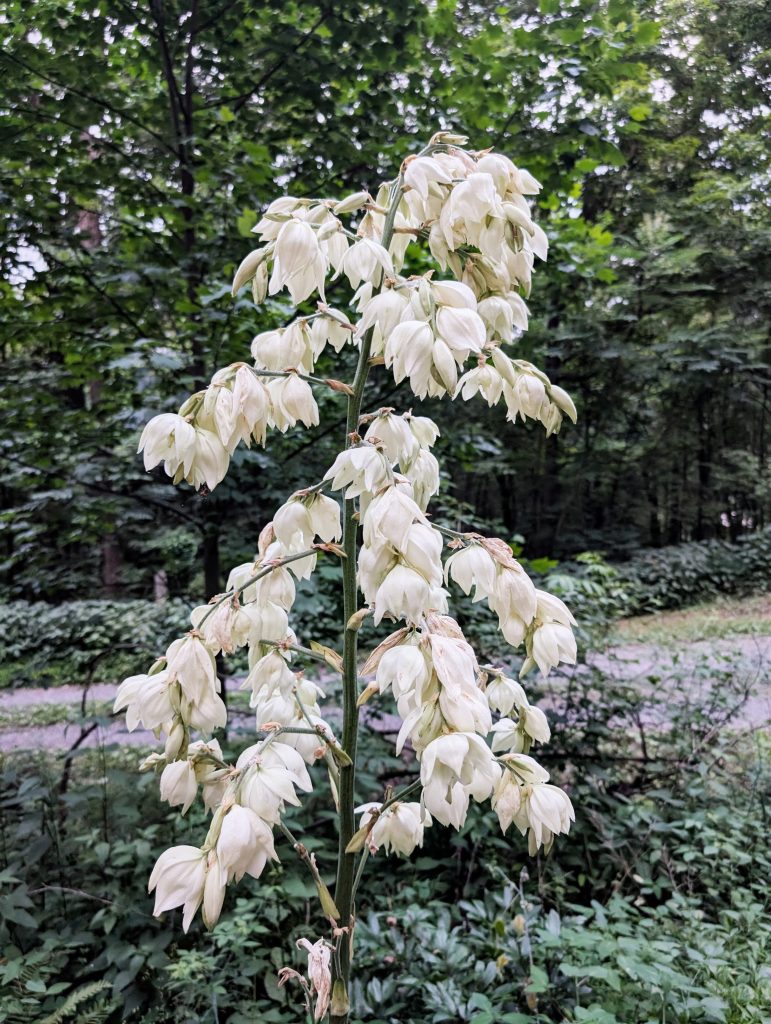
Yucca filamentosa is a hardy, evergreen perennial forming dense basal rosettes of stiff, sword-shaped leaves. Mature plants produce a dramatic vertical flowering stalk that can rise 3–8 feet above the foliage.
The species spreads slowly by rhizomes, forming colonies that may persist in the same location for decades.
(not pictured) Leaves are long, narrow, and rigid, typically 30–60 cm (12–24 in) long. They are bluish-green to dark green and taper to a sharp point.
A distinctive identifying feature is the fine thread-like filaments that peel from the leaf margins, giving the plant its species name filamentosa.
The leaves grow in a radial rosette directly from the base of the plant.
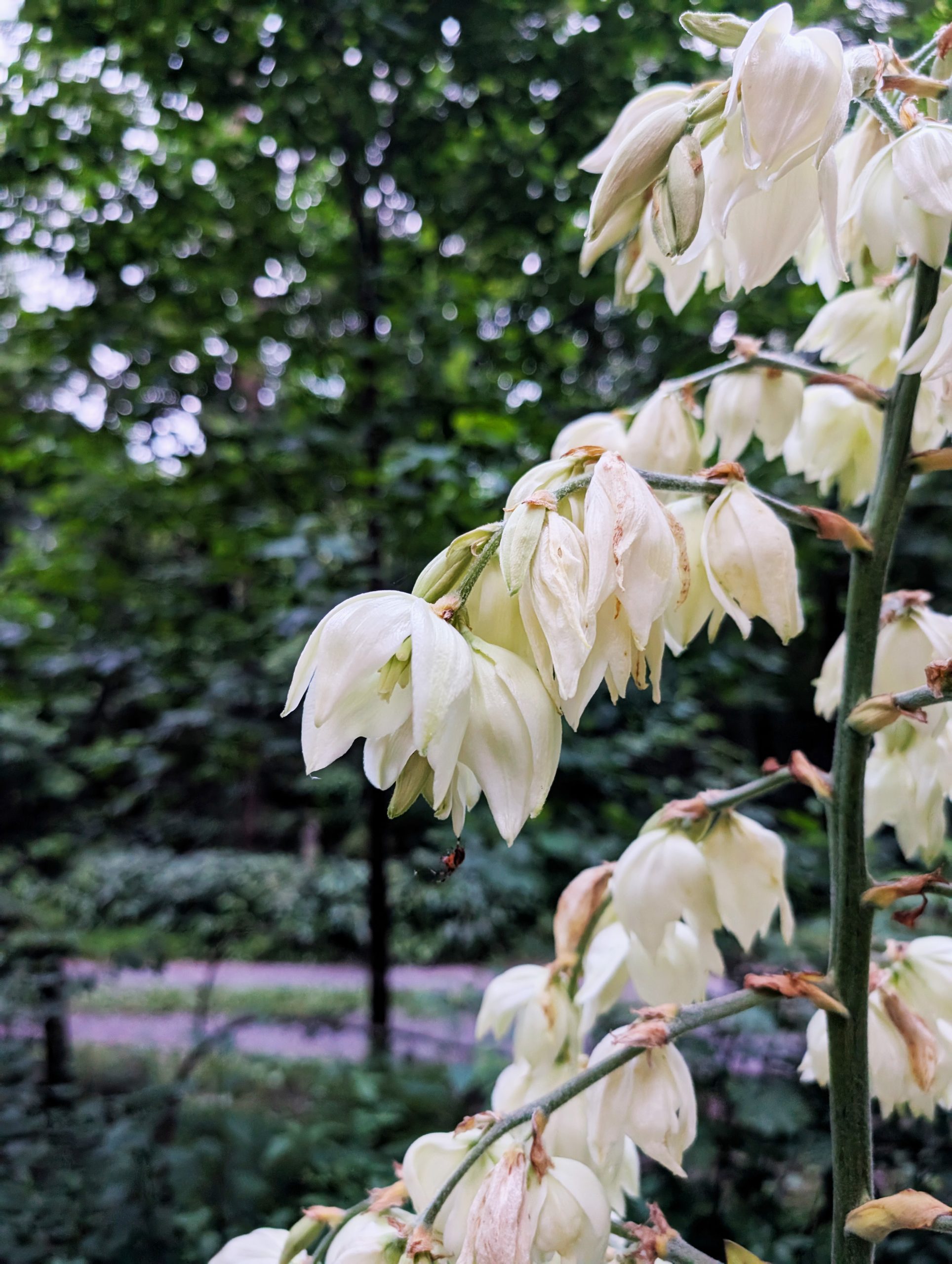
The flowering stalk (inflorescence) appears in late spring to early summer and forms a tall panicle bearing numerous pendulous blossoms.
Flowers are:
• creamy white
• waxy and bell-shaped
• typically 5–7 cm across
• arranged in cascading clusters along branched stems
Each blossom has thick, fleshy petals that droop downward like small lanterns.
Flowering stalks may persist for several weeks before drying.
The plant develops a deep and resilient root system with thick rhizomes that allow it to survive drought, disturbance, and poor soils. Colonies often expand slowly outward from the original plant.
Native to the southeastern United States but widely naturalized across much of eastern North America.
Typical native distribution includes:
• Virginia
• North Carolina
• South Carolina
• Georgia
• Alabama
• Mississippi
Due to horticultural planting and naturalization, it is now commonly found throughout:
• the Midwest
• the Mid-Atlantic
• the Northeast
• parts of southern Canada
It thrives in USDA zones 4–10.
Adam’s Needle is extremely tolerant of difficult growing conditions.
Preferred habitat includes:
• dry open woods
• sandy soils
• rocky slopes
• roadside banks
• old fields
• abandoned homesteads
Environmental preferences:
Sun: full sun to light partial shade
Soil: well-drained, sandy, rocky, or poor soils
Water: drought tolerant once established
The plant performs poorly in wet or poorly drained soils.
Propagation occurs through two primary mechanisms.
Underground rhizomes gradually produce new rosettes, allowing the plant to form clumps or colonies.
Flowers produce capsules containing numerous black seeds when successfully pollinated.
Pollination is typically performed by the yucca moth, a specialized insect with a unique evolutionary relationship with the plant.
Generally resistant to most pests and diseases.
Occasional issues include:
• root rot in poorly drained soil
• leaf spotting from fungal pathogens
• damage from yucca weevil (Scyphophorus yuccae)
Most established plants remain healthy with minimal intervention.
One of the most remarkable aspects of Yucca filamentosa is its mutualistic relationship with the yucca moth (Tegeticula species).
The moth actively pollinates the flowers while laying eggs inside the developing ovary. The larvae consume a portion of the seeds but leave enough for the plant to reproduce. This relationship represents one of the most well-documented cases of obligate plant–insect coevolution.
Historically, Indigenous peoples used yucca for multiple practical purposes:
• leaf fibers for rope, cordage, and weaving
• roots containing natural saponins used as soap
• flowers and young shoots occasionally consumed as food
Because of its durability and striking flowering stalks, Adam’s Needle is frequently planted as an ornamental and often persists long after homes or gardens have disappeared.
Colonies of yucca can therefore sometimes serve as living markers of historic settlement sites.
Maintenance requirements are minimal.
Recommended practices:
• remove spent flowering stalks after blooming if desired
• divide colonies every several years to control spread
• plant in well-drained soil to avoid root rot
Once established, plants typically require no watering or fertilization.