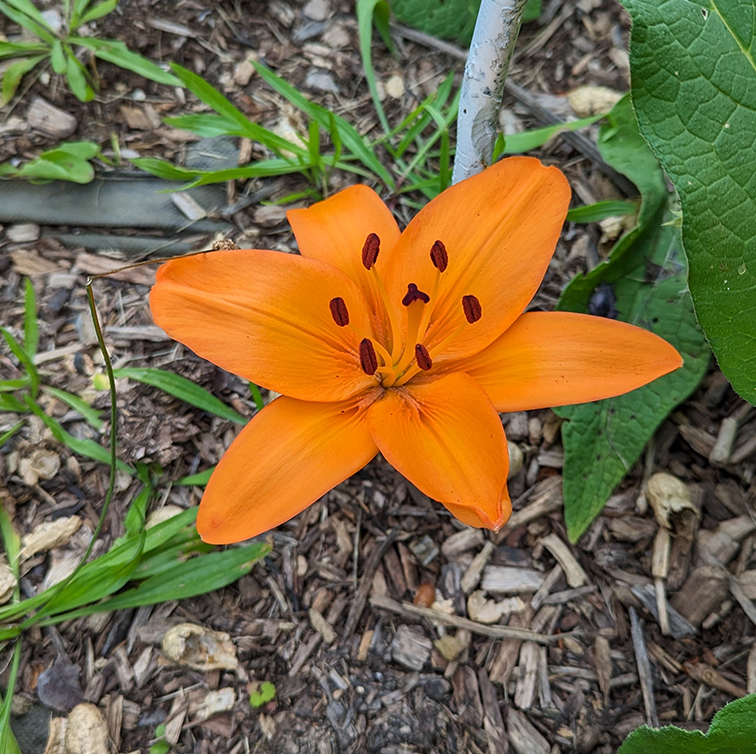
Lilium bulbiferum -orange

Comments:0 Comments

Fire Lily

Taxonomy

Kingdom: Plantae
Clade: Tracheophytes
Clade: Angiosperms
Clade: Monocots
Order: Liliales
Family: Liliaceae
Genus: Lilium
Species: Lilium bulbiferum L.

Common Names by Region

General / English: Orange Lily, Fire Lily, Lily of Fire
Central & Southern Europe: Fire Lily, Pyrenean Lily
Germanic Regions: Feuerlilie
French: Lis orangé
Botanical / Horticulture: Orange Bulb Lily, Bulbil Lily


Description

Physical Characteristics

Lilium bulbiferum is a robust, upright perennial lily distinguished by its vivid orange to reddish-orange, bowl-shaped flowers marked with dark spotting near the center.

Plants produce strong, unbranched stems bearing whorled or scattered lance-shaped leaves. A defining trait is the formation of small bulbils in leaf axils along the upper stem—vegetative propagules that allow rapid local spread.

Flowers are large, upward- to outward-facing, with six recurving tepals and prominent stamens tipped with dark anthers. The coloration gives the plant its “fire” reputation in alpine and meadow landscapes.

Growth Habit

  • Perennial, bulb-forming herb
  • Erect, single-stem growth
  • Produces aerial bulbils
  • Dies back completely in winter
  • Regenerates annually from underground bulb


Known Range

Native Range

  • Central and Southern Europe
  • Alps, Pyrenees, Balkans, and adjacent regions
  • Native to montane and subalpine zones

Naturalized Range

  • Parts of Western and Northern Europe
  • Scattered populations in North America (cultivation escapees)

Habitat Range

  • Mountain meadows
  • Open woodland edges
  • Rocky slopes
  • Alpine grasslands
  • Well-drained montane soils

Typically found where sunlight is strong but moisture is seasonally reliable.


Care / Habitat

Light

  • Full sun to light partial shade
  • Best flowering in high light conditions

Water

  • Moderate moisture requirements
  • Prefers evenly moist soils
  • Intolerant of prolonged waterlogging

Soil

  • Well-drained loam or sandy loam
  • Slightly acidic to neutral
  • High organic matter preferred

Temperature

  • Hardy in USDA Zones 4–8
  • Tolerates alpine cold and late frosts
  • Requires winter dormancy

Air / Humidity

  • Adapted to open-air, low-humidity mountain climates
  • Good airflow reduces disease risk


Propagation / Reproduction

Natural Reproduction

  • By seed (slow, variable)
  • By underground bulb division
  • By aerial bulbils (primary natural method)

Cultivation Methods

  • Bulb division in autumn
  • Harvesting and planting bulbils
  • Seed propagation for genetic diversity (long establishment period)

Bulbils can be collected in late summer and grown in nursery beds for 2–3 years before flowering.


Pests / Diseases / Threats

Common Pests

  • Lily beetle (Lilioceris lilii)
  • Aphids
  • Slugs and snails

Diseases

  • Botrytis (gray mold) in wet conditions
  • Basal rot in poorly drained soils
  • Viral infections in stressed plants

Environmental Threats

  • Overcollection in wild populations
  • Habitat loss in alpine regions
  • Competition from invasive grasses

Wild populations are locally protected in parts of Europe.


Additional Notes

Special Features

  • Produces aerial bulbils (rare among lilies)
  • Exceptionally vivid coloration
  • Strong vertical presence in meadow systems
  • One of Europe’s most recognizable native lilies

Ecological Role

  • Nectar source for bees and butterflies
  • Supports alpine pollinator networks
  • Contributes to meadow biodiversity
  • Indicator of intact montane habitat

Cultural / Historical Use

  • Symbolic “fire flower” in Alpine folklore
  • Featured in regional art and heraldry
  • Historically protected in several countries

Maintenance / Management

  • Low maintenance once established
  • Requires protection from lily beetles
  • Benefits from mulching in colder zones
  • Best left undisturbed after planting

Not aggressive in native settings, but can spread modestly through bulbils in favorable garden conditions.


Field Notes: Fire on the Hillside

You don’t miss Lilium bulbiferum.

In a meadow of greens and silvers, it arrives like a flare:
orange petals,
dark freckles,
a vertical line of flame rising from grass.

It doesn’t blend.
It announces.

But it doesn’t overstay.

What to Notice

Where fire lilies grow naturally:

  • Slopes are open
  • Soil drains quickly
  • Grasses share space
  • Wildflowers still compete
  • Nothing forms a monopoly

The plant rises, blooms, seeds, and retreats.

No conquest.
No carpet.
No takeover.

Just presence.

The Bulbil Strategy

Most lilies trust seeds.

This one hedges its bets.

Along the stem, in the angle between leaf and stalk, small dark bulbils appear—ready-made clones.

They fall.
They root.
They wait.

Not everywhere.
Only where conditions are right.

It’s resilience without recklessness.

In Gardens: Respect the Origin

In cultivation, fire lilies can thrive—or sulk—depending on whether their mountain logic is respected.

They want:

  • Sun
  • Drainage
  • Winter cold
  • Air movement
  • Time

They do not want:

  • Wet feet
  • Heavy clay
  • Constant disturbance
  • Crowding

Give them slope and space.
They repay you in flame.

Native, Naturalized, or Ornament?

Outside Europe, Lilium bulbiferum sits in a gray zone.

Not invasive.
Not fully native.
Not entirely innocent.

It behaves.

That matters.

A plant that knows when to stop is worth keeping.

Reading the Landscape

When you see an orange lily, ask:

Is it standing alone—or among many species?
Is it spreading slowly—or racing outward?
Is it flowering consistently—or fading under pressure?
Is the meadow still diverse?

Healthy systems keep fire lilies in balance.

Degraded ones let anything run wild.

Why It Matters

Color attracts attention.
Behavior tells the truth.

Lilium bulbiferum is not just bright.

It is disciplined.

It shows how beauty fits into a system without dominating it.

That’s rare.


Field Note, Not a Rule

If you plant fire lilies, do it where they make sense.

If you find them wild, learn the slope before you praise the flower.

Some plants burn fast.
Some burn steady.
Some burn everything down.

This one burns in place.

Blue Ribbon Team field notes are observations, not edicts. Learn the place first. Then decide what it needs.

Spread the love

Categories:

Leave a Reply