
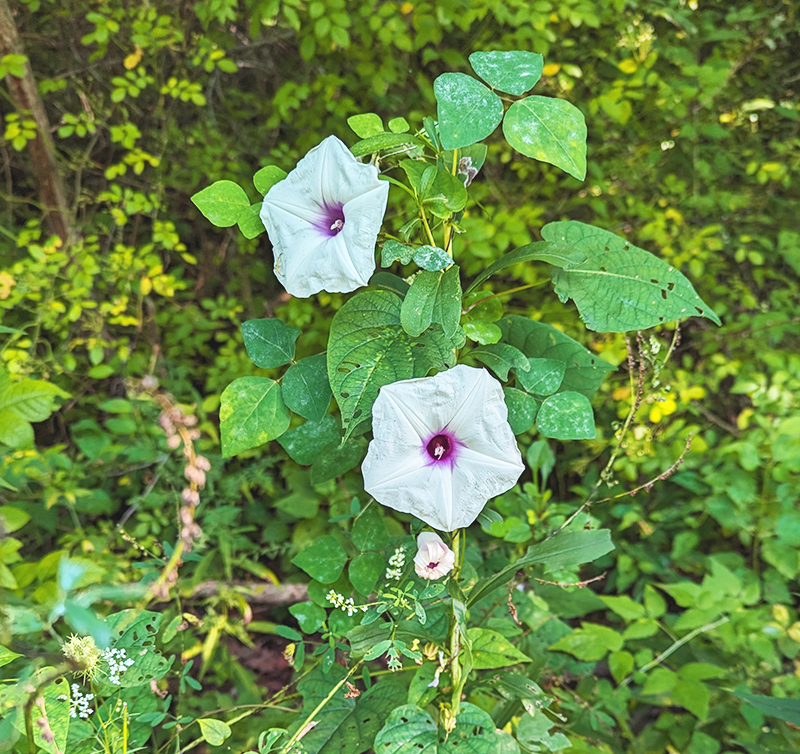
Kingdom: Plantae
Clade: Tracheophytes
Clade: Angiosperms
Clade: Eudicots
Order: Solanales
Family: Convolvulaceae
Genus: Ipomoea
Species: Ipomoea pandurata (L.) G. Mey.
General / North America:
Wild Potato Vine, Man-of-the-Earth, Bigroot Morning Glory
Eastern United States:
Man-of-the-Earth, Wild Sweet Potato
Midwest / Plains:
Wild Potato, Prairie Morning Glory
Folk / Traditional Use:
Man-of-the-Ground, Ground Morning Glory
Scientific / Field Use:
Ipomoea pandurata
Perennial, herbaceous climbing vine with vigorous seasonal growth.
Emerges from a massive underground tuber each spring.
Climbs, sprawls, and weaves through shrubs, fences, and low trees.
Dies back completely in winter, returning from the root crown.
Growth is assertive but seasonal rather than permanent.
Vine Length: Commonly 6–15 feet (1.8–4.5 m), occasionally longer
Root Mass: Tuber may exceed 20–40 pounds in mature plants
Spread: Variable, dependent on available supports
Leaves are large, heart- to fiddle-shaped (pandurate).
Margins smooth, with gently lobed or waisted forms.
Color ranges from medium to deep green.
Texture is soft but resilient.
Foliage creates broad, overlapping shade during peak growth.
Large, trumpet-shaped flowers resembling cultivated morning glories.
White to pale lavender with deep purple throats.
Diameter: 2.5–4 inches (6–10 cm).
Blooms open in early morning and close by afternoon.
Flowering occurs mid-summer through early fall.
Produces rounded seed capsules.
Capsules split when mature, releasing dark, hard-coated seeds.
Seed production is variable and often secondary to vegetative persistence.
Native to much of eastern and central North America.
Core distribution includes:
Ranges from Texas and Kansas eastward to the Atlantic Coast.
Occurs naturally in:
Prefers transitional zones between forest and open ground.
Thrives where disturbance meets stability.
Prefers full sun to partial shade
Flowers best in full sun
Tolerates dappled woodland edges
Moderate water needs
Drought-tolerant once established
Deep root system buffers seasonal dry periods
Adaptable to many soil types
Prefers well-drained loam or sandy soils
Tolerates clay if drainage is adequate
Handles mildly acidic to neutral soils
Hardy in USDA Zones 4–9
Withstands cold winters via underground tuber
Highly heat tolerant
Tolerant of variable humidity
Performs well in both humid and dry summer climates
Primarily propagated by seed
Can be propagated from root sections
Resprouts reliably from established tubers
Seed germination benefits from scarification.
Once established, plants are long-lived.
Generally resistant to most pests
Occasional issues include:
Diseases are uncommon
Root rot possible in chronically wet soils
Primary threat is habitat loss and excessive mowing.
Massive underground storage root
High drought resilience
Showy native vine with minimal care
Seasonal dieback prevents permanent structural dominance
Supports native bees, butterflies, and moths
Important nectar source in late summer
Provides cover and structure in edge habitats
Root systems stabilize soil
Historically used in folk medicine
Roots once studied for medicinal compounds
Not recommended for unsupervised use
Suitable for:
Not ideal for small ornamental beds due to vigor.
Low maintenance once established
Cut back dead vines in late fall or early spring
Control spread by pruning if necessary
Avoid excessive fertilization
Does best when allowed space and structure.
Wild Potato Vine does not negotiate with the surface.
It invests everything underground first.
Years of stored energy.
A root the size of intention.
Then, when conditions are right, it sends up green ambition—
climbing, searching, leaning on whatever happens to be nearby.
The flowers are polite.
Brief.
Elegant.
The root is not.
It is permanence disguised as a seasonal plant.
You can cut it back.
You can ignore it.
You can mow over it.
Next year, it will return.
Not because it is aggressive.
Because it planned ahead.
Put it in shallow soil and it struggles.
Put it in deep ground and it settles in for decades.
This is not a vine that lives in the moment.
It lives in reserves.
—
Blue Ribbon Team field notes are observational records of plants in their working landscapes, not romanticizations. They document what persists, what adapts, and what earns its place.