
Kingdom: Animalia
Phylum: Chordata
Class: Amphibia
Order: Caudata
Family: Ambystomatidae
Genus: Ambystoma
Species: Ambystoma tigrinum (Green, 1825)
General: Tiger Salamander
United States: Eastern Tiger Salamander, Barred Tiger Salamander
Herpetology / Field Guides: Ambystoma tigrinum Complex
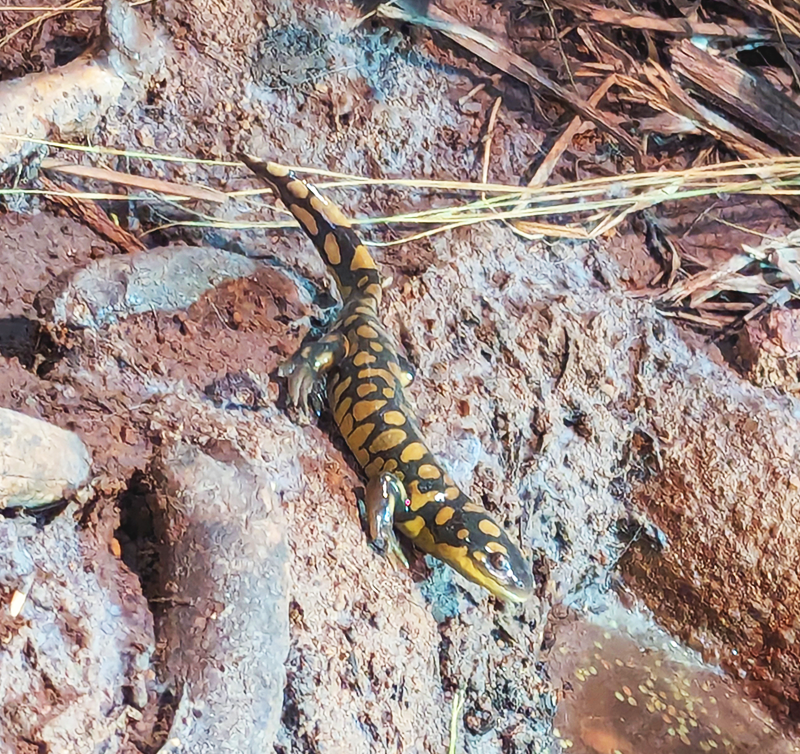
The Tiger Salamander is one of the largest and most recognizable terrestrial salamanders in North America, noted for its bold yellow or olive blotches set against a dark brown to black body.
Its thick, cylindrical body and broad head give it a sturdy, almost prehistoric appearance. The skin is smooth and moist, reflecting its dependence on humid environments and underground shelter.
Color patterns vary regionally but typically consist of irregular bars, spots, or patches resembling tiger stripes—hence the common name.
The tail is laterally compressed and muscular, aiding in swimming during breeding seasons.
Eyes are small but alert, with dark pupils adapted for low-light conditions.
Adult size is substantial for a salamander:
Length: typically 7–10 inches (18–25 cm)
Occasionally exceeding 12 inches
Movement on land is slow and deliberate, with bursts of speed when startled.
Tiger Salamanders are native to much of North America, with populations distributed across:
The eastern and central United States
Parts of southern Canada
The Great Plains and Midwest
Isolated populations in the Southwest
Preferred habitats include:
Deciduous and mixed forests
Grasslands and prairies
Wet meadows and floodplains
Areas near ponds, vernal pools, and wetlands
Loose soils suitable for burrowing
For most of the year, Tiger Salamanders live underground in burrows, often using abandoned mammal tunnels or natural soil cavities.
They migrate seasonally to breeding ponds, sometimes traveling considerable distances across land.
Tiger Salamanders are opportunistic carnivores, feeding primarily on:
Earthworms
Insects and larvae
Slugs and snails
Spiders
Small crustaceans
Occasionally small amphibians
Larval forms consume aquatic invertebrates and zooplankton.
They serve as important mid-level predators, regulating invertebrate populations and contributing to nutrient cycling between aquatic and terrestrial ecosystems.
Their dual life cycle links wetland health with surrounding upland habitats.
Tiger Salamanders are secretive and primarily nocturnal.
Behavioral traits include:
Strong preference for underground shelter
Limited surface activity outside breeding season
Reliance on concealment rather than aggression
Defensive secretion of mild skin toxins when stressed
They are most commonly encountered:
During spring breeding migrations
After heavy rains
When soil or debris is disturbed
When threatened, they may coil, raise the tail, or remain motionless.
Biting is rare and defensive only.
Tiger Salamanders are oviparous, breeding in freshwater bodies.
Breeding occurs in late winter to early spring
Adults migrate to ponds and vernal pools
Females lay clusters of eggs attached to vegetation
Larvae hatch within several weeks
Larval development may last months or, in some regions, several years.
Some populations exhibit neoteny, retaining larval features and remaining aquatic into adulthood.
Metamorphosis occurs when environmental conditions favor terrestrial life.
IUCN Status: Least Concern
Primary Threats:
Wetland drainage and destruction
Road mortality during migrations
Habitat fragmentation
Pesticide and chemical runoff
Loss of upland burrowing habitat
Local declines are common where breeding ponds are filled, polluted, or isolated from surrounding forests and grasslands.
Tiger Salamanders are harmless to humans and beneficial to ecosystems through pest control.
They are occasionally collected for bait or kept as pets, practices that can negatively impact wild populations.
Ethical interaction consists of:
Protecting breeding wetlands
Maintaining natural soil and leaf litter
Allowing migration corridors to remain unobstructed
Avoiding disturbance during breeding season
They are best appreciated in place rather than in captivity.
The Tiger Salamander represents resilience through patience and timing.
It spends most of its life unseen, preparing quietly underground for brief moments of movement and transformation. Its migrations are acts of memory—returning, year after year, to the same waters that made it.
It embodies the reality that healthy systems depend on connection: forest to pond, soil to water, past to future.
When those links are broken, the salamander disappears first.
When they are preserved, it returns.