
Kingdom: Plantae
Clade: Tracheophytes
Clade: Angiosperms
Clade: Monocots
Order: Asparagales
Family: Orchidaceae
Genus: Phalaenopsis
Species: Phalaenopsis spp. (hybrid cultivars)
General / English: Moth Orchid
Horticulture / Trade: Phalaenopsis Orchid, Yellow Veined Phalaenopsis
Informal / Collector Use: Sunrise Moth Orchid, Veined Gold Phal (varies by cultivar)
Monopodial, epiphytic orchid forming a central upright stem.
Produces thick, arching leaves and flowering spikes from leaf nodes.
Growth is slow, steady, and vertically oriented.
Height: 12–24 inches (30–60 cm) in bloom
Spread: 8–16 inches (20–40 cm)
Flower Spikes: Up to 24 inches (60 cm)
Broad, leathery, and oval to lance-shaped.
Color ranges from medium to deep glossy green.
Leaves grow in opposite pairs along the stem and serve as water-storage organs.
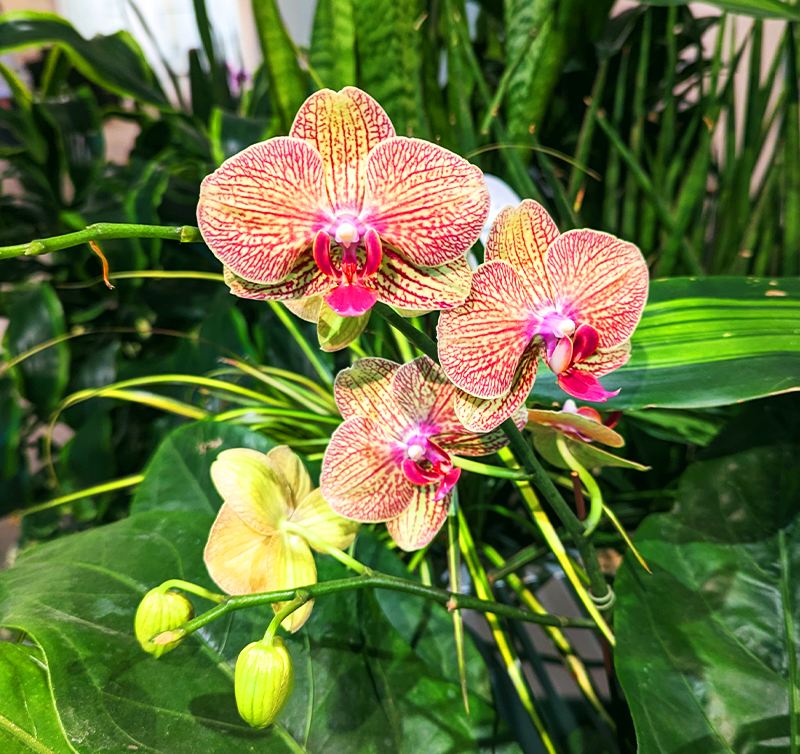
Large, rounded, “moth-shaped” blooms.
Base color: soft to saturated yellow.
Overlay: rose to magenta veining and striping radiating from the center.
Lip often deeper pink or crimson.
Texture is waxy and long-lasting.
Blooms persist 6–12 weeks under good conditions.
Flowering may occur once or twice per year, often in winter to spring.
Rare in cultivated hybrids without manual pollination.
When produced, forms elongated seed capsules containing microscopic seeds.
Wild Phalaenopsis species originate in:
Naturally found in:
Grows as an epiphyte, not in soil.
Prefers bright, indirect light
East- or filtered south-facing windows ideal
Avoid direct midday sun (causes leaf scorch)
Moderate, regular watering
Allow media to dry slightly between waterings
Water thoroughly, then drain completely
Never allow roots to sit in water
Requires free-draining orchid media
Typically bark-based mixes with perlite and charcoal
Not suited to standard potting soil
Ideal range: 65–80°F (18–27°C)
Minimum: ~55°F (13°C)
Sensitive to cold drafts and sudden temperature drops
Prefers moderate humidity (40–70%)
Tolerates household levels if airflow is good
Benefits from pebble trays or grouped plants
Primarily propagated through:
Keikis may be removed and potted once roots reach 2–3 inches.
Division is not typical for this genus.
Exceptionally long-lasting flowers
Wide hybrid diversity and color stability
Adapted to indoor environments
High tolerance for consistent home conditions
In native habitats, supports specialized pollinators
Cultivated forms are primarily ornamental
Plays a role in ex situ conservation of orchid genetics
Very low maintenance when conditions are stable
Best suited for:
Phalaenopsis orchids do not hurry.
They build slowly—leaf by leaf, root by root—until, one day, they release a cascade of color that seems almost extravagant for how quietly it arrived.
The yellow petals carry warmth.
The rose veins trace structure.
Nothing is random. Nothing is wasted.
This is a plant that rewards consistency.
Neglect it, and it withdraws.
Pamper it, and it rots.
Understand it, and it stays.
Not dramatic.
Not fragile.
Just exact.
—
Blue Ribbon Team field notes are observations, not edicts.
Learn the place first. Then decide what it needs.