
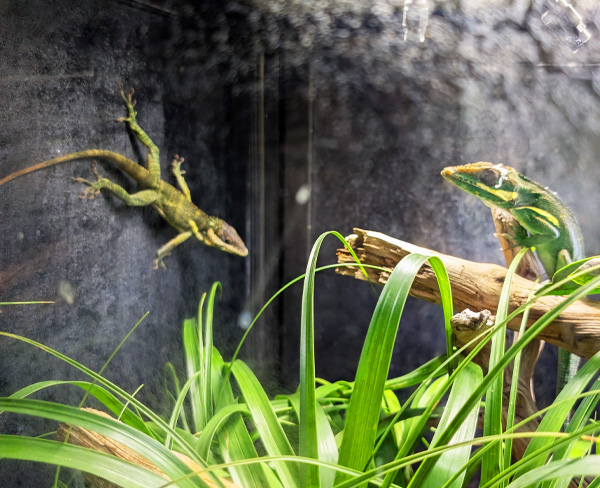
Kingdom: Animalia
Phylum: Chordata
Class: Reptilia
Order: Squamata
Family: Dactyloidae
Genus: Anolis
Species: Anolis carolinensis (Voigt, 1832)
General: American Green Anole, Green Anole
United States: Green Anole, Carolina Anole
Herpetology / Field Guides: American Anole
Informal / Local Use: Tree Lizard
The American Green Anole is a small, slender, arboreal lizard known for its color-shifting ability, alert posture, and territorial displays.
Coloration ranges from bright leaf-green to olive, gray, or brown depending on temperature, stress, social status, and environment. A pale lateral stripe is often visible, especially in females and juveniles.
The body is lightweight and streamlined, with long limbs and expanded toe pads that allow it to cling to smooth surfaces, leaves, bark, and glass.
Males possess a prominent pink to reddish-pink dewlap (throat fan) used in courtship and territorial signaling.
Adult size is modest:
Length: typically 5–8 inches (13–20 cm), including tail
Body length: usually 2–3 inches (5–8 cm)
Movement is quick, precise, and vertical, favoring climbing, perching, and short bursts of speed.
Southeastern United States, including:
Now found in parts of the Midwest, Texas, and urban areas beyond its original range due to human transport.
American Green Anoles are strongly arboreal, preferring elevated perches rather than ground cover.
They occupy vertical “layers” of habitat, often displaced upward where competing species are present.
American Green Anoles are insectivores, feeding primarily on:
They play an important role in regulating insect populations, particularly in urban and suburban ecosystems.
Their presence indicates functional green space and active invertebrate communities.
American Green Anoles are diurnal, active during daylight hours.
Behavioral traits include:
Males defend small territories and will confront rivals through ritualized displays before physical contact.
Females and juveniles are less aggressive and often occupy lower or more concealed perches.
Despite their bold displays, anoles rely primarily on speed and camouflage for defense.
American Green Anoles are oviparous (egg-laying).
Breeding occurs from spring through late summer.
Females lay single eggs every 1–2 weeks during the breeding season, depositing them in moist soil, leaf litter, or decaying vegetation.
Clutches are small but frequent.
Hatchlings are independent at birth and receive no parental care.
Reproductive output is high enough to support stable populations in suitable habitat.
IUCN Status: Least Concern
Primary Threats:
While not globally threatened, native populations may decline locally where invasive competitors dominate.
American Green Anoles are harmless to humans and widely appreciated for their presence in gardens and neighborhoods.
They are often regarded as “yard mascots” and natural pest controllers.
Ethical interaction consists of:
They adapt well to human environments when basic habitat needs are met.
The American Green Anole represents intelligence expressed through visibility and restraint.
It survives not through force, size, or venom, but through awareness, positioning, and communication.
Every head-bob is information.
Every color shift is feedback.
Every perch is a calculated choice.
It lives in a world of vertical boundaries and negotiated space, thriving where structure and opportunity overlap.
Its continued presence depends on living systems that allow climbing, shelter, and insect life to persist.
Like many small regulators, it does not dominate its environment.
It reads it.
And responds.
Quietly, constantly, and with remarkable precision.