
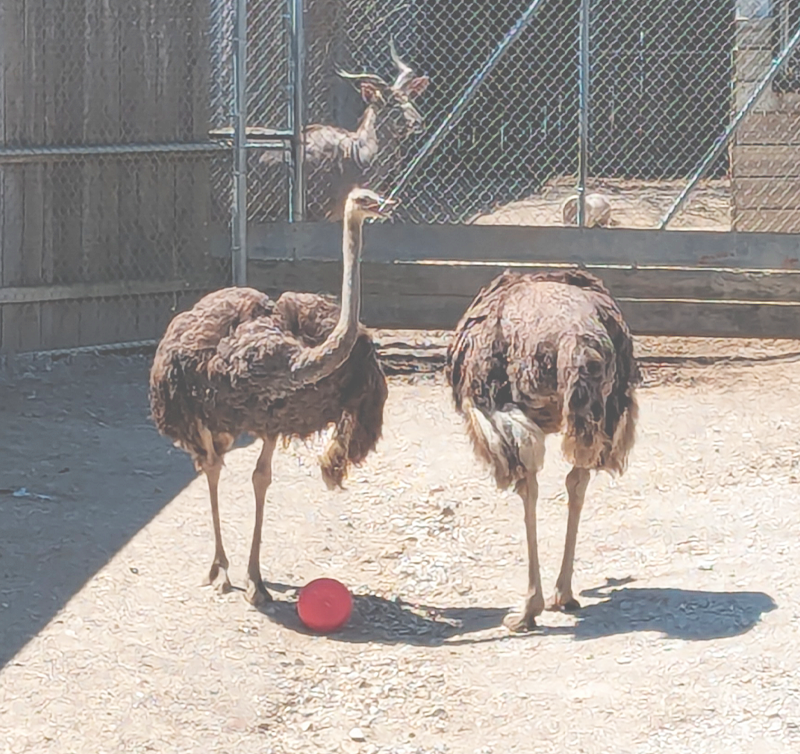
Kingdom: Animalia
Phylum: Chordata
Class: Aves
Order: Struthioniformes
Family: Struthionidae
Genus: Struthio
Species: Struthio camelus Linnaeus, 1758
General: Common Ostrich, Ostrich
Scientific / Conservation: Struthio camelus
Africa (Regional): North African Ostrich, Maasai Ostrich (subspecies-related usage)
Colloquial: Big Bird, Desert Ostrich (informal)
The Common Ostrich is the largest living bird and the fastest bipedal animal on land. It is a flightless, long-legged, long-necked species adapted for open landscapes and high-speed locomotion.
Key physical features include:
Adult size:
Sexual dimorphism is pronounced:
Movement emphasizes stride length, balance, and endurance rather than maneuverability.
Common Ostriches are native to much of sub-Saharan Africa and parts of North Africa, occupying:
They require large, open territories that provide:
Ostriches avoid dense forests and steep terrain. Habitat fidelity is moderate, with seasonal movements tied to rainfall and food availability.
Common Ostriches are omnivorous generalists, consuming:
They ingest stones and grit to aid digestion in the gizzard.
Ecological functions include:
In open ecosystems, ostriches act as mobile nutrient processors linking plant and invertebrate communities.
Common Ostriches are socially flexible, forming:
Behavioral traits include:
Primary defense is early detection and escape. When cornered, ostriches can deliver powerful kicks capable of serious injury.
Daily activity pattern:
Vision and situational awareness dominate their survival strategy.
Common Ostrich reproduction is communal and polygynous.
Dominant females lay centrally in the nest; subordinate females lay peripherally.
Parental care:
Chicks are precocial, mobile within hours, and remain with adults for several months.
IUCN Status: Least Concern (globally)
Primary threats:
While stable overall, some regional subspecies have experienced significant declines.
Ostriches have interacted with human societies for millennia.
Historical and modern uses include:
They appear in ancient art, trade records, and folklore across Africa and the Mediterranean.
Despite their size, they are generally non-aggressive unless provoked or nesting.
Scientific interest focuses on:
The Common Ostrich represents one of the oldest surviving avian body plans.
It belongs to the ratite lineage, an ancient group of flightless birds that diversified after the breakup of Gondwana.
Key evolutionary traits include:
Ostrich ancestors adapted to expanding grasslands by prioritizing:
These traits enabled survival through:
They are not relics of failure to fly, but specialists in terrestrial dominance.
The Common Ostrich demonstrates that power does not require flight, armor, or aggression.
It endures by choosing:
Where many species retreat into complexity, the ostrich expands into openness.
It survives by mastering:
Space.
Speed.
Stillness.
Timing.
Some animals dominate by hiding.
Others dominate by seeing everything coming.
The ostrich does not escape the world.
It runs straight through it—and keeps going.