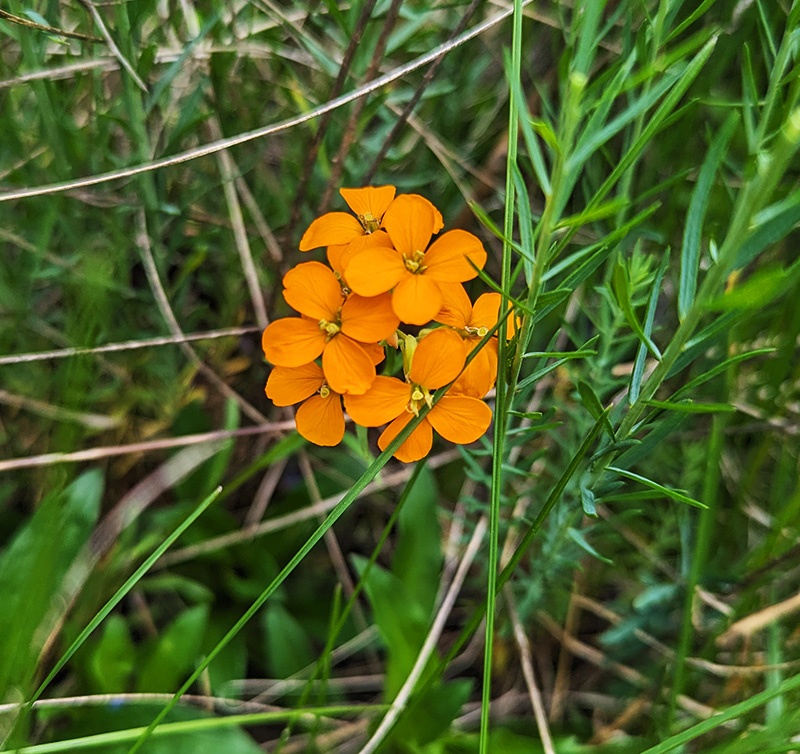
Western Wallflower
Taxonomy
- Kingdom: Plantae
- Clade: Tracheophytes
- Clade: Angiosperms
- Clade: Eudicots
- Order: Brassicales
- Family: Brassicaceae
- Genus: Erysimum
- Species: Erysimum asperum (Nutt.)
Common Names by Region
- General / North America: Western Wallflower, Prairie Wallflower, Rough Wallflower
- Great Plains / Midwest: Prairie Wallflower
- Western U.S.: Plains Wallflower, Wild Wallflower
- Botanical / Academic: Western Wallflower (Erysimum asperum)
Description
Growth Habit
Western Wallflower is a native biennial or short-lived perennial wildflower that forms upright, slender stems emerging from a basal rosette. It typically grows in open grasslands, prairies, and disturbed soils, where it integrates easily into mixed native plant communities.
Plants often appear scattered rather than in dense colonies, contributing subtle structure and color to natural landscapes.
Size
- Height: 12–30 inches (30–75 cm)
- Spread: 6–12 inches (15–30 cm)
Leaves
- Basal leaves form a low rosette in early growth stages
- Narrow, lance-shaped to oblong
- Gray-green to deep green
- Surface often slightly rough or hairy, giving the species its “asperum” (rough) name
Flowers
- Four-petaled blooms typical of the mustard family
- Bright orange to deep golden-yellow
- Arranged in dense terminal clusters
- Each flower displays prominent central stamens
- Blooms gradually open from the bottom upward
Flowering typically occurs from late spring through early summer.
Stems
- Erect and unbranched to lightly branched
- Covered with fine hairs
- Green to pale gray-green
Known Range
Western Wallflower is native to central and western North America.
- Primary Range:
- Great Plains
- Midwest
- Rocky Mountain region
- Western interior states
- Habitat Types:
- Native prairies
- Dry grasslands
- Roadsides and open fields
- Sandy or gravelly soils
- Disturbed ground
It favors open, sunny environments with good drainage.
Care / Habitat
Natural Habitat
In the wild, Western Wallflower thrives in:
- Full sun
- Well-drained soils
- Low to moderate fertility
- Periodically disturbed landscapes
It is adapted to climates with cold winters and warm, dry summers.
Cultivation
When grown in gardens or restoration settings:
- Light: Full sun (6+ hours daily)
- Soil: Sandy, loamy, or rocky soils with good drainage
- Water: Low to moderate; drought-tolerant once established
- Maintenance: Minimal
This species is well-suited for native plant gardens, pollinator plantings, and prairie restorations.
Propagation / Reproduction
Seed Production
Western Wallflower reproduces primarily by seed.
- Produces elongated seed pods (siliques)
- Seeds mature in mid to late summer
- Readily self-seeds under favorable conditions
Germination
- Seeds benefit from cold stratification
- Fall sowing mimics natural cycles
- Germination occurs in spring
Life Cycle
- Often biennial: first year rosette, second year flowering
- Some populations behave as short-lived perennials depending on conditions
Pests / Diseases / Threats
Pests
- Generally resistant to major insect damage
- Occasionally affected by aphids or flea beetles
Diseases
- Rarely impacted by serious plant diseases
- Root rot may occur in poorly drained soils
Threats
- Habitat loss from development
- Prairie fragmentation
- Overuse of herbicides
- Competition from invasive grasses
Despite these pressures, the species remains locally common in many regions.
Additional Notes
- Member of the mustard family, related to cabbages and mustards
- Important early-season nectar source for native bees and butterflies
- Provides visual continuity between spring ephemerals and summer prairie blooms
- Often overlooked due to its modest size, despite its vivid coloration
Western Wallflower plays a quiet but valuable role in maintaining prairie biodiversity and seasonal pollinator support.
Maintenance / Management
- Avoid heavy fertilization, which encourages weak growth
- Do not overwater
- Allow some seed heads to mature for natural regeneration
- In restoration areas, pair with native grasses and forbs
- Periodic light disturbance helps maintain populations
In managed landscapes, Western Wallflower performs best when treated as part of a functioning native ecosystem rather than as an isolated ornamental.
Post Views: 1,065