
Kingdom: Animalia
Phylum: Chordata
Class: Mammalia
Order: Cetacea
Family: Delphinidae
Genus: Orcinus
Species: Orcinus orca (Linnaeus, 1758)
General: Killer Whale, Orca
United States / Canada: Killer Whale, Orca
United Kingdom / Ireland: Killer Whale, Orca
Scientific / Marine Biology: Orca, Orcinus orca
Overall Form
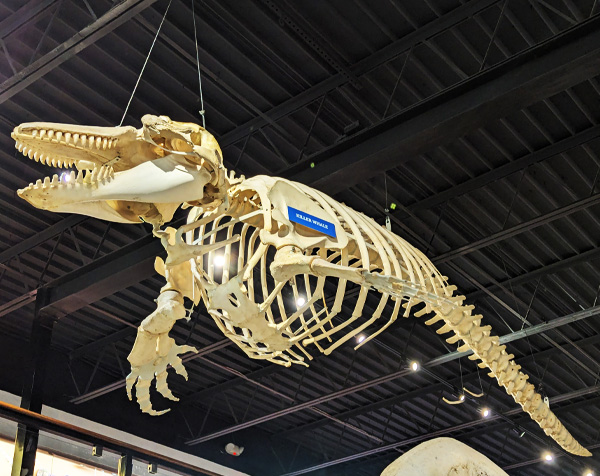
The killer whale is the largest member of the dolphin family and one of the ocean’s most powerful apex predators. The skeleton reveals a highly specialized marine mammal body plan — elongated, hydrodynamic, and structurally optimized for strength, speed, and maneuverability.
Skull and Dentition
The skull is massive, elongated, and reinforced for powerful biting forces. Conical teeth are uniform and robust, adapted for grasping and tearing prey rather than chewing. The jaw hinge allows strong vertical closure but limited lateral movement — typical of active predatory marine mammals.
Vertebral Column
The spine is long and flexible, especially through the posterior region, supporting powerful propulsion from the tail flukes. The vertebrae transition from more rigid thoracic support to flexible caudal motion — an essential feature for efficient swimming.
Forelimbs (Flippers)
The flippers are modified forelimbs with recognizable mammalian bone structure — humerus, radius, ulna, carpals, and elongated digits — all flattened into rigid paddles for steering and stability rather than propulsion.
Ribcage and Thoracic Structure
A broad ribcage houses large lungs and supports the musculature needed for deep diving and rapid surfacing. Rib articulation allows controlled compression under pressure during deep dives.
Vestigial Hind Limb Elements
Like all modern whales, orcas retain small internal pelvic bones — evolutionary remnants of terrestrial ancestors.
Orcas are found in all world oceans, from polar seas to tropical waters. They are among the most widely distributed mammals on Earth. Distinct ecotypes occupy different regions and often specialize in particular prey.
Museum skeletal mounts require:
Proper articulation preserves anatomical accuracy and educational value.
Orcas are viviparous marine mammals with long gestation (~15–18 months) and extended maternal care. Complex social structures influence reproduction, calf survival, and population dynamics. Skeletal remains used for educational display typically originate from stranded individuals, natural death, or scientific collection programs.
Living populations face:
Museum specimens face:
Functional Anatomy Insight
The orca skeleton demonstrates the complete evolutionary transition from land mammal to fully aquatic predator. Limb modification, spinal specialization, and cranial reinforcement all reflect adaptation to high-speed marine pursuit and predation.
Educational Importance
Full skeletal mounts provide rare insight into marine mammal biomechanics, comparative anatomy, and evolutionary history. They allow close study of structures that are otherwise concealed beneath blubber and muscle in living animals.
Specimen Context
This mounted skeleton represents an articulated museum specimen prepared for educational display (taxidermy skeletal mount). Such preparations emphasize anatomical accuracy rather than lifelike posture.
For more information on skeletal exhibits and preparation, visit:
https://www.skeletonmuseum.com/
Long-term preservation of skeletal displays requires:
Proper maintenance ensures structural safety and continued scientific and educational usefulness.
Cernunnos Foundation Note
This profile is provided for educational and open-reference use. Anatomical understanding supports ecological literacy, conservation awareness, and appreciation of evolutionary biology.
Within Cernunnos Foundation materials, this animal is often referred to simply as “Blackfish.” This is intentional. I refuse to treat this creature as anything less than a thinking, principled, and demonstrably intelligent animal with complex social structure, memory, communication, and culture. Recognizing that level of being should not be controversial — yet many people still struggle to extend even basic respect and recognition to members of their own species. The standard should be higher. Grow up.