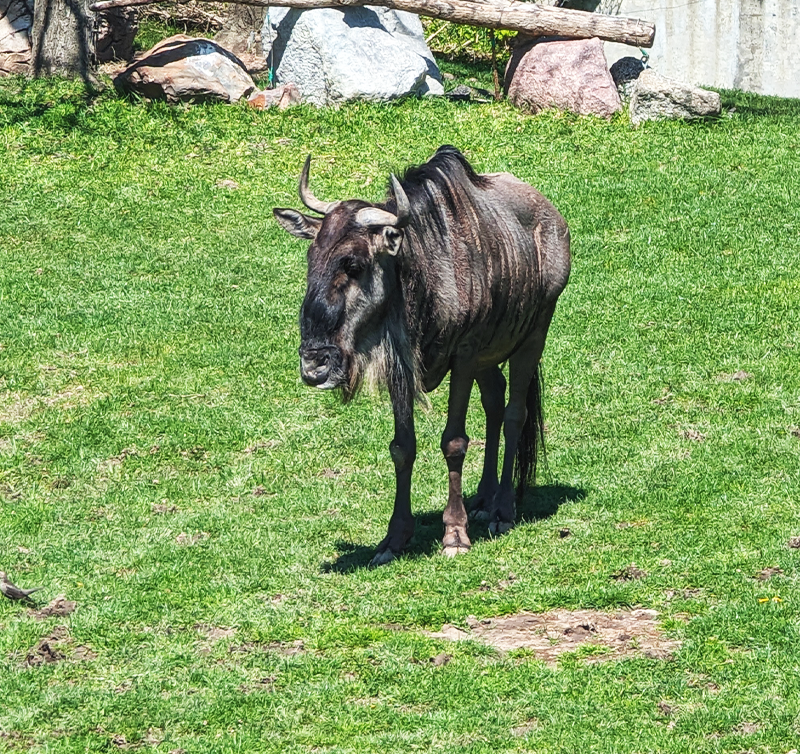
Eastern White-Bearded Wildebeest
Taxonomy
- Kingdom: Animalia
- Phylum: Chordata
- Class: Mammalia
- Order: Artiodactyla
- Family: Bovidae
- Subfamily: Alcelaphinae
- Genus: Connochaetes
- Species: Connochaetes taurinus
- Subspecies: Connochaetes taurinus albojubatus
Common Names by Region
- General / English: Eastern White-bearded Wildebeest
- Alternate English: White-bearded Gnu
- Swahili: Nyumbu
- Scientific / Field Use: Eastern White-bearded Wildebeest
Description
Physical Characteristics
The Eastern white-bearded wildebeest is a large, powerfully built antelope distinguished by its heavy forequarters, sloping back, and robust neck. Adult males are noticeably heavier and more muscular than females, with thicker horns and more pronounced shoulder mass.
Its most defining feature is the pale, whitish beard extending from the throat and chest, which contrasts with the darker gray-brown to charcoal body coat. The mane is coarse and dark, running from the crown down the neck, while the tail is long and black, resembling that of a horse.
Both sexes possess horns, which curve outward and then upward, forming a broad, hook-like shape well suited for dominance displays and combat during the breeding season.
- Shoulder height: ~115–145 cm (45–57 in)
- Body length: ~170–240 cm (67–94 in)
- Weight: ~120–270 kg (265–595 lb)
Known Range
The Eastern white-bearded wildebeest is native to East Africa, with primary populations found in:
This subspecies is especially well known for its role in the Serengeti–Mara ecosystem, where it forms the backbone of one of the largest remaining terrestrial migrations on Earth.
Habitat / Ecology
- Open savannas and grasslands
- Lightly wooded plains
- Seasonal floodplains
They prefer areas with short to medium grasses and access to permanent or seasonal water sources. Their movements are tightly coupled to rainfall patterns and grass regeneration cycles.
Behavior & Social Structure
- Highly gregarious, forming herds ranging from dozens to hundreds of thousands
- Strongly migratory, following seasonal rains and grazing opportunities
- Males establish temporary breeding territories during the rut
- Vocal animals, known for their distinctive grunts, snorts, and lowing calls
Despite their ungainly appearance, wildebeest are capable of surprising speed and endurance, making them a keystone prey species for large predators such as lions, hyenas, and crocodiles.
Diet
Primary Diet
- Short grasses (primarily grazing, not browsing)
Feeding Strategy
- Continuous grazers with strong dependence on fresh grass growth
- Often follow or precede other grazing species, contributing to grassland cycling
Their grazing behavior plays a critical role in nutrient redistribution across the savanna.
Reproduction & Life Cycle
- Breeding is highly synchronized, typically occurring at the start of the rainy season
- Gestation lasts ~8.5 months
- Calves are born within a short window of time, overwhelming predators through sheer numbers
- Newborns can stand and run within minutes of birth
This synchronization is a key survival strategy in open landscapes.
Protection Status
- IUCN Red List Status: Least Concern
The Eastern white-bearded wildebeest remains abundant and stable at the species level, largely due to protected areas and large-scale conservation programs in the Serengeti–Mara region.
Ongoing Threats
- Habitat fragmentation (roads, fencing, agriculture)
- Disruption of migration corridors
- Climate variability affecting rainfall patterns
While not currently threatened, the long-term viability of migration routes is critical to sustaining healthy populations.
Additional Notes
- Central to the Great Migration, involving over a million wildebeest annually
- Often described as ecologically “inelegant,” yet functionally indispensable
- Their mass movement shapes grassland structure, predator dynamics, and nutrient cycling
- A classic example of how unglamorous species can be foundational to entire ecosystems
Maintenance / Management
- Conservation efforts focus on corridor preservation, not captive breeding
- Protected landscapes and cross-border cooperation are essential
- Disruption of migratory pathways poses greater risk than direct hunting pressure
The Eastern white-bearded wildebeest is a reminder that ecological success is often measured not in beauty or grace, but in persistence, adaptation, and scale.
Post Views: 15