
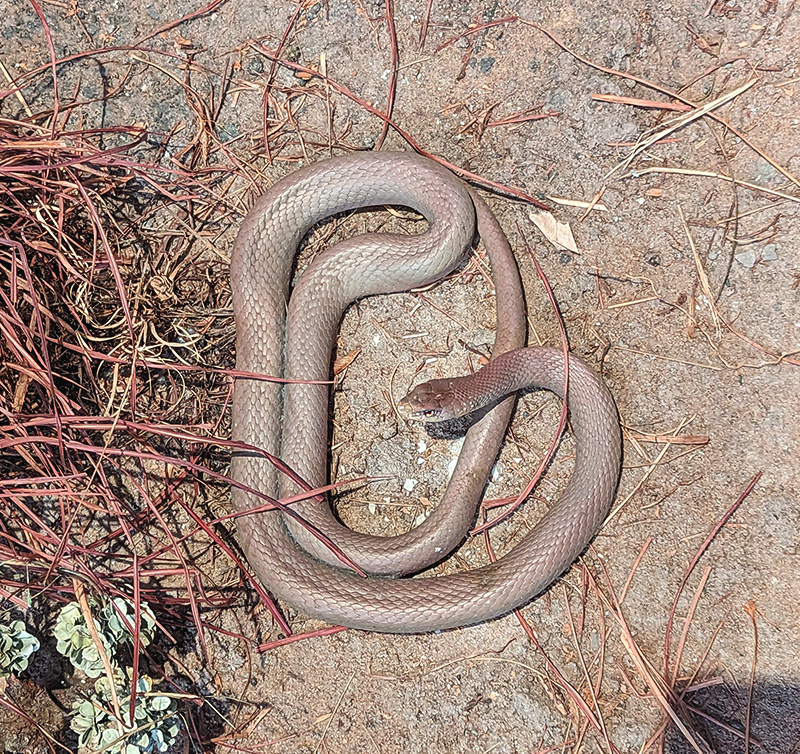
Kingdom: Animalia
Phylum: Chordata
Class: Reptilia
Order: Squamata
Family: Colubridae
Genus: Haldea
Species: Haldea striatula (Linnaeus, 1766)
General: Rough Earth Snake
United States: Rough Earthsnake, Striated Earth Snake
Herpetology / Field Guides: Haldea striatula
The Rough Earth Snake is a small, non-venomous colubrid characterized by its modest size, subdued coloration, and strongly keeled scales that give the body a slightly rough texture.
Coloration typically ranges from light brown to grayish-brown, often blending seamlessly with leaf litter and soil. A faint dorsal stripe or subtle longitudinal patterning may be present but is often indistinct. The belly is pale cream to light gray, occasionally marked with small dark flecks.
The head is small and only slightly distinct from the neck, contributing to its inconspicuous appearance. Eyes are small, with round pupils, suited to a life spent beneath cover rather than in open view.
Adult size is modest:
Movement is slow and deliberate, favoring concealment over speed or aggression.
The Rough Earth Snake is native to the eastern and southeastern United States. Its range includes:
Preferred habitats include:
This species is fossorial and secretive, spending much of its life underground or hidden beneath surface debris.
Rough Earth Snakes specialize in soft-bodied invertebrates, primarily:
They play a quiet but important ecological role by regulating invertebrate populations and contributing to soil health dynamics. Their presence often indicates intact ground cover and healthy microhabitats.
Rough Earth Snakes are docile and non-aggressive.
Behavioral traits include:
They are primarily nocturnal or crepuscular and are most often encountered after rain or when leaf litter is disturbed.
Due to their secretive nature, they are frequently overlooked despite being locally common.
Haldea striatula is ovoviviparous, giving birth to live young.
Reproductive rates are moderate, supporting stable populations where habitat conditions remain suitable.
IUCN Status: Least Concern
Primary Threats:
Although not globally threatened, local populations may decline where forest floors are heavily disturbed or “over-cleaned.”
Rough Earth Snakes are harmless to humans and provide direct ecological benefit through pest control.
They are sometimes mistaken for more dangerous species due to unfamiliarity, but pose no risk. Ethical interaction consists of leaving them undisturbed and maintaining natural ground cover rather than attempting removal or captivity.
The Rough Earth Snake represents intelligence expressed through restraint and invisibility. It survives not by dominance, speed, or display, but by fitting perfectly into the spaces others overlook.
Its continued presence depends on patience at ground level—leaf litter left in place, soil allowed to breathe, and systems maintained without excessive interference.
Like many quiet stabilizers, it does its work unseen, holding the edges together where larger forces rarely look.