
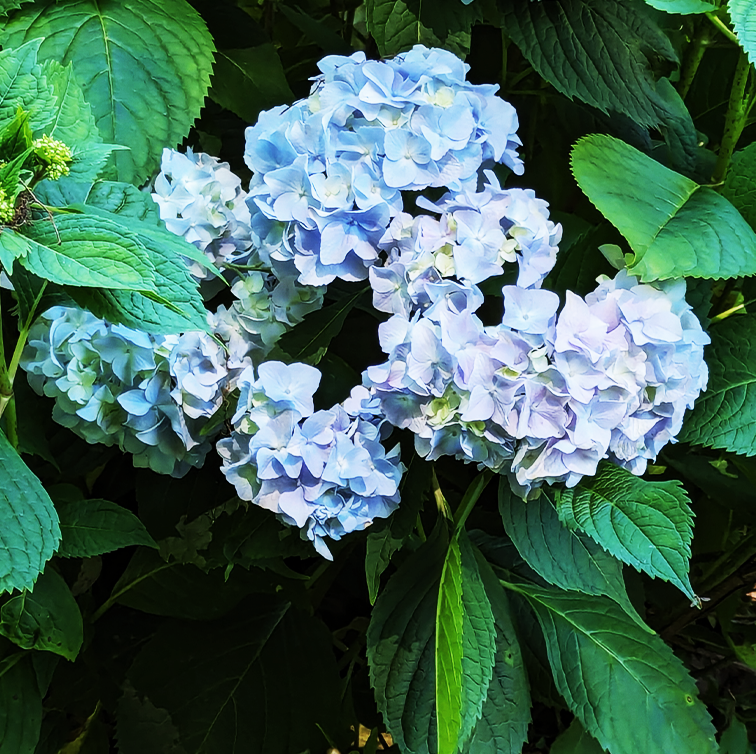
Kingdom: Plantae
Clade: Tracheophytes
Clade: Angiosperms
Clade: Eudicots
Order: Cornales
Family: Hydrangeaceae
Genus: Hydrangea
Species: Hydrangea macrophylla (Thunb.) Ser.
General / English: Bigleaf Hydrangea, French Hydrangea
Horticulture / Trade: Mophead Hydrangea, Lacecap Hydrangea
Japan (native range): Ajisai
Deciduous shrub with a rounded, mounding form.
Growth is moderate and bushy, with stems arising from a woody crown.
Older plants develop a layered structure, with flowers held above broad foliage.
Height: Typically 3–6 feet (0.9–1.8 m)
Spread: 3–6 feet (0.9–1.8 m), sometimes wider in rich soils
Large, ovate to elliptic leaves with serrated margins.
Glossy, medium to deep green with a soft, almost leathery texture.
Leaves are one of the plant’s defining features and contribute substantial visual mass even when not in bloom.
Showy, globe-shaped (mophead) or flattened (lacecap) flower clusters.
Bloom color ranges from blue to pink to purple, influenced by soil pH and aluminum availability.
Flowers appear in early to midsummer and may persist for weeks.
Many cultivars bloom on old wood; some modern selections bloom on both old and new wood.
Small, inconspicuous seed capsules that form after flowering.
Ornamental value lies almost entirely in foliage and flower heads rather than fruit.
Native to Japan and parts of eastern Asia.
Widely cultivated across temperate regions of North America, Europe, and Asia.
Common in gardens, shaded landscapes, and ornamental plantings.
Prefers partial shade
Morning sun with afternoon shade is ideal
Too much direct sun can scorch leaves and fade flowers
Moderate to high water needs
Requires consistent moisture, especially during flowering
Sensitive to drought stress
Prefers rich, well-drained soils with high organic matter
Soil pH influences flower color:
Hardy in USDA Zones 5–9 (cultivar dependent)
Late frosts can damage flower buds on old-wood varieties
Tolerates moderate humidity
Performs best where air is moist but not stagnant
Easily propagated by softwood cuttings in early summer
Can be propagated by hardwood cuttings in dormancy
Layering is also effective in garden settings
Generally low pest pressure
Possible issues include:
Bud damage from late spring frosts is a common limitation in colder regions.
Flower color variability tied directly to soil chemistry
Large leaves provide a lush, cooling visual effect in summer landscapes
Dried flower heads offer off-season interest if left standing
Provides nectar for pollinators, especially bees
Primarily ornamental, with limited native wildlife dependency in North America
Moderate maintenance
Prune carefully and with awareness of bloom habit
Avoid heavy pruning on old-wood cultivars
Mulch to conserve soil moisture and protect roots
Bigleaf hydrangea reflects attention.
Water it well, shelter it from harsh sun, and it answers with abundance.
Ignore its timing or cut it back without understanding, and it withholds.
This is not a plant for neglect or force.
It rewards patience, observation, and restraint.
Change the soil, and it changes color.
Change the care, and it changes character.
Hydrangea macrophylla doesn’t argue with its environment.
It mirrors it.
—
Blue Ribbon Team field notes are observations, not edicts. Learn the place first. Then decide what it needs.