
Kingdom: Plantae
Clade: Angiosperms
Clade: Eudicots
Order: Ericales
Family: Balsaminaceae
Genus: Impatiens
Species: Impatiens capensis Meerb.
General / North America: Jewelweed, Spotted Jewelweed, Spotted Touch-me-not
Eastern United States: Jewelweed, Touch-me-not
Canada: Spotted Jewelweed
Appalachian / Regional Folk Use: Jewelweed (commonly referenced in traditional plant knowledge)
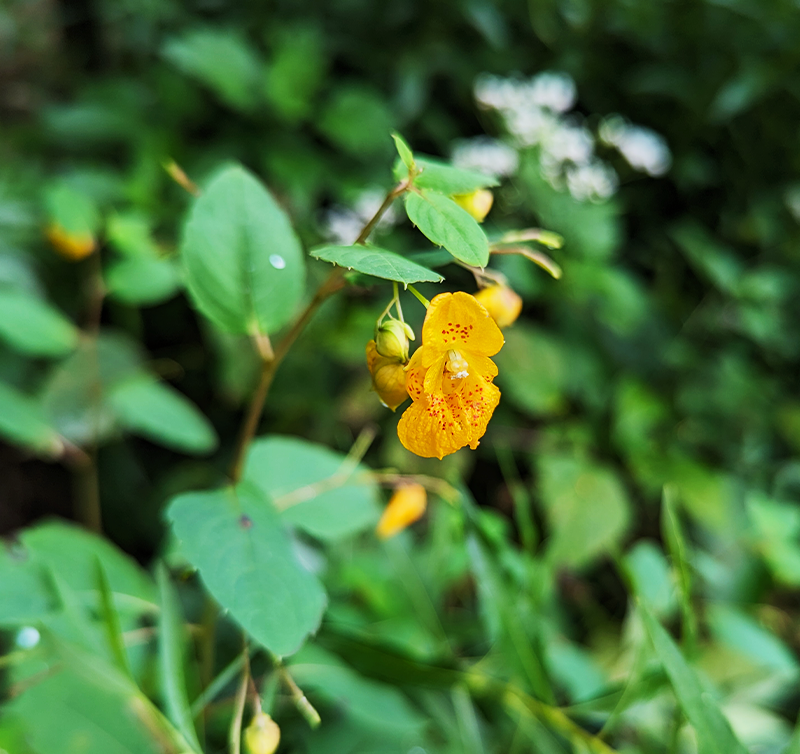
Impatiens capensis is a native North American annual known for its bright, pendant orange flowers, translucent succulent stems, and explosive seed dispersal. It thrives in moist, shaded environments and often appears in dense colonies along streams, wetlands, and forest edges.
The leaves are oval to ovate with lightly toothed margins and a soft, watery texture. When submerged or viewed in bright light, the foliage can appear to shimmer or glow — the origin of the name “jewelweed.” The stems are pale green to translucent, easily crushed, and rich in sap.
Flowers are irregular and trumpet-shaped, typically orange with red or brown speckling on the lower petal. They hang individually from slender stalks and bloom throughout summer into early fall. Two flower types are produced: showy, open-pollinated flowers and smaller, closed, self-fertile flowers that ensure reproduction even when pollinators are scarce.
One of the plant’s most distinctive traits is its seed capsules, which burst open when touched, flinging seeds several feet — hence the name “touch-me-not.”
Native to eastern and central North America, including:
Typical native habitats include:
It favors consistently moist, nutrient-rich soils and often appears after disturbance where moisture remains reliable.
Light: Partial shade to full shade; tolerates dappled sun in moist conditions
Temperature: Warm-season annual; frost-sensitive
Moisture: High moisture preference; thrives in wet or consistently damp soils
Humidity: Well-adapted to humid environments
Soil: Rich, organic soils; tolerates periodic flooding but not prolonged drought
Form: Upright to loosely branching annual
Typical Size: 2–5 feet tall, depending on moisture and fertility
Stems: Succulent, translucent, easily broken
Bloom Season: Mid-summer through early fall
Reproduction: Seed-based; prolific self-seeding via ballistic capsules
Impatiens capensis is widely known in traditional North American plant knowledge for its topical use in soothing skin irritation, particularly after exposure to plants that cause contact dermatitis. The fresh sap is often applied directly to the skin.
Note: These uses are part of traditional practice and not a substitute for medical advice.
The seed pods of jewelweed are under constant tension as they mature. A light touch — or even a falling raindrop — can trigger them to burst open, launching seeds in all directions. It’s one of the more interactive plants in the North American understory, especially for curious kids and hikers who can’t resist testing the name “touch-me-not.”