
Kingdom: Plantae
Clade: Tracheophytes
Clade: Angiosperms
Clade: Monocots
Order: Liliales
Family: Liliaceae
Genus: Lilium
Species: Lilium bulbiferum L.
General / English: Orange Lily, Fire Lily, Lily of Fire
Central & Southern Europe: Fire Lily, Pyrenean Lily
Germanic Regions: Feuerlilie
French: Lis orangé
Botanical / Horticulture: Orange Bulb Lily, Bulbil Lily
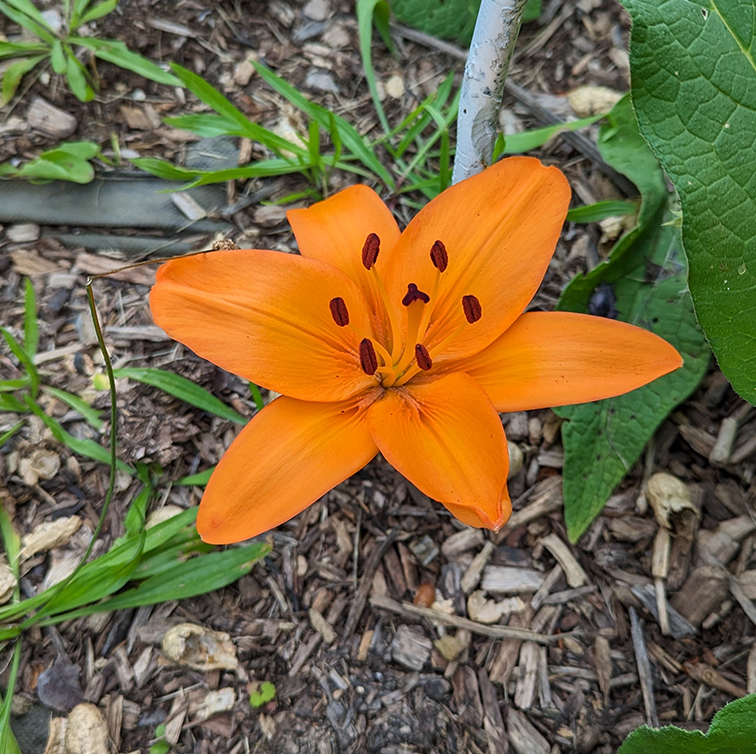
Lilium bulbiferum is a robust, upright perennial lily distinguished by its vivid orange to reddish-orange, bowl-shaped flowers marked with dark spotting near the center.
Plants produce strong, unbranched stems bearing whorled or scattered lance-shaped leaves. A defining trait is the formation of small bulbils in leaf axils along the upper stem—vegetative propagules that allow rapid local spread.
Flowers are large, upward- to outward-facing, with six recurving tepals and prominent stamens tipped with dark anthers. The coloration gives the plant its “fire” reputation in alpine and meadow landscapes.
Typically found where sunlight is strong but moisture is seasonally reliable.
Bulbils can be collected in late summer and grown in nursery beds for 2–3 years before flowering.
Wild populations are locally protected in parts of Europe.
Not aggressive in native settings, but can spread modestly through bulbils in favorable garden conditions.
You don’t miss Lilium bulbiferum.
In a meadow of greens and silvers, it arrives like a flare:
orange petals,
dark freckles,
a vertical line of flame rising from grass.
It doesn’t blend.
It announces.
But it doesn’t overstay.
Where fire lilies grow naturally:
The plant rises, blooms, seeds, and retreats.
No conquest.
No carpet.
No takeover.
Just presence.
Most lilies trust seeds.
This one hedges its bets.
Along the stem, in the angle between leaf and stalk, small dark bulbils appear—ready-made clones.
They fall.
They root.
They wait.
Not everywhere.
Only where conditions are right.
It’s resilience without recklessness.
In cultivation, fire lilies can thrive—or sulk—depending on whether their mountain logic is respected.
They want:
They do not want:
Give them slope and space.
They repay you in flame.
Outside Europe, Lilium bulbiferum sits in a gray zone.
Not invasive.
Not fully native.
Not entirely innocent.
It behaves.
That matters.
A plant that knows when to stop is worth keeping.
When you see an orange lily, ask:
Is it standing alone—or among many species?
Is it spreading slowly—or racing outward?
Is it flowering consistently—or fading under pressure?
Is the meadow still diverse?
Healthy systems keep fire lilies in balance.
Degraded ones let anything run wild.
Color attracts attention.
Behavior tells the truth.
Lilium bulbiferum is not just bright.
It is disciplined.
It shows how beauty fits into a system without dominating it.
That’s rare.
Field Note, Not a Rule
If you plant fire lilies, do it where they make sense.
If you find them wild, learn the slope before you praise the flower.
Some plants burn fast.
Some burn steady.
Some burn everything down.
This one burns in place.
—
Blue Ribbon Team field notes are observations, not edicts. Learn the place first. Then decide what it needs.