
Kingdom: Animalia
Phylum: Chordata
Class: Aves
Order: Psittaciformes
Family: Psittaculidae
Genus: Melopsittacus
Species: Melopsittacus undulatus (Shaw, 1805)
Global: Budgerigar
North America: Budgie, Parakeet
United Kingdom / Australia: Budgie
Aviculture / Scientific Use: Melopsittacus undulatus
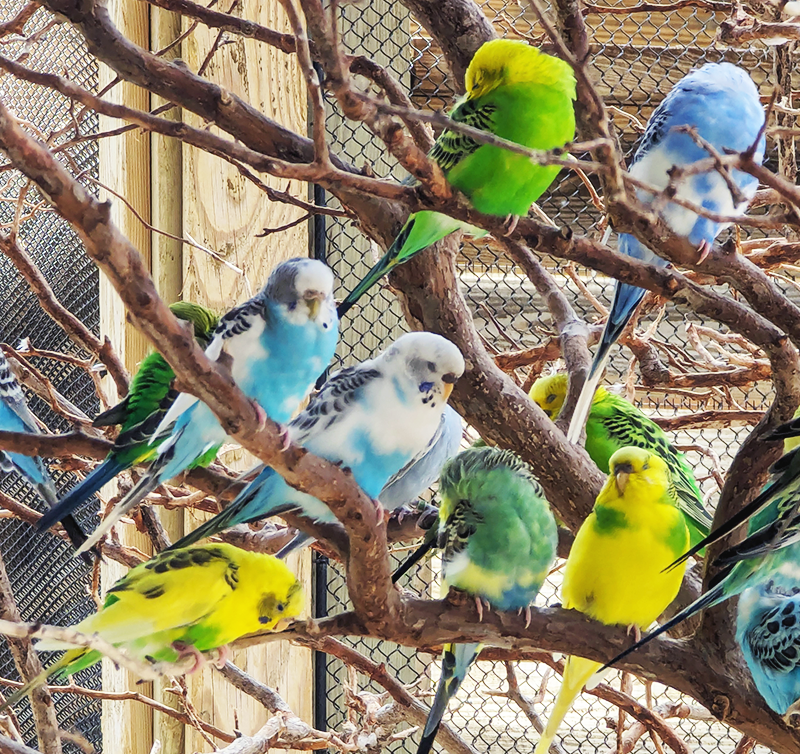
The Budgerigar is a small parrot species known for its alert posture, expressive behavior, and strong social instincts. Adults typically measure 7–8 inches (18–20 cm) in length, including the tail, with a lightweight, streamlined body adapted for sustained flight.
Wild-type coloration consists of a green body with a yellow head, black scalloped markings across the wings and nape, and long blue-green tail feathers. Through selective breeding, captive populations display a wide range of color morphs including blue, white, yellow, gray, violet, and pied variations.
The beak is short, curved, and strong, suited for cracking seeds and manipulating objects. Eyes are dark in juveniles and develop a lighter iris ring with maturity. Budgerigars exhibit notable sexual dimorphism in the cere (the fleshy area above the beak), which varies in color between males and females depending on age and condition.
Native Range:
Interior Australia, particularly arid and semi-arid regions
Introduced / Captive Range:
Worldwide (one of the most commonly kept companion birds globally)
In the wild, Budgerigars are nomadic, tracking rainfall and seed availability rather than occupying fixed territories.
In their native environment, Budgerigars inhabit:
They are strongly adapted to variable, drought-prone environments, capable of traveling long distances to locate food and water. Wild flocks may number from a handful of individuals to thousands during favorable conditions.
Budgerigars are highly social and rely on flock behavior for foraging efficiency and predator detection.
Primary Diet (Wild):
Captive Diet Considerations:
In natural systems, Budgerigars function as seed consumers and dispersers, influencing grassland plant dynamics during population booms.
Budgerigars are intelligent, curious, and highly communicative birds. Vocalizations include chirps, warbles, contact calls, and mimicry. While both sexes vocalize, males are typically more frequent and complex callers.
Behavioral traits include:
Their cognitive abilities allow them to recognize individuals, routines, and environmental changes quickly.
Budgerigars are cavity nesters, breeding opportunistically in response to rainfall and food abundance.
In captivity, breeding occurs readily under stable conditions, which has contributed to their global abundance.
IUCN Status: Least Concern
Population Trend: Stable, with periodic large fluctuations in the wild
Despite massive numbers in captivity, wild populations are sensitive to:
However, their mobility and reproductive flexibility provide resilience compared to many other parrot species.
The Budgerigar is among the earliest and most successful examples of a human–avian companion species. Its popularity stems from manageable size, social nature, and adaptability to human environments.
Responsible care emphasizes:
When kept with attention to behavioral needs, Budgerigars demonstrate complex personalities and long-term bonds.
Melopsittacus undulatus illustrates how resilience and adaptability can coexist with sensitivity to environmental change. Though common, it remains dependent on intact ecological rhythms—rainfall, seed cycles, and space to move.
Abundance should never be mistaken for invulnerability. Even the familiar deserves respect, proper care, and ecological awareness.
Small lives, when multiplied by millions, shape landscapes.