
Kingdom: Animalia
Phylum: Arthropoda
Class: Insecta
Order: Coleoptera
Family: Carabidae
Genus: Pterostichus
Species: Pterostichus melanarius (Illiger, 1798)
General / English: Black Ground Beetle
North America: European Ground Beetle, Black Carabid
Entomology / Field Use: Pterostichus melanarius
Informal / Garden Use: Ground Beetle (black form)
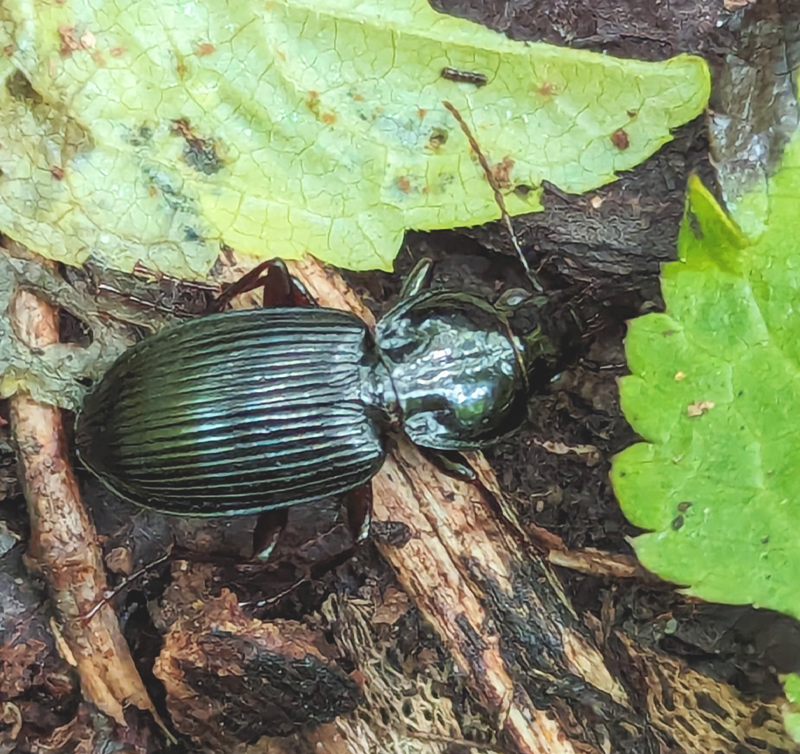
Pterostichus melanarius is a large, robust ground beetle with a smooth, elongated body and a glossy black to dark metallic exoskeleton. The elytra (wing covers) are marked by deep, parallel longitudinal grooves, giving the beetle a ridged, armored appearance.
The head is relatively large with strong mandibles adapted for predation. Antennae are long and filamentous, enhancing tactile and chemical sensing in low-light environments. Legs are powerful and well suited for rapid movement across soil, leaf litter, and decaying wood.
Coloration is typically uniform black, though faint greenish or bluish iridescence may appear under certain lighting conditions.
Body length: ~12–18 mm (0.5–0.7 in)
Native to Europe and western Asia, Pterostichus melanarius has been widely introduced and is now well established across:
It is now one of the most common large ground beetles in disturbed and semi-natural habitats across much of North America.
This species favors cool, moist microhabitats with ample ground cover. It is primarily nocturnal, remaining hidden during daylight hours.
Ecologically, P. melanarius functions as a generalist predator, playing a significant role in regulating invertebrate populations at ground level.
When threatened, individuals may release defensive chemical secretions typical of carabid beetles.
Despite its size and abundance, it is rarely noticed unless uncovered while moving debris or leaf litter.
An active hunter rather than a scavenger. It patrols the soil surface and subsurface layers, using chemical and tactile cues to locate prey.
In agricultural systems, P. melanarius is often considered beneficial, particularly for slug control.
Depending on climate, individuals may overwinter as larvae or adults. Lifespan commonly spans one to two years.
Conservation Status: Not evaluated (common and widespread)
This species is abundant and stable, often thriving in human-altered landscapes.
Pterostichus melanarius exemplifies ecological effectiveness without visibility—an organism that works constantly, quietly, and at scale beneath our feet.