
Kingdom: Plantae
Clade: Angiosperms
Clade: Monocots
Order: Asparagales
Family: Orchidaceae
Subfamily: Epidendroideae
Genus: Miltoniopsis
Species: Miltoniopsis phalaenopsis (Lindl.) Garay & Dunst.
General / Horticulture: Pansy Orchid
Orchid Trade: Miltoniopsis (often historically sold as “Miltonia”)
Descriptive Name: Pansy-faced orchid (referring to the flat, rounded flower form)
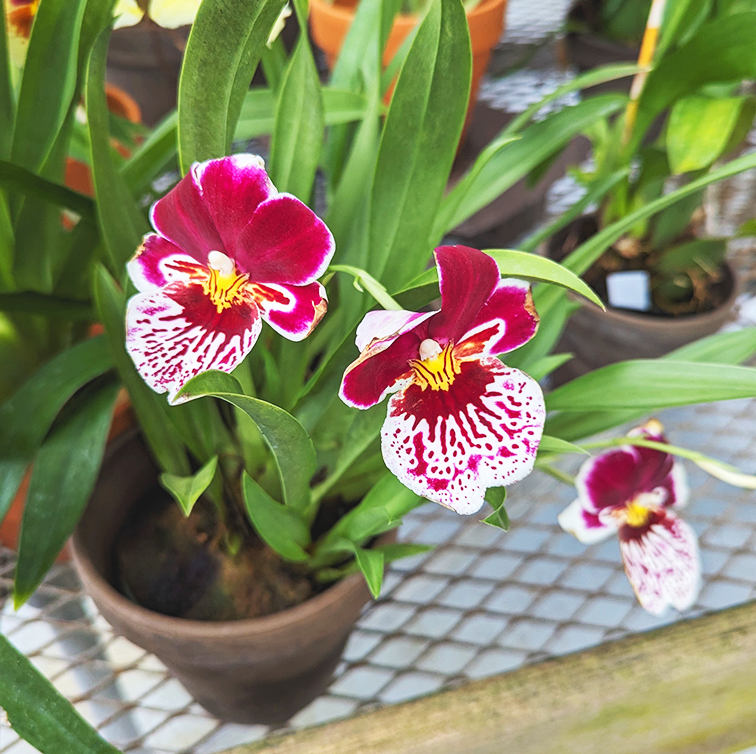
Miltoniopsis phalaenopsis is a cool-growing epiphytic orchid prized for its large, flat, vividly patterned flowers that resemble garden pansies. Blooms are typically broad and rounded, with overlapping petals and sepals forming a nearly circular face.
Coloration is highly variable but commonly includes deep burgundy, crimson, magenta, and maroon tones contrasted sharply against white or cream backgrounds. The lip (labellum) is prominent and often displays dramatic veining, blotches, or radiating lines in red, purple, or yellow, with a golden-yellow callus at the center.
Flowers are borne on slender, arching inflorescences emerging from the base of the pseudobulbs. Each spike may carry multiple blooms, which are lightly fragrant in some clones, especially during the day.
Vegetatively, the plant forms flattened, oval pseudobulbs, each supporting two narrow, pleated, bright-green leaves. The foliage is thinner and more delicate than many orchids, reflecting its preference for cool, humid cloud-forest conditions.
Native to the northern Andes of South America, primarily:
Typical habitats include:
Light: Bright, indirect light; avoid direct midday sun
Temperature: Cool to intermediate
Form: Sympodial epiphyte
Size: Typically 10–18 inches tall including flower spikes
Leaves: Narrow, pleated, light green
Bloom Season: Often spring to early summer; some clones bloom more than once per year
Longevity of Blooms: Several weeks under proper conditions
Growth Pattern: New growths emerge from the base of older pseudobulbs
Miltoniopsis phalaenopsis was historically grouped under the genus Miltonia, leading to ongoing confusion in labeling. True Miltonia species prefer warmer conditions, while Miltoniopsis species are distinctly cool-growing.
Because of their dramatic, expressive flowers, Miltoniopsis orchids are often regarded as “show orchids” — spectacular when happy, unforgiving when conditions drift out of range.
The flat, forward-facing flowers of Miltoniopsis phalaenopsis evolved to be highly visible to pollinators in dim, mist-filled forests. In cultivation, this same trait makes them one of the most visually striking orchids on a bench — they don’t hide their beauty at any angle.