
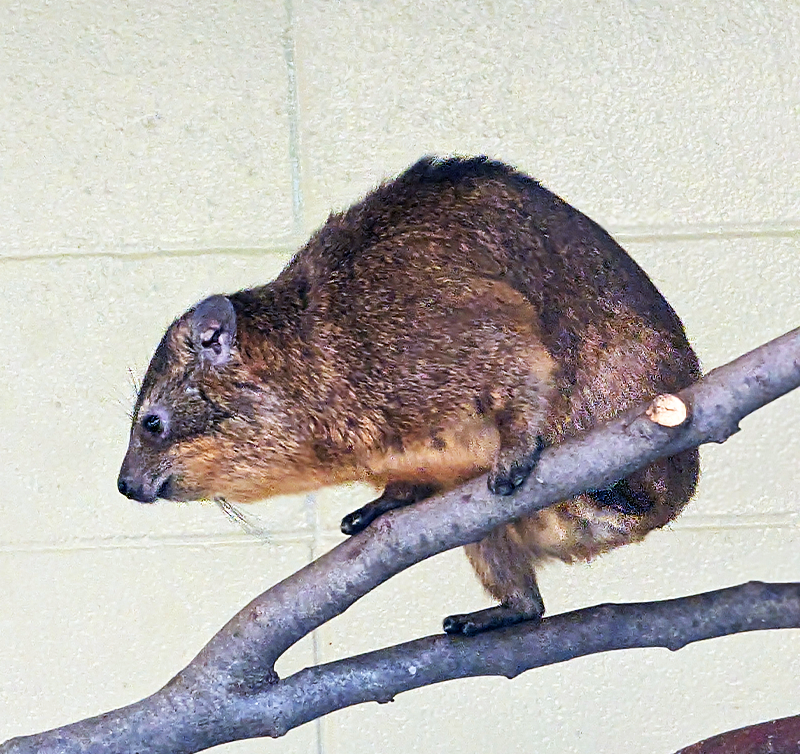
Kingdom: Animalia
Phylum: Chordata
Class: Mammalia
Order: Hyracoidea
Family: Procaviidae
Genus: Procavia
Species: Procavia capensis (Pallas, 1766)
General: Rock Hyrax
Scientific / Conservation: Procavia capensis
Colloquial: Dassie (Southern Africa)
The Rock Hyrax is a small, compact, rock-dwelling mammal with a rounded body, short limbs, and dense gray-brown fur adapted for thermal regulation in exposed environments.
Despite its rodent-like appearance, the hyrax possesses anatomical and physiological traits linking it to elephants and sirenians (manatees and dugongs), reflecting an ancient evolutionary lineage.
Key physical features include:
Eyes are forward-facing and highly alert, optimized for predator detection in open terrain.
Adult size:
Movement is cautious and deliberate, emphasizing grip, balance, and positional awareness over speed.
Rock Hyraxes are native to sub-Saharan Africa and parts of the Middle East, occupying:
They rely on crevices and fissures for shelter, temperature regulation, and predator avoidance.
Colonies are tightly bound to stable rock systems that provide:
Habitat fidelity is high, with colonies occupying the same formations for generations.
Rock Hyraxes are primarily herbivorous, consuming:
They are highly efficient water conservers, deriving most moisture from food and metabolic processes.
Ecological functions include:
In arid systems, they contribute to micro-ecosystem stability around rock formations.
Rock Hyraxes are highly social and organized mammals, living in colonies structured around dominant males and extended family groups.
Behavioral traits include:
Colonies maintain lookout individuals who issue alarm calls when threats appear.
Daily routines revolve around:
Social cohesion is critical to survival in exposed habitats.
Rock Hyrax reproduction is slow and conservative, reflecting long-term survival strategies.
Young are born well-developed, with open eyes and coordinated movement.
Extended maternal care and group protection support high juvenile survival in stable colonies.
IUCN Status: Least Concern (globally)
Primary Threats:
While not globally endangered, local populations are sensitive to rock system disturbance and long-term landscape changes.
Rock Hyraxes have lived alongside human settlements for thousands of years, often occupying stone walls, ruins, and rocky infrastructure.
They are referenced in ancient texts and regional folklore, reflecting their long-standing presence in human landscapes.
Despite their harmless nature, they are sometimes misunderstood due to their abundance near settlements.
Scientific interest centers on their evolutionary importance and physiological adaptations.
Rock Hyraxes are among the most important living examples of mammalian deep-time survival.
They belong to the Afrotheria clade, sharing ancestry with:
Their lineage traces back over 60 million years, to early mammal groups that survived multiple mass extinction events.
Hyrax ancestors were once large, diverse, and widespread. Over time, environmental pressure selected for:
These traits allowed their lineage to persist through:
They represent a refined survival form rather than a primitive one.
Rock Hyraxes are living proof that survival does not require dominance, speed, or size.
They are descendants of ancient mammal lines that endured planetary upheaval by choosing:
They persist by mastering small spaces and long timeframes.
In a world that rewards rapid growth and short-term gain, the hyrax demonstrates another model:
Endure.
Adapt quietly.
Protect the system.
Stay rooted.
Some species survive by conquering.
Others survive by remembering how not to disappear.