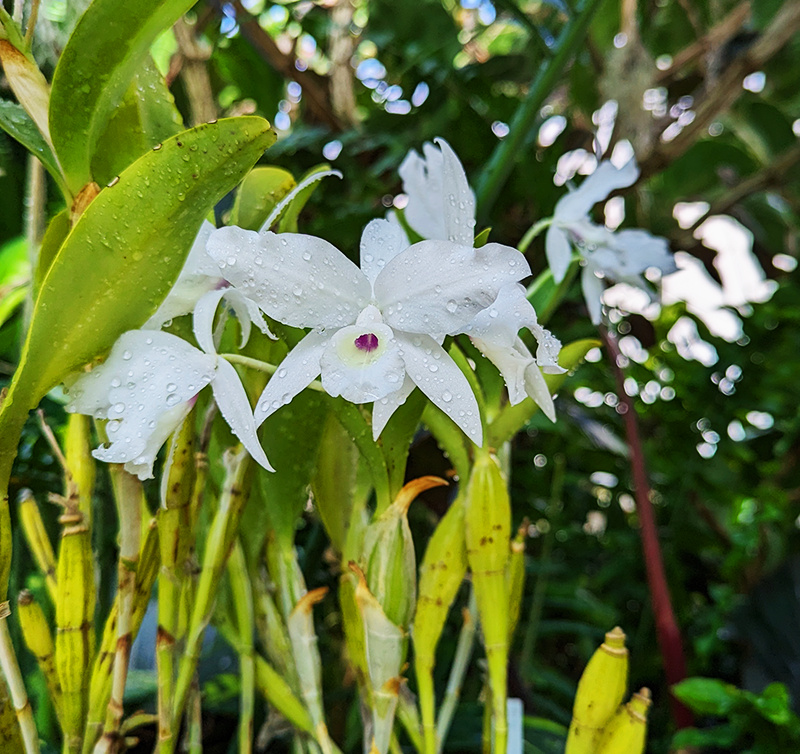
Guaria Morada Alba / White Skinner’s Cattleya
Taxonomy
- Kingdom: Plantae
- Clade: Tracheophytes
- Clade: Angiosperms
- Clade: Monocots
- Order: Asparagales
- Family: Orchidaceae
- Genus: Guarianthe
- Species: Guarianthe skinneri f. alba
Common Names by Region
- General / International: White Skinner’s Cattleya, Guaria Morada Alba
- Costa Rica: Guaria Morada Blanca (informal usage)
- Horticulture / Orchid Trade: Cattleya skinneri alba
Description
Growth Habit
Medium-sized, sympodial epiphytic orchid forming compact to moderately spreading clumps.
Produces upright pseudobulbs topped with paired leaves.
Growth follows strong seasonal rhythms tied to rainfall and temperature.
Size
- Height: 12–24 inches (30–60 cm) including inflorescences
- Spread: 12–24 inches (30–60 cm) in mature specimens
Leaves
Thick, leathery, elliptic leaves, usually two per pseudobulb.
Medium green under optimal light.
Leaves are upright and orderly, giving the plant a restrained, architectural form.
Flowers
Produces clustered inflorescences bearing 5–15 blooms.
Flowers medium to large, with broad petals and a pronounced lip.
Color: pure white to soft ivory, often with faint yellow or cream tones in the throat.
Surface texture silky to lightly waxed.
Primary bloom season: late winter through spring.
Fruit
Produces elongated seed capsules when pollinated.
Capsules mature slowly and release dust-like seeds adapted for wind dispersal.
Known Range
Native Range
Wild populations originate from Central America, especially:
- Costa Rica
- Guatemala
- Honduras
- Nicaragua
- Southern Mexico
The alba form is rare in nature and more common in cultivated collections.
Habitat Range
Occurs naturally in:
- Lower montane forests
- Humid tropical woodlands
- Forest margins
- River corridors
Primarily epiphytic on mature trees in bright, well-ventilated canopy zones.
Care / Habitat Requirements
Light
- Bright, indirect light
- Gentle morning sun beneficial
- Excess shade reduces flowering
Water
- Moderate watering during active growth
- Allow medium to dry slightly between waterings
- Reduce frequency in cooler months
Soil / Medium
- Coarse orchid bark, mounted culture, or open baskets
- Excellent drainage essential
- Avoid decomposed or compacted media
Temperature
- Intermediate to warm grower
- Ideal range: 60–80°F (16–27°C)
- Tolerates mild seasonal cooling if kept dry
Humidity
- Moderate to high (50–70%)
- Requires steady airflow
Propagation / Reproduction
- Propagated by division of mature clumps
- Each division should retain 3–4 healthy pseudobulbs
- Seed propagation restricted to laboratory culture
Pests / Diseases / Threats
- Susceptible to scale, mealybugs, spider mites
- Root and crown rot in stagnant conditions
- Leaf spotting in poor airflow
- Rare forms vulnerable to overcollection
Additional Notes
Special Features
- Naturally occurring color mutation lacking purple pigmentation
- Highly prized by collectors
- Often used in breeding for pale and pastel hybrids
- Flowers photograph exceptionally well
Ecological Value
- Supports native pollinators in natural habitats
- Part of canopy epiphyte communities
- Indicator of intact forest systems
Maintenance / Management
- Repot every 2–3 years
- Feed lightly but consistently during growth
- Reduce fertilizer in winter
- Provide stable support—does not tolerate frequent disturbance
- Protect blooms from water spotting and physical damage
Field Notes: Quiet Authority
The alba form does not announce itself.
It removes color
and leaves structure exposed.
Every petal is visible.
Every flaw is honest.
Where purple commands attention,
white demands precision.
Light must be right.
Water must be timed.
Air must move.
There is nowhere to hide mistakes.
When grown well,
it looks effortless.
When grown poorly,
it tells on you immediately.
This is not a louder orchid.
It is a stricter one.
—
Blue Ribbon Team field notes are observations, not edicts.
Learn the place first. Then decide what it needs.
Post Views: 682