
Kingdom: Animalia
Phylum: Chordata
Class: Actinopterygii
Order: Scorpaeniformes
Family: Scorpaenidae
Genus: Pterois
Species: Pterois volitans (Linnaeus, 1758)
General / English: Red Lionfish, Common Lionfish
Indo-Pacific: Red Firefish (regional usage)
Caribbean / Western Atlantic: Invasive Lionfish
Aquarium Trade: Red Lionfish, Volitan Lionfish
Informal / Diver Use: Zebra Lionfish, Featherfin Lionfish
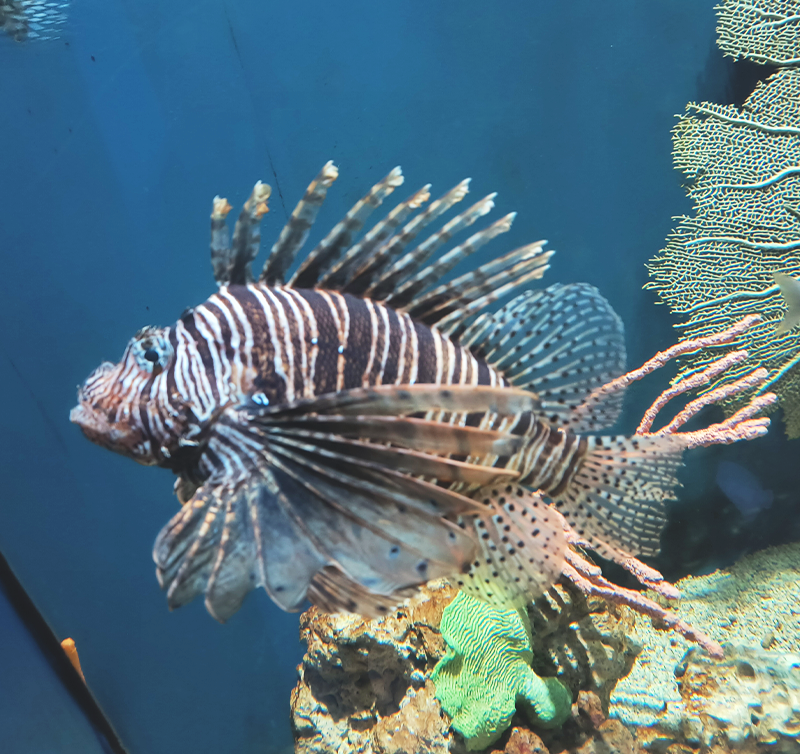
Pterois volitans is a large, highly distinctive reef fish with elongated fins and bold striping. The body is laterally compressed and armored with venomous dorsal, anal, and pelvic spines.
Coloration consists of alternating red, brown, and white vertical bands. The pectoral fins are greatly expanded and fan-like, giving the species its characteristic “lion’s mane” appearance.
The head bears fleshy tentacles above the eyes and mouth, aiding in camouflage and sensory awareness.
Body length: ~30–38 cm (12–15 in), occasionally larger.
Venom is delivered through grooved spines and is used defensively, not for hunting.
Indo-Pacific region, including:
Widely established in the Western Atlantic:
This species is now one of the most successful marine invaders in recorded history.
Coral reefs
Rocky reefs
Mangroves
Seagrass edges
Artificial reefs and wrecks
Depth range: shallow coastal waters to >300 ft (90+ m)
Prefers warm, clear waters with complex structure.
In native habitats, functions as a mesopredator regulated by larger reef predators.
In invaded habitats, acts as an unregulated apex-style predator, consuming large quantities of native reef fish.
Strongly alters community structure where established.
Lionfish exhibit little fear of divers or large animals in invaded ranges.
They rely on camouflage and venom for defense rather than speed.
Small reef fish
Juvenile fish
Crustaceans
Shrimp
Crabs
An ambush predator.
Uses expanded pectoral fins to corner prey against reef structures, then inhales victims through rapid suction feeding.
Capable of consuming prey up to half its own length.
In invaded ecosystems, feeding pressure is extreme and continuous.
Larvae disperse widely via ocean currents, enabling rapid geographic expansion.
Lifespan: commonly 10+ years.
Native range: Not evaluated / stable
Introduced range: Invasive, high ecological risk
Populations in the Atlantic and Caribbean are expanding despite control efforts.
Listed among the most damaging marine invasive species globally.
Highly venomous defensive spines
Exceptional reproductive output
High tolerance for depth and temperature variation
Low predation pressure outside native range
Popular in the aquarium trade (source of original introductions)
Severe reduction of juvenile reef fish
Disruption of coral reef recovery
Competition with native predators
Long-term alteration of reef food webs
Represents a case study in how aquarium releases can reshape ecosystems.
Active management required in invaded regions:
No natural population control currently effective.
Requires large, well-filtered marine aquaria.
Not suitable for mixed-community tanks with small fish.
Care only recommended for advanced marine aquarists.
The red lionfish is one of the most visually arresting animals on any reef.
Every line is deliberate.
Every fin is ornamental.
Every movement is slow and confident.
Nothing about it looks destructive.
And yet, in the Atlantic, it empties reefs.
It hunts constantly.
It reproduces endlessly.
It fears almost nothing.
This is what unchecked advantage looks like in nature.
Not chaos.
Efficiency.
In its native waters, balance holds it in place.
Outside them, it becomes architecture’s undoing.
Not through malice.
Through perfection.
—
Blue Ribbon Team field notes are observations, not edicts.
Learn the system first. Then decide how to protect it.