
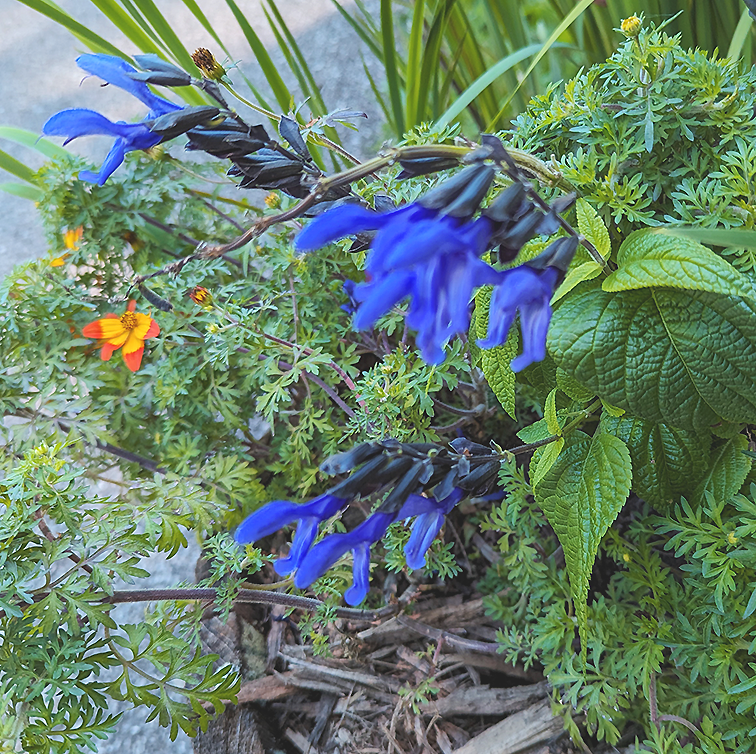
Kingdom: Plantae
Clade: Tracheophytes
Clade: Angiosperms
Clade: Eudicots
Order: Lamiales
Family: Lamiaceae
Genus: Salvia
Species: Salvia patens Cav.
General / English: Blue Sage, Gentian Sage
Horticulture / Trade: Blue Gentian Sage, True Blue Salvia
Mexico (native range): Chía Azul (regional usage)
Tender perennial or warm-climate perennial with an upright, clump-forming habit.
Stems are square and softly textured, typical of the mint family.
Growth is moderately vigorous in favorable conditions, forming loose, airy colonies.
Plants die back in cold climates and resprout from underground tubers in spring.
Height: Typically 2–4 feet (60–120 cm)
Spread: 1.5–3 feet (45–90 cm)
Opposite, ovate to heart-shaped leaves with pointed tips.
Soft green with a slightly matte surface.
Leaves are lightly aromatic when crushed.
Foliage remains attractive through most of the growing season when moisture is adequate.
Large, tubular, intensely blue flowers arranged along upright spikes.
Color is a vivid cobalt to gentian blue, among the strongest true blues in garden plants.
Blooms appear from late summer into fall, especially in warm regions.
Individual flowers are showy and long-lasting.
Flower production improves with regular deadheading and consistent moisture.
Small nutlets typical of the mint family.
Rarely of ornamental interest.
Most plants are propagated vegetatively rather than from seed.
Native to central and southern Mexico, especially in montane and highland regions.
Widely cultivated in ornamental gardens across North America, Europe, and temperate regions worldwide.
Often grown as an annual in colder climates.
Common in pollinator gardens, mixed borders, and container plantings.
Prefers full sun to partial shade
Performs best with morning sun and light afternoon shade in hot climates
Excessive shade reduces flowering
Moderate water needs
Prefers evenly moist soil
Sensitive to prolonged drought
Does not tolerate waterlogged conditions
Prefers fertile, well-drained soils with high organic matter
Loamy soils are ideal
Avoid heavy clay without amendment
Hardy in USDA Zones 8–10 (varies by cultivar)
Grown as a tender perennial or annual in Zones 5–7
Tubers may survive light freezes with heavy mulching
Tolerates moderate humidity
Requires good airflow to prevent fungal issues
Performs best in open, well-ventilated sites
Easily propagated by division of tubers in spring
Softwood cuttings in early summer root readily
Can be grown from seed, though germination is variable
Division is the most reliable method for maintaining vigor
Generally resistant to serious pests
Possible issues include:
• Aphids
• Spider mites in dry heat
• Root rot in poorly drained soils
• Powdery mildew in stagnant air
Cold damage is the primary limitation in temperate climates.
Produces one of the most saturated natural blue flowers in ornamental horticulture
Strong attraction for hummingbirds and large pollinators
Tuberous roots allow seasonal dormancy and regrowth
Works well as a vertical accent in mixed plantings
Provides nectar for bees, butterflies, and hummingbirds
Moderate pollinator value
Primarily ornamental outside its native range
Moderate maintenance
Deadhead to encourage continued flowering
Cut back after frost in cold regions
Lift and store tubers in severe winters if desired
Mulch to regulate soil moisture and temperature
Avoid heavy pruning during active growth.
Blue sage responds to rhythm.
Give it sun, water it steadily, and it produces color that feels almost unreal.
Neglect its moisture, and it retreats.
Overcrowd it, and it weakens.
This is a plant that prefers space and consistency.
It does not tolerate extremes well.
Not drought.
Not saturation.
Not heavy shade.
Meet it halfway, and it performs.
Change the light, and it changes posture.
Change the water, and it changes vigor.
Salvia patens does not dominate a garden.
It punctuates it.
—
Blue Ribbon Team field notes are observations, not edicts. Learn the place first. Then decide what it needs.