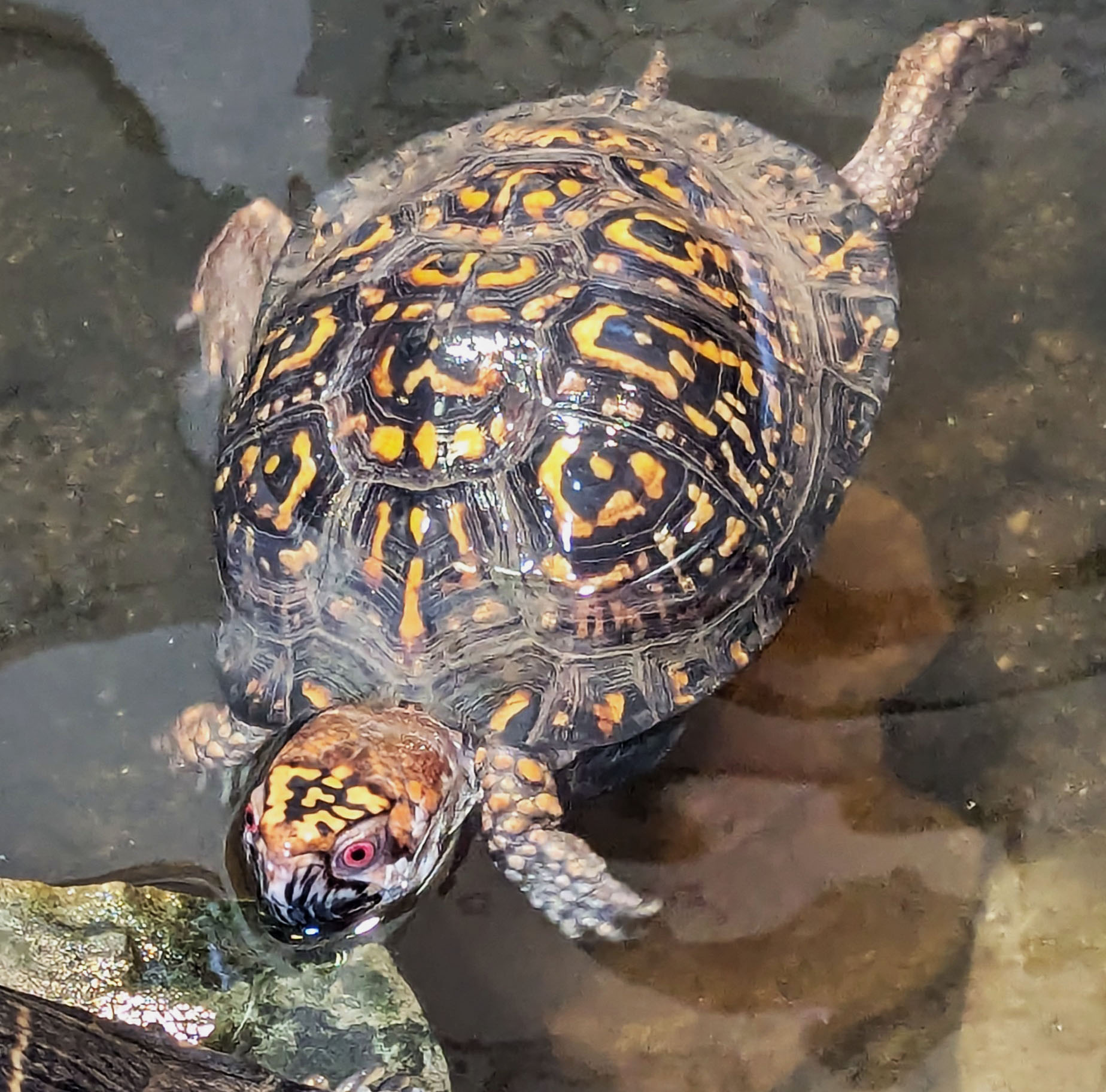
Terrapene carolina

Comments:0 Comments

Eastern Box Turtle


Taxonomy

  • Kingdom: Animalia
  • Phylum: Chordata
  • Class: Reptilia
  • Order: Testudines
  • Family: Emydidae
  • Genus: Terrapene
  • Species: Terrapene carolina
  • Subspecies (regional variants include): T. c. carolina, T. c. major, T. c. triunguis, T. c. bauri, others

Common Names by Region

  • Eastern Box Turtle
  • Common Box Turtle
  • Woodland Box Turtle
  • Terrapin (colloquial, though technically imprecise)


Description

What You’re Seeing

A high-domed terrestrial turtle with a hinged plastron (bottom shell) that allows it to close completely like a box.

Key visual identifiers:

  • Dark brown to black carapace with radiating yellow, orange, or amber streaks
  • Strongly domed shell profile
  • Orange or red markings on head and forelimbs (often brighter in males)
  • Hinged plastron capable of full closure
  • Stout, terrestrial-adapted limbs

Adults typically measure 4.5–6 inches (11–15 cm) in shell length.

Sexual dimorphism:

  • Males often have red or orange eyes and more vivid head coloration
  • Females often have brown eyes and slightly flatter shells

This species is primarily terrestrial despite belonging to a family that includes aquatic turtles.


Known Range

Native to the eastern United States, including:

  • Eastern seaboard
  • Midwest
  • Southeastern states
  • Into parts of the Gulf region

They prefer:

  • Mixed hardwood forests
  • Woodland edges
  • Meadows
  • Moist leaf litter zones

They are site-faithful and often maintain small home ranges over decades.


Care / Habitat (Wild Context)

Eastern Box Turtles require:

  • Moist forest floor conditions
  • Leaf litter cover
  • Access to shallow water sources
  • Seasonal temperature gradients
  • Soft soil for nesting

They are highly sensitive to habitat fragmentation and road mortality.

In captivity (where legal and ethical), they require:

  • Large, enriched enclosures
  • UVB exposure
  • Humidity gradients
  • Varied omnivorous diet

However, wild individuals should not be removed. They have low reproductive turnover and high site fidelity.


Propagation / Reproduction

  • Mating: Spring through early summer
  • Nesting: Late spring to midsummer
  • Clutch size: Typically 3–8 eggs
  • Incubation: ~60–90 days
  • Temperature-dependent sex determination

Lifespan commonly exceeds 40–50 years in the wild. Some individuals likely live longer.


Pests / Diseases / Threats

Primary threats:

  • Habitat loss
  • Road mortality
  • Collection for pet trade
  • Lawn equipment strikes
  • Fire mismanagement
  • Climate instability affecting nesting success

They are considered a species of conservation concern in multiple states.


Additional Notes

Although classified among pond turtles (Family Emydidae), the Eastern Box Turtle is largely terrestrial.

However, they are competent swimmers.

They will:

  • Enter shallow streams
  • Cross small ponds
  • Soak in water during hot periods
  • Use ephemeral pools for hydration

They are not aquatic turtles, but they are not strictly dry-land specialists either. Their ecological strategy includes flexible use of moist environments.


Maintenance / Management (Landscape Context)

To support wild populations:

  • Preserve contiguous woodland
  • Maintain leaf litter
  • Avoid heavy mowing in edge habitats
  • Install wildlife crossings near roadways
  • Reduce chemical runoff

Small habitat corridors matter significantly due to their limited mobility.


Field Notes

Observed individual entered shallow water and swam with steady, alternating limb strokes. Movement was deliberate, not distressed.

While Eastern Box Turtles are primarily terrestrial, they do spend measurable time in water:

  • Soaking for thermoregulation
  • Hydrating during dry periods
  • Crossing low water bodies within home range
  • Utilizing shallow aquatic margins for foraging

They are stronger swimmers than many assume, but they do not inhabit deep aquatic systems as sliders or cooters do.

Observation reinforces that terrestrial does not mean hydrophobic. Moisture remains central to their ecology.


Educational & Artistic Use Notice

All text and original observations published under the Cernunnos Foundation are intended for educational and artistic use. Readers, educators, and creators are encouraged to reference, adapt, and build upon this material in the spirit of open knowledge and ecological literacy.

Attribution is appreciated. Stewardship is expected.

Spread the love

Categories:

Leave a Reply