
Taxonomy
Common Names by Region
Description
General Appearance Canis lupus is a large, powerfully built cursorial predator with long legs, a deep chest, and a broad, blocky head that distinguishes it immediately from domestic dogs and coyotes at any distance. The body is designed for sustained travel across open terrain — efficient, low-waste movement over enormous distances is the animal’s primary physical gift. Up close the coat resolves into a layered system of dense underfur and coarse guard hairs that together shed water, retain heat, and take abuse from brush and prey alike. The overall impression is of controlled power held in reserve — an animal that is never quite relaxed.
Size Body Length: 105–160 cm (nose to base of tail) Tail Length: 29–50 cm Shoulder Height: 66–81 cm Weight: 23–80 kg; significant variation by subspecies and region; northern populations substantially larger
Females average roughly 20% lighter than males. Sexual dimorphism is visible but not dramatic at a distance.
Coloration and Markings Coat color is highly variable across the species range, running from pure white in Arctic populations through the full range of grays, browns, and tawny rufous tones to solid black. The most common presentation in temperate populations is a grizzled gray-brown agouti, with paler cream or white on the throat, chest, and inner legs, and darker saddle patterning across the back and shoulders. Individual facial markings — dark masking around the eyes and muzzle, pale cheek patches — vary enough that pack members familiar with one another likely distinguish individuals by face. Coat condition and color intensity peak in winter; the summer coat is shorter, sparser, and noticeably less impressive.
Distinguishing Features Substantially larger and more heavily built than coyote (Canis latrans) at all ages Broad, blocky muzzle; larger feet relative to body than domestic dogs Tail carried horizontally or low; not curled upward as in many domestic breeds Long legs relative to body depth; built for ground-covering trot, not sprint Yellow to amber iris typical in adults
Juvenile / Immature Appearance Pups are born blind and deaf, covered in short dark fur that lightens and shifts in color through the first year. Juvenile wolves retain a softer facial structure and more uncertain movement through their first winter. Ear-to-head ratio appears exaggerated in young animals. Dispersal from natal packs typically occurs between one and three years of age.
Known Range Canis lupus once ranged across virtually the entire Northern Hemisphere — most of North America, Europe, Asia, and into the Middle East and North Africa. Extirpation through the 19th and 20th centuries contracted this range dramatically. Current stable wild populations are concentrated in Canada, Alaska, the northern U.S. Rockies and Great Lakes region, Scandinavia, Russia, and portions of Eastern Europe and Central Asia. Reintroduction efforts in Yellowstone (1995) and elsewhere have partially restored range in the American West. The species remains extirpated from most of its former range in the contiguous U.S. and Western Europe.
Habitat and Behavior Habitat: Boreal forest, temperate forest, grassland, tundra, mountain terrain, and shrubland; generalist across biomes where prey is available Activity: Crepuscular and nocturnal primarily; active at any hour Social: Highly social; pack-living
Canis lupus is the definitive coursing pack predator of the Northern Hemisphere. Packs are family units — typically a breeding pair and offspring from one or more years — that cooperate in hunting, territorial defense, pup-rearing, and den maintenance. Pack size ranges from two to over twenty individuals depending on prey density and habitat; operational hunting groups are often smaller subsets of the full pack.
Territory size varies enormously by prey availability and pack size, ranging from under 100 km² in prey-rich areas to over 1,000 km² in prey-sparse Arctic terrain. Territorial boundaries are maintained through scent marking (urine, scat, and gland secretions deposited on prominent features) and howling, which simultaneously coordinates pack movement, reinforces social bonds, and advertises territorial occupation to neighboring packs.
The howl is the signature behavior of the species — a long, modulated vocalization that carries several kilometers across open terrain. Individual voices are distinguishable to pack members. Chorus howling appears to serve both social and territorial functions and is one of the more acoustically complex vocal displays produced by any terrestrial predator.
Wolves are coursing predators. They test herds of ungulates — often for extended periods before committing to a chase — selecting individuals that reveal weakness through behavior or movement. Pursuit is a sustained trot, not an explosive sprint; wolves outlast prey rather than outrun it. Kill rates vary dramatically by prey species, season, terrain, and pack competence.
Diet Diet Type: Carnivore; apex predator
Primary prey across most of the range consists of large ungulates: white-tailed deer, mule deer, elk, moose, bison, caribou, and wild boar depending on region. Smaller prey — beaver, hare, ground squirrels, birds — supplements the diet opportunistically, particularly in summer. Wolves will scavenge when conditions favor it. In coastal and island populations, marine mammals and fish contribute significantly to the diet.
Propagation / Reproduction Breeding Season: January–March depending on latitude Gestation: 62–75 days Litter Size: 4–6 pups average (range 1–11) Parental Care: Breeding female primary; full pack participates in pup-rearing
Reproduction is typically limited to the dominant (breeding) pair within a pack, though subordinate females occasionally breed in large packs. Pups are born in dens — excavated burrows, rock crevices, or modified beaver dens — in spring. The full pack participates in provisioning, babysitting, and socializing pups through the summer. Pups join pack hunts by autumn. Sexual maturity is reached at two years; social maturity and breeding status generally come later, upon achieving dominance.
Pair bonds between breeding animals are long-term and appear to involve genuine attachment — widowed animals have been documented declining to breed for extended periods. Lifespan in the wild averages 6–8 years; captive individuals have reached 17 years.
Pests / Diseases / Threats Conservation Status: Least Concern (IUCN globally); status varies significantly by subspecies and region
Canine distemper, parvovirus, rabies, and mange are documented disease pressures. Sarcoptic mange in particular has caused significant mortality events in some populations. Internal parasites including heartworm and various tapeworm species are common.
Primary threats are human-caused: lethal control in response to livestock depredation, legal hunting where permitted, illegal poaching, vehicle strikes, and habitat fragmentation limiting connectivity between populations. The political economy of wolf management remains contentious across most of the species’ recovering range, with livestock interests, hunting constituencies, and conservation advocates in sustained conflict over management targets and methods.
Maintenance / Management Not applicable as a managed captive species for general keeping. Wolves are maintained in zoological and sanctuary settings where enclosure requirements are extensive — large acreage, social housing, complex environmental enrichment, and specialized veterinary care. Wild population management involves a mix of legal protection, regulated hunting, livestock depredation response protocols, and reintroduction programs. Effective coexistence strategies include livestock guardian animals, range riders, and non-lethal deterrents, all of which have documented efficacy in reducing conflict without lethal control.
Additional Notes The gray wolf is among the most extensively studied wild mammals in North America, generating a literature spanning ecology, behavior, genetics, and human-wildlife conflict that few other species can match. Yellowstone reintroduction research in particular has produced significant findings on trophic cascade effects — wolf predation pressure on elk altering grazing behavior, which allowed riparian vegetation recovery, which in turn affected stream morphology and aquatic habitat. The mechanism, sometimes called a “landscape of fear,” demonstrated that apex predator effects extend well beyond direct prey mortality.
Culturally the wolf occupies a singular position in the human imagination — simultaneously the dangerous wilderness threat of European folklore and the noble, loyal archetype of Indigenous traditions across North America. Neither caricature survives contact with the actual animal. The wolf is a highly intelligent, socially complex, behaviorally flexible predator that has coexisted with human populations for millennia and continues to do so wherever management policy permits.
The domestic dog (Canis lupus familiaris) is a subspecies — the wolf is, in a direct genetic and taxonomic sense, the ancestor of every domestic dog alive.
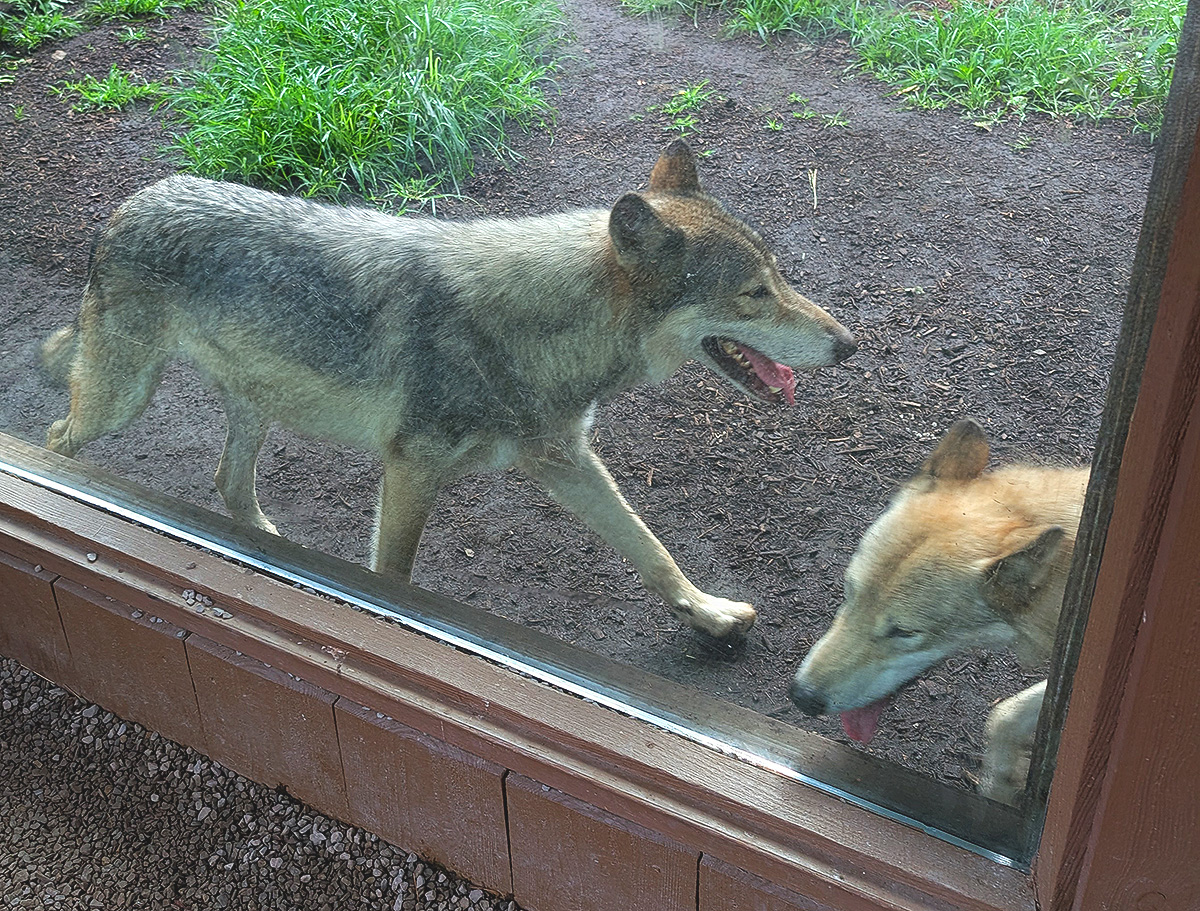
Field Notes (BRT Observation) Photographed through glass at a small animal rescue operating on limited resources. Two individuals visible. The standing animal in the left frame shows classic temperate gray wolf presentation — grizzled gray-brown agouti coat, dark dorsal saddle, pale throat and chest, and the characteristically broad muzzle and large feet of the species. Mouth open, tongue visible; the animal is alert and in motion. The second individual, visible in the lower right, shows a noticeably warmer tawny-rufous coat — within normal color variation for the species, possibly indicating a different age class or regional genetic background. Both animals appear to be in good coat condition.
The glass barrier and modest mulch substrate tell the fuller story. This is not a wealthy institution. The enclosure reflects the financial reality of a rescue organization doing serious work without serious money — keeping animals alive, visible to the public, and serving as ambassadors for a species that has never had an easy relationship with the humans deciding its fate. Every wolf here arrived from somewhere worse. That is worth sitting with.
There is something uncomfortable about watching an animal built to range hundreds of miles pace behind glass, even when the alternative for that specific animal was death. The discomfort is appropriate. These wolves are alive because someone with limited means decided they were worth saving, and they are on display because that same organization needs the public to care enough to keep the lights on. It is an imperfect arrangement arrived at through genuine commitment, and it deserves to be seen as such.
Identification as Canis lupus is consistent with the size, morphology, and coat pattern of both individuals.
All images and written content published on this site are provided freely for educational and artistic use. Attribution appreciated but not required. Knowledge grows when shared.