
Pelargonium × hortorum
Taxonomy
Kingdom: Plantae
Clade: Tracheophytes
Clade: Angiosperms
Clade: Eudicots
Order: Geraniales
Family: Geraniaceae
Genus: Pelargonium
Species: Pelargonium × hortorum
Binomial Name: Pelargonium × hortorum L.H. Bailey, 1916
Hybrid parentage: chiefly Pelargonium zonale × Pelargonium inquinans
Common Names by Region
Zonal Geranium (English, general)
Garden Geranium / Bedding Geranium (English)
Horseshoe Geranium (English — for the leaf band)
Geranium (English, common usage, though botanically a Pelargonium)
Geranio / Malvón (Spanish)
Géranium des jardins / Pélargonium zonale (French)
Garten-Pelargonie / Zonal-Pelargonie (German)
Description
Growth Habit
Pelargonium × hortorum is a tender perennial subshrub, mounding to upright, with thick, jointed, succulent stems that turn woody at the base with age. In containers it usually holds at 12–24 inches. It carries no real cold hardiness, so across most of the country, including Pennsylvania, it serves as a warm-season bedding and container plant, lifted indoors or restarted from cuttings to carry it through winter. Frost blackens the top growth quickly.
Leaves
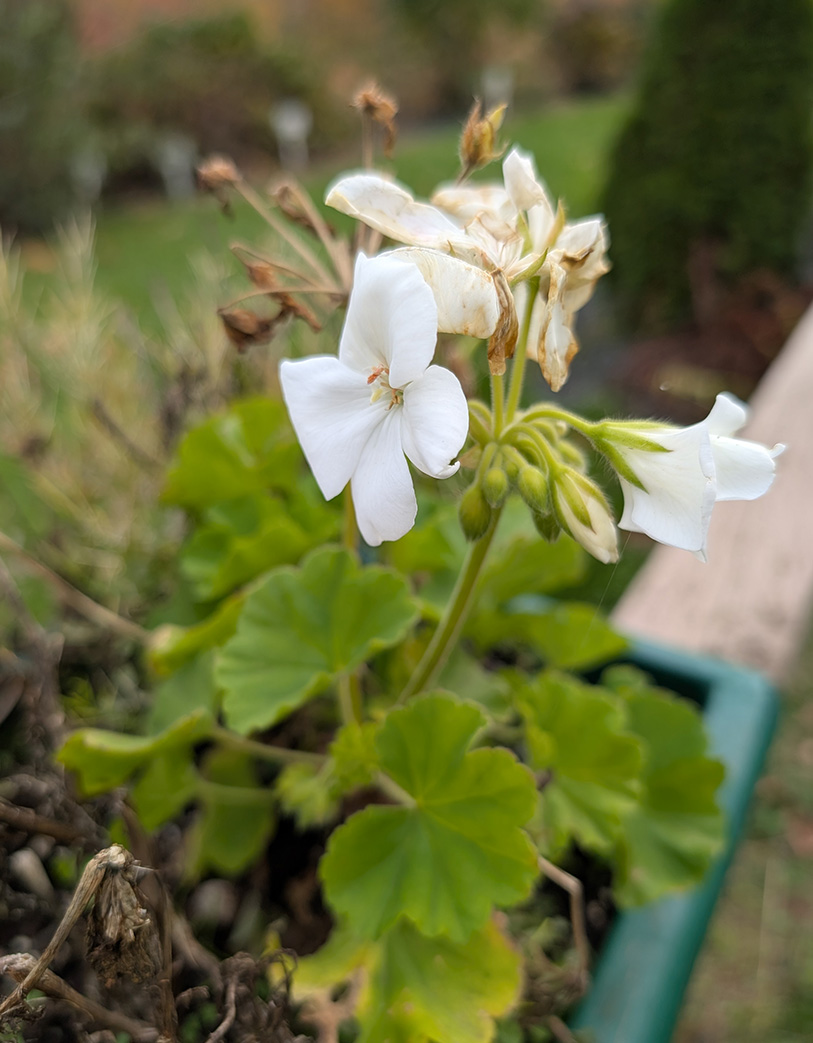
Leaves are rounded to kidney-shaped, palmately veined, with shallow scalloped (crenate) margins and a soft, slightly cupped surface covered in fine hairs. Many cultivars show a darker horseshoe-shaped band — the “zone” that gives the group its name — though white and pale selections often carry only a faint zone or none, as on this plant. Crushed foliage gives off a pungent, slightly musky scent rather than the rose or citrus of the scented-leaf relatives.
Flowers
Flowers are held in rounded umbels on long stalks that rise above the foliage. Each bloom has five petals in a gently two-lipped arrangement, the two upper petals set a little apart from the three lower ones. Color across the group runs white, pink, salmon, coral, red, and magenta, in single and double forms; this is a clean white single. A single umbel opens over days, so fresh flowers, tight buds, and spent blooms often sit together on one head. Bloom runs from spring through to frost.
Seed Heads / Fruit
Fruit is the long-beaked schizocarp shared across the Geraniaceae — the “stork’s bill” that gives Pelargonium its name. At maturity it splits into spring-loaded segments, each with a feathery tail that aids dispersal. Garden cultivars set little viable seed and rarely come true, so increase is almost always vegetative.
Quick ID
Rounded umbel of white five-petaled flowers, the two upper petals slightly separated from the three lower — gently two-lipped
Flower head carried on a long stalk well above the leaves
Rounded, kidney-shaped, scalloped leaves, softly hairy and aromatic when crushed
Faint-to-absent dark horseshoe “zone” on the leaves in this white form
Thick, jointed, succulent stems, woody at the base with age; tender, blackens at frost
Known Range
A garden hybrid with no wild native range, derived from species of the South African Cape (notably Pelargonium zonale and P. inquinans). Grown worldwide as a bedding and container staple. In North America it is winter-hardy only in the warmest zones (roughly USDA 10–11) and is treated as an annual or overwintered houseplant everywhere colder, Pennsylvania included. It does not naturalize in the wild here.
Care / Habitat
Light: Full sun to part sun, six or more hours; tolerates light afternoon shade in summer heat.
Soil: Average to rich, fast-draining potting mix or bed soil; resents soggy ground.
Moisture: Moderate — let the top inch dry between waterings; reasonably drought-tolerant and rot-prone if kept wet.
USDA Zones: 10–11 as a perennial; grown as an annual in zone 9 and colder.
Typical Habitat (cultivated): containers, window boxes, hanging pots, beds, and borders; favors warm, sunny spots and south-facing exposures.
Propagation / Reproduction
Easiest from softwood stem cuttings, which root readily in water or a light mix through the growing season. Some seed strains (the “seed geranium” series) grow true from seed, but most named cultivars must be increased from cuttings. To overwinter, bring potted plants indoors before frost, take fall cuttings, or store dormant bare-root plants in a cool, dark place and cut them back to restart in spring.
Pests / Diseases / Threats
Generally tough and largely deer-resistant thanks to the aromatic foliage. Watch for gray mold (Botrytis) on spent blooms and leaves in cool, damp weather — relevant to the browning seen here as the season turns — along with geranium budworm boring into buds, plus aphids, whitefly, and edema in overwatered plants. Root and crown rot from wet soil is the main killer, especially on overwintered stock.
Maintenance / Management
Deadhead spent umbels at the base to keep new heads coming and to limit Botrytis. Pinch growing tips to hold a bushy shape. Feed lightly through the season. Bring plants in or take cuttings ahead of the first hard frost, and cut overwintered plants back in spring as growth restarts.
Additional Notes
The everyday garden “geranium” is a Pelargonium rather than a true Geranium; the true geraniums are the hardy cranesbills. Linnaeus first lumped both under Geranium, and L’Héritier separated Pelargonium in 1789, but the common name had already taken root and stayed. Both names point to the beaked fruit: Geranium from the Greek geranos, “crane,” and Pelargonium from pelargos, “stork.” Pelargonium × hortorum itself is a complex hybrid rather than a wild species, with P. zonale and P. inquinans behind most of it. It is the workhorse of the bedding trade, valued for long bloom, heat tolerance, and easy cuttings. White forms like this one carry well in evening light and pair cleanly with stronger colors.
It is distinct from the ivy geranium (P. peltatum), which trails and has glossy, pointed ivy-shaped leaves; from the regal or Martha Washington geranium (P. × domesticum), with showier blotched flowers and less heat tolerance; from the scented-leaf geraniums (P. graveolens and kin); and from the hardy cranesbills of the genus Geranium, which carry flat, radially symmetric five-petaled flowers on deeply lobed, winter-hardy foliage. The umbel of softly two-lipped flowers on a long stalk above rounded, scalloped leaves settles this one as zonal.
Field Notes (CF Observation)
Photographed in Geistown, Pennsylvania in early November, growing in a green plastic planter at the edge of a bed. A fresh umbel of pure white flowers stood open above the foliage with green buds still rising to follow, set against several frost-browned, drying blooms on the same and neighboring stalks — the season clearly on the turn. Rounded, scalloped, cupped leaves held fresh green below. Behind the plant, blurred autumn foliage in orange and rust gave way to a dark conifer hedge at right and a wood plank along the bed’s edge. Identification rested on the rounded umbel of five-petaled, faintly two-lipped white flowers held on a long stalk, the kidney-shaped scalloped leaves with little visible zone, and the thick jointed stems — Pelargonium × hortorum in its white form.
All images and written content published on this site are provided freely for educational and artistic use. Attribution appreciated but not required. Knowledge grows when shared.