
Back in April I posted the V2 Update and said the framework was open and the numbers were waiting to be tested. Since then the work has gone sideways in the good sense — outward, into the deployment modes the main series named but never developed.
Five appendices are published today. They finish Version 2.
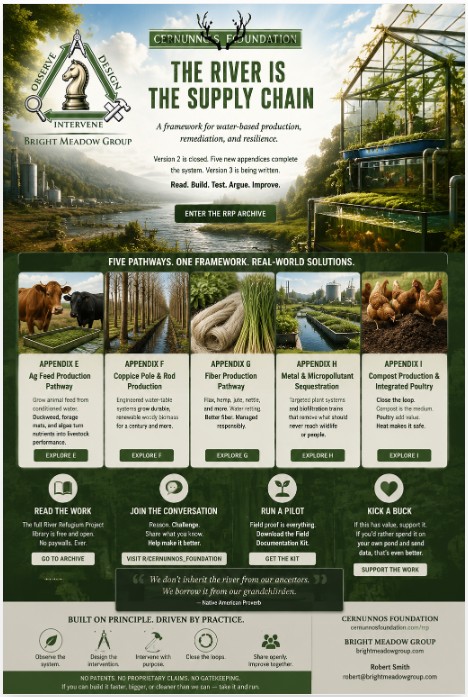
RRP0002-AppE
The version of the RRP aimed at people who already own the water and the livestock. Nutrient capture terminates in feed instead of fiber or char — duckweed, hydroponic forage mats, and protein-dense microalgae grown on conditioned farm water.
The spine of it is Section 6, the source-water tier system, and Section 5, the refugium stage that is not optional. Deliver raw ditch water to a raceway and you still remove nutrients, but the harvest is whatever colonized it first. The refugium decides who eats.
Also states the tension without softening it: the species that make good remediators make good accumulators, and accumulators do not distinguish between nutrients and contaminants. Sections 7 through 10 are how you manage that. Section 8 is what happens when the metal loading gets high enough to be worth assaying rather than avoiding.
Download: [LINK]
RRP0002-AppF
The structural opposite of the feed pathway. Days to weeks becomes years. Protein content becomes rot resistance. What may enter an animal becomes what survives thirty years in ground contact.
Willow, alder, hazel, chestnut, black locust, osage orange — arranged across four designed water-table bands, in compost buckets set on rock in an aerated channel. The bucket offset is the tuning knob: a black locust that hates wet feet and a willow that loves them can share a channel at the same water level and both be right.
If you have run an aquaponic media bed, you will recognize every element of Section 4. Fixed level, gravel to the halfway point, heavy aeration, bell siphon. The only substitutions are what is planted in it and where the water came from.
It also names a gap in our own financial model. Coppice is standing stock on multi-year rotation and RRP6 has no shape for a delayed-first-harvest asset. Section 12 says so and does not close it.
Download: [LINK]
RRP0002-AppG
Nobody eats a shirt. That single fact is why this pathway can be sited on the water every other use has to refuse — stormwater outfalls, industrial corridors, legacy-contaminated reaches, the worst tier in the watershed.
Flax, hemp, jute, kenaf, nettle, ramie, and cotton. The strongest argument in it is Section 5: water retting produces better fiber than dew retting and Europe gave it up because of the effluent. High BOD, organic acids, strips oxygen out of whatever receives it. That is precisely the liquid the refugium and biofiltration train were built to eat. We can run the process the industry abandoned because we already own the reason it was abandoned.
Section 8 draws the boundary, and it is the part I most want people to read: thermochemical processing destroys organics and does not destroy elements. Metals do not burn. They arrive in the char more concentrated than they went in. The pathway’s freedom is real and it stops at the char.
Download: [LINK]
RRP0002-AppH
The first pathway in the series whose product is the removal itself. Azolla, duckweed, vetiver, coontail, biosorption beds — planted from a site contaminant assay rather than from a market, harvested on tissue loading rather than maturity, run through a redox-sequenced train where each cell removes a different thing by a different mechanism.
Deployment is a biosecure enclosed station. Full stop. Kesterson is in Section 2 for a reason: an open pond of metal-laden floating plants is a feeding station that concentrates contaminants exactly where wildlife will find them. Mercury gets its own screening gate, because a sulfate-reducing cell on mercury-bearing water is an excellent methylation reactor.
Section 8 may be the most important thing in the series. Pharmaceutical and micropollutant capture is the one place the framework does not relocate a problem. The compound enters the water, enters the plant, enters the reactor, and is gone. Nobody inherits it. PFAS is the exception and has to be screened before you build.
Download: [LINK]
RRP0002-AppI
Every rooted plant in this system grows in compost, which makes compost infrastructure rather than a byproduct. This closes the last open loop: the water grows the biomass, the biomass becomes the medium, the medium grows the next crop.
Two things worth flagging. First, the phosphorus argument — recirculating aquaponic systems are chronically phosphorus-limited and buy in mined rock phosphate to fix it. River water has the opposite problem. We are running that cycle in the correct direction.
Second, the poultry sequencing problem. Birds on a maturing pile do genuinely useful work — turning, fragmenting, fertilizing, converting worms into eggs at no labor cost. They also arrive after the pile’s kill step and undo it on the way past. The second thermophilic heat after the birds move on is what makes the arrangement safe, and it is exactly the stage a busy operator will skip. Section 7 makes it mandatory.
The rest is old knowledge. Pile it, keep air moving, turn it, put worms in when it cools, wait. Anyone who builds good piles and reads nothing else will be doing the most important thing in the document.
Download: [LINK]
This is the last release against Version 2.0.
Version 3 is underway. It is a rewrite rather than an expansion — folding in what the appendices taught us, resolving the contradictions the series accumulated honestly (RRP4 §3.9 still reads as though bamboo is a textile crop; it isn’t, and G and F both say so), and presenting the whole thing in considerably fewer pages. Twenty-plus documents is a library. What most people need is the argument.
No date on it. Read these first — they are where the current thinking actually lives.
There is a forum now: r/Cernunnos_Foundation. Reasoning behind it is here.
These five documents are full of provisional figures drawn from open-field literature that may be poor predictors of what happens under continuous nutrient supply. Every one of them has a “what the pilot must prove” section that amounts to a list of things I do not know. If you have grown flax, run a sulfate-reducing cell, composted algae at scale, kept birds on a pile, or coppiced anything — you know something I don’t. Come tell me. Wrong in which direction matters enormously.
Rules are short: stay on topic, no ads, abuse gets the axe.
The RRP archive: cernunnosfoundation.com/rrp
Previous releases
Field testing
Aquaponics, food, and the systems underneath all of it
None of this is behind a paywall and none of it is going to be. The documents are free, the framework is open, and the only thing it costs anybody is the time to read it.
It does cost something to make, though — hosting, software, lab reading, the occasional tank of gas to go look at water. If any of this has been worth your afternoon, kick a buck. A dollar is a real amount and I mean it literally. If you would rather spend the dollar on your own pond and send me the data instead, that is the better trade and I would take it over the buck.
Same terms as always. No patents, no proprietary claims, no gatekeeping. If you can build it faster, bigger, or cleaner than I can, take it and run.
Robert Smith
robert@brightmeadowgroup.com