
Kingdom: Plantae
Clade: Tracheophytes
Clade: Angiosperms
Clade: Eudicots
Clade: Asterids
Order: Asterales
Family: Campanulaceae
Genus: Platycodon
Species: Platycodon grandiflorus (Jacq.) A.DC.
Monotypic genus — one species, no relatives within Platycodon. Its nearest kin are the bellflowers, Campanula.
General / English: Balloon flower, Chinese bellflower, Japanese bellflower, platycodon
Japan: Kikyō (桔梗)
Korea: Doraji (도라지) — refers to both the plant and, more often, the root
China: Jiégěng (桔梗); the dried root is Platycodi radix
Etymology: Platycodon is from Greek platys, broad, and kodon, bell — a broad bell. Grandiflorus means large-flowered. The English common name comes from the bud, which inflates like a small balloon before opening.
An upright herbaceous perennial forming a clump of stems from a thick fleshy taproot. Slow to emerge in spring — often the last thing in the bed to show, which gets it dug up accidentally by gardeners who assume it died over winter. Mark the spot.
Long-lived and slow. It does not spread, does not sucker, and does not need dividing. A well-sited plant persists for decades.
Height: 30–90 cm (1–3 ft); dwarf cultivars 15–25 cm
Spread: 30–45 cm (12–18 in)
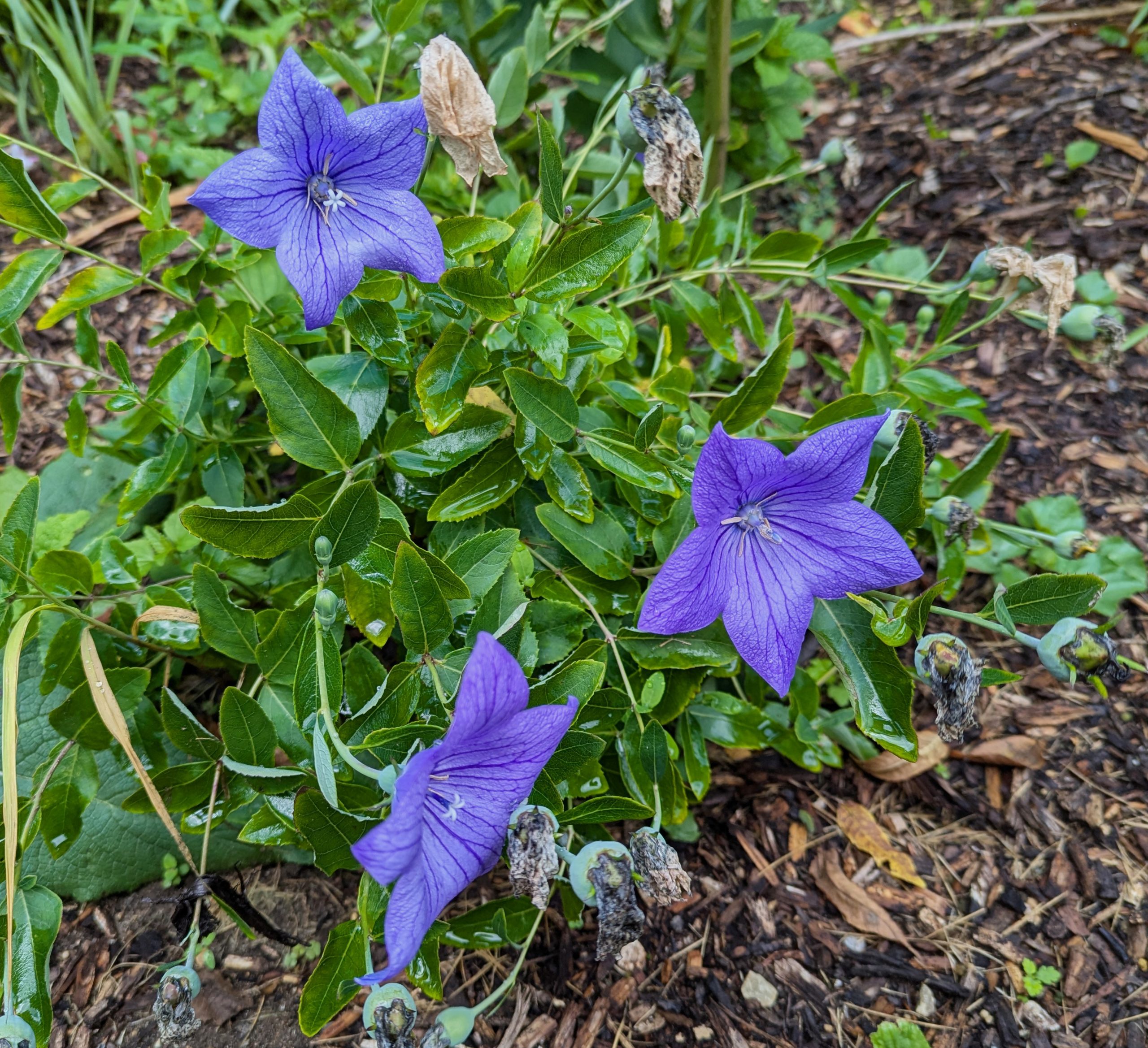
Nothing else in a temperate garden inflates its buds like this. If it looks like a purple balloon on a stem, that’s the plant. Open flowers separate from Campanula by being flat stars rather than hanging bells, and by the toothed leaves.
Native to East Asia — China, Korea, Japan, and eastern Siberia — on grassy slopes in hills and mountains.
Widely grown as an ornamental in temperate gardens worldwide, and naturalizing in a few U.S. states. It is not aggressive and is not treated as invasive.
Hardy USDA zones 3–8.
Field note
The root is toxic raw and edible cooked. That distinction is the whole of it, and it should not be improvised on.
In Korea, doraji is a staple vegetable. The root is peeled, soaked, and prepared as doraji-namul or doraji-muchim — a seasoned side dish served with rice — and also pickled, fried, candied into doraji-jeonggwa, made into a syrup (doraji-cheong) for tea, and infused into soju. The flavor is bitter-sweet and slightly fibrous. It is a common ingredient rather than an exotic one.
In traditional Chinese and Korean medicine, the dried root — Platycodi radix, jiégěng — has been used for respiratory complaints for over two thousand years, with documented use in formulas since the Han dynasty. Cough, phlegm, sore throat, bronchitis. It is officially listed in the Chinese Pharmacopoeia.
The chemistry is real. The active compounds are triterpenoid saponins called platycodins, running roughly 2–3% of dry root weight, alongside flavonoids and phenolic acids. Platycodin D in particular has attracted substantial modern research for anti-inflammatory, immunomodulatory, and antitumor activity. Most of that work is in vitro or in animals, and none of it makes the root a treatment for anything. A chromosome-level reference genome was published in 2022 to support further work on the biosynthetic pathways.
Saponins are also the reason the raw root is a problem — they are membrane-active and irritant, and cooking or soaking is what makes the root safe to eat.
In Japan, kikyō is one of the Seven Flowers of Autumn (aki no nanakusa) — a grouping celebrated in Japanese literature since the Nara period, and traced to poems by Yamanoue no Okura in the Man’yōshū. The other six are bush clover, silver grass, kudzu, nadeshiko, golden lace flower, and thoroughwort. All seven were fixtures of Heian aristocratic gardens and remain standard seasonal reference points in haiku.
The five-pointed flower became the kikyōmon, a family crest used by several clans — most famously the Akechi. The same pentagram form appears as the Seimei kikyō, the seal of the Heian-period onmyōji Abe no Seimei and the emblem of the Bureau of Onmyōdō, where the five points map to the five Chinese elements: wood, fire, earth, metal, water.
The traditional flower meaning is unchanging love, along with honesty and remembrance.
In Korea, Doraji taryeong — the balloon flower song — is among the best-known folk songs on the peninsula, sung in both North and South Korea and among ethnic Koreans in China, and familiar in Japan as Toraji. It originated in Eunyul, Hwanghae Province, and the version sung today has taken on Gyeonggi minyo rhythmic characteristics.
A plant that is simultaneously a garden ornamental, a vegetable, a pharmacopoeia entry, a heraldic device, a Taoist cosmological diagram, and a folk song is doing more work than most.
This site is open for educational use. Teachers and students are welcome to adapt, translate, and reuse this material with attribution.