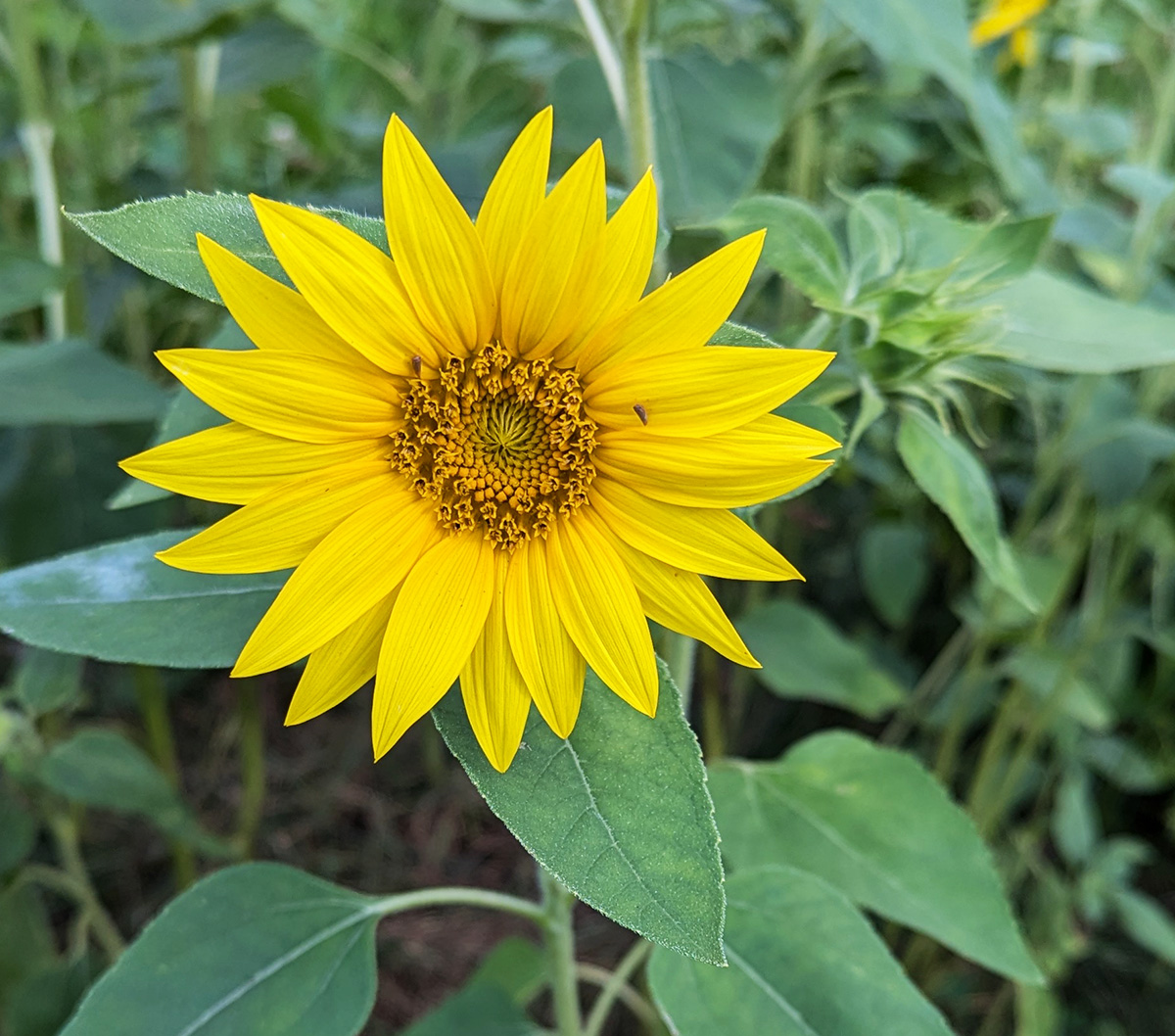
Helianthus annuus
Taxonomy
Domain: Eukaryota
Kingdom: Plantae
Subkingdom: Tracheobionta
Superdivision: Spermatophyta
Division: Magnoliophyta
Class: Magnoliopsida
Clade: Eudicots
Clade: Asterids
Order: Asterales
Family: Asteraceae
Genus: Helianthus
Species: Helianthus annuus
Common Names by Region
- United States / Canada: Common sunflower, annual sunflower, wild sunflower, mirasol
- Mexico / Latin America: Girasol, mirasol
- Europe: Tournesol (Fr.), Sonnenblume (Ger.), girasole (It.)
- General: Sunflower
Description
Quick ID
- Growth form: Coarse annual, 3–10 feet depending on lineage and soil. Single thick stem in crop and ornamental strains; branched with multiple heads in wild and volunteer plants.
- Flowers: Composite heads 3–12 inches across. Twenty to forty yellow ray florets — sterile, purely advertising — around a broad disc of hundreds of fertile disc florets. The disc opens from the outside inward, so a working head shows a ring of shedding pollen with a pale green unopened center.
- Leaves — the diagnostic feature: Alternate above the first few nodes, long-petioled, broadly ovate to heart-shaped with a squared or cordate base, and coarsely toothed. No other Helianthus in the eastern range carries that combination.
- Leaf and stem texture: Stiff white bristles throughout — leaves sandpapery on both faces, stems and petioles visibly hairy.
- Roots: Deep taproot with a dense fibrous mat in the upper foot of soil. The fibrous fraction is what does the work in remediation applications.
Blooming
- Midsummer into fall, roughly July through frost, with staggered heads on branched plants extending the display for weeks. This photograph dates to July 8, early in the run — the primary head is finished while the secondary is at peak.
Look-alikes
- Jerusalem artichoke (Helianthus tuberosus): The common confusion at full size. Thicker, rougher lance-shaped leaves, perennial from tubers, and it doesn’t open until August. A July bloom rules it out.
- Woodland sunflowers (H. divaricatus, H. decapetalus, H. strumosus): All carry opposite, narrower, short-stalked or stalkless leaves and much smaller heads. Check the leaf attachment and the count is settled.
- Oxeye sunflower (Heliopsis helianthoides): Opposite leaves, and its ray florets persist on the seed head rather than dropping.
- Mexican sunflower (Tithonia rotundifolia): Orange rays, velvety leaves, different genus entirely.
Known Range
- Native: Western and central North America, with the wild type centered in the Great Plains and interior West.
- Domesticated: In eastern and central North America by Indigenous farmers at least four thousand years ago — one of a small handful of major world crops originating north of Mexico.
- Present distribution: Effectively worldwide in temperate agriculture. Naturalized and weedy across all fifty states and most of Canada, and a significant field weed in parts of its own native range.
Care / Habitat
Light
- Full sun, without qualification. Shade produces spindly stems and poor heads. Young plants track the sun through the day; mature heads set east and stop.
Soil
- Wide tolerance — sandy, clay, compacted, and low-fertility ground all work. Prefers neutral to slightly alkaline. Deep loose soil produces the tallest plants, but poor ground still produces a crop.
Water
- Drought-tolerant once the taproot is down. Does not want standing water or heavy clay that stays saturated.
Typical Habitat
- Disturbed ground of every kind: roadsides, rail ballast, fill dirt, field margins, fence lines, mowing edges, garden beds, and the strip behind the garage. A colonizer of broken soil that has followed human settlement across the continent and then across the world.
Propagation / Reproduction
- Seed only — a true annual with no vegetative spread. Direct-sow after last frost; transplants poorly because of the taproot.
- Self-sows readily. Volunteers from spilled birdseed are among the most common sunflowers people encounter.
- Reversion: Crop and ornamental seed produces offspring that drift back toward the wild form — shorter, branched, many-headed, smaller seed. That reversion is visible and it is the fastest way to read a plant’s history in the field.
- Allelopathic residues. Breakdown products suppress germination in several common weeds and in some vegetable seedlings. Worth planning a rotation around rather than working against.
Pests / Diseases / Threats
- Birds are the primary pressure on seed. Goldfinches, chickadees, cardinals, and jays strip heads through fall.
- Insects: Sunflower moth, seed weevils, and aphids. Rarely enough to matter outside commercial production.
- Disease: Downy mildew, rust, Sclerotinia head rot, and Verticillium wilt, mostly in dense monoculture stands.
- Deer browse young plants heavily.
- No conservation concern. Common, widespread, and in places an agricultural weed.
Additional Notes
Ecology & Use
- High and broad pollinator value. Native specialist bees in Andrena, Melissodes, and Svastra depend on Helianthus pollen. Generalist bees and butterflies work the heads throughout bloom.
- Seed for wildlife and for people — the reason this species is in half the birdseed sold in the country, and the source of one of the world’s four major vegetable oils.
- Hollow pithy stalks make serviceable native bee nesting habitat when cut and bundled after the season.
- Phytoremediation, read carefully. The strong case is rhizofiltration: plants grown hydroponically on contaminated water pull dissolved metals and radionuclides efficiently, demonstrated on Chernobyl-area ponds in the 1990s for cesium-137 and strontium-90. The weak case is field-scale soil cleanup, where uptake from bound soil fractions is slow and post-Fukushima plantings returned discouraging numbers. Either way the biomass determines the outcome — a hyperaccumulator tilled back under has accomplished nothing. Harvest and disposal, or thermal conversion with capture of the ash fraction, is where remediation separates from theater.
Management
- Want it? Sow in place, full sun, and leave it.
- Want seed? Bag the heads or accept that the birds are the harvest.
- Leave the stalks standing through winter. Standing heads feed goldfinches into February and standing stems shelter overwintering insects. Tidiness costs more here than it returns.
Field Note
- Photographed July 8 at a settlement edge — mixed grass, garden margin, ground that has been disturbed and left alone since.
- This plant has branched. Three heads at least, at three separate stages, on side stems off a single root. Commercial sunflower is bred hard for the opposite: one stalk, one head, one ripening date, everything ready for the combine at once. Branching means the plant has slipped the program — either a cut-flower ornamental selected for multiple blooms, or, more often at ground like this, a volunteer sprung from spilled birdseed and reverting toward the architecture its wild ancestors carried.
- The staggered heads in this frame are the whole story. A crop plant finishes at once. This one is spreading its bloom across weeks, which is worse for a harvest and better for everything that eats.
- A branched sunflower at a settlement edge is nearly always a volunteer. It costs nothing to leave. It is a seed source, a bird feeder, and standing evidence that the ground under it will still grow something.
All Cernunnos Foundation materials are free to use for any educational purpose.
Post Views: 129