
Taxonomy
Kingdom: Animalia
Phylum: Chordata
Class: Actinopterygii
Order: Characiformes
Family: Characidae
Genus: Gymnocorymbus
Species: Gymnocorymbus ternetzi
Binomial Name: Gymnocorymbus ternetzi (Boulenger, 1895)
Ornamental Form: Longfin cultivar (selectively bred; not a distinct taxon)
Common Names by Region
Black Skirt Tetra (English, North American trade standard)
Black Widow Tetra (English, general)
Black Tetra (English, general)
Petticoat Tetra / Blackamoor (English, older trade names)
Trauermantelsalmler (German — “mourning-cloak tetra”)
Mariposa / Monjita (Spanish, South America)
Adult
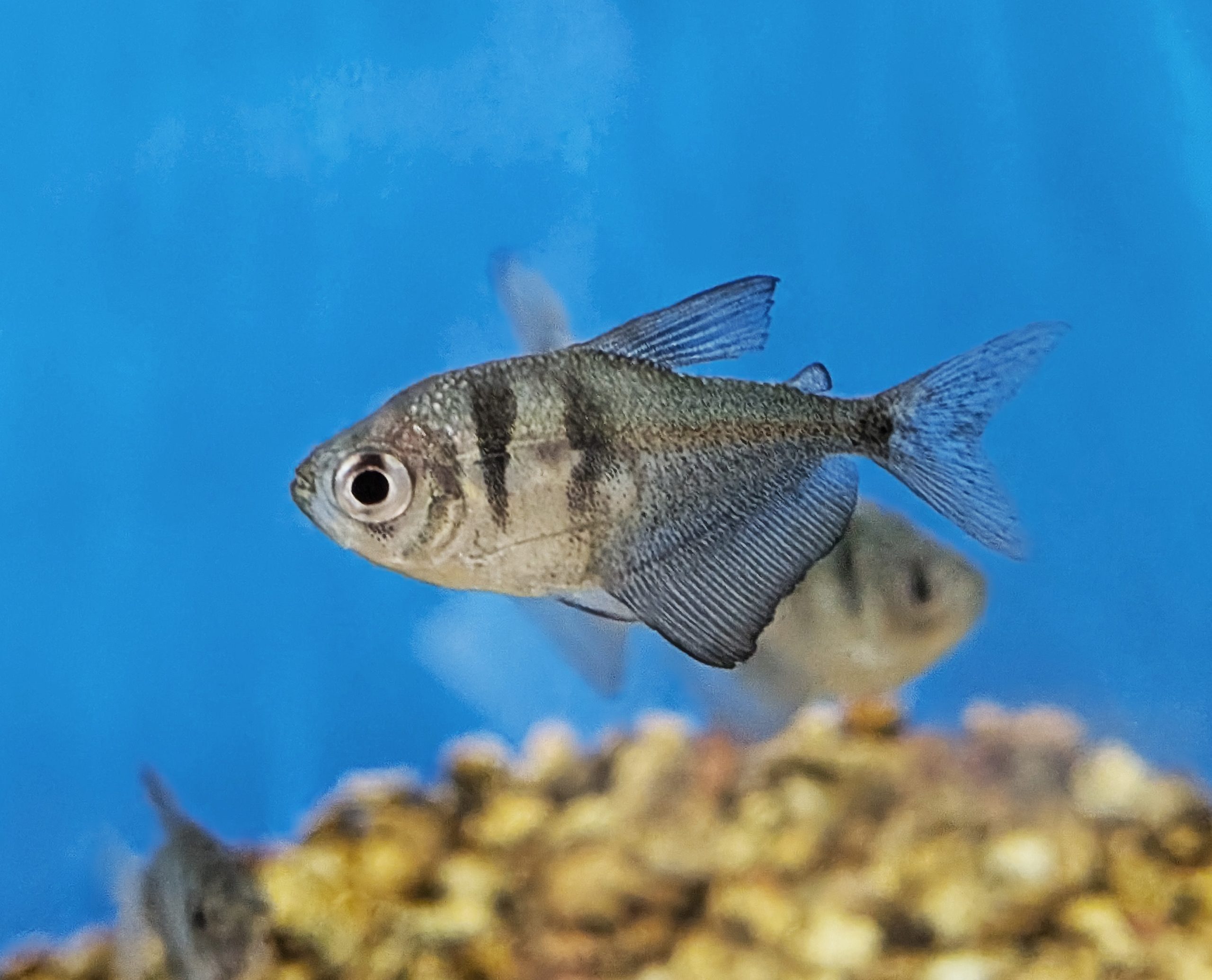
A deep-bodied, laterally compressed tetra reaching about 2 to 2.5 inches (5–6 cm) standard length, with the body noticeably taller than long-bodied tetras of similar size. The forward half of the body is silver to olive-tan with a faint metallic sheen; the rear half and the trailing fins are dusky to black in fresh young stock. Two prominent vertical black bars cross the shoulder and midbody, with a third fainter bar sometimes visible.
The defining trade feature is the anal fin — broad, deep, and skirt-like, sweeping back along the underside of the fish. The name comes from this fin.
Color Fading
An important and widely misunderstood trait: the black pigment fades with age. Juveniles in a store tank are dark and dramatic; adults progressively lose the rear black until many mature fish are largely silver-gray with only the vertical bars remaining. This is normal ontogenetic change, not illness and not water quality. Buyers regularly report that their fish “lost their color” and assume something went wrong.
Longfin Variety
A selectively bred ornamental form in which the dorsal, anal, and caudal fins are substantially extended and trailing. It is the same species, not a subspecies or a separate taxon. The extended fins are attractive but functionally costly: they reduce swimming efficiency, are more prone to tearing and to bacterial and fungal fin infection, and make the fish a preferred target for fin-nipping tankmates.
Sexing
Females are deeper-bodied and fuller, particularly when carrying eggs, with a wider, more rounded anal fin. Males are slimmer with a somewhat more pointed dorsal fin. Differences are subtle and unreliable in young fish.
Dyed and Modified Stock
This species is one of the most commonly abused in the ornamental trade. Artificially dyed “painted,” “strawberry,” “blueberry,” and similar tetras are black skirt tetras injected with dye or dipped in caustic solution and stained. The process kills a large fraction of the fish and shortens the lifespan of survivors. There is also a commercially produced GloFish form. Dyed fish should not be purchased under any circumstances; the practice continues only because it sells.
Quick ID
Deep, tall, laterally compressed body — noticeably taller than most tetras
Broad skirt-like anal fin sweeping along the belly
Two clear vertical black bars behind the gill cover
Rear body and fins dark in juveniles, fading toward silver-gray with age
Longfin form: same fish with extended trailing dorsal, anal, and caudal fins
Known Range (Wild)
South America — the Paraguay and Guaporé river basins, spanning Brazil, Bolivia, Paraguay, and northern Argentina. Introduced and established in parts of the southeastern United States and elsewhere through aquarium releases.
Habitat (Wild)
Slow-moving and still water: small tributaries, backwaters, creeks, and shaded margins with overhanging vegetation and submerged wood. Wild fish live under cover in dim, tannin-stained water, not in the open under bright light — a fact that matters considerably for how they should be kept.
Life Cycle / Reproduction
An egg-scattering species with no parental care. Females release several hundred adhesive eggs among fine-leaved plants or spawning mops; both parents will eat eggs and fry immediately if given the chance. Eggs hatch in roughly 24 to 36 hours and free-swimming fry appear after another two to three days, requiring infusoria or similar microscopic food before graduating to baby brine shrimp.
Slightly soft, acidic water and a temperature at the upper end of the range trigger spawning. Lifespan is typically 3 to 5 years in good conditions, with longfin stock trending toward the shorter end.
Diet
Omnivorous and undemanding. Wild diet is small crustaceans, insects and insect larvae, worms, and plant matter. In captivity a quality flake or micropellet base supplemented with frozen or live bloodworms, daphnia, and brine shrimp keeps color and condition. They feed readily in the middle of the water column and are not shy at feeding time.
Aquarium Care
Minimum group: Six or more is the correct recommendation; four is the absolute floor and should be treated as a temporary condition, not a plan. This is a shoaling species, and understocked groups produce the exact behavior people complain about — nervousness, hiding, and fin-nipping directed at tankmates. A proper group is a calmer group.
Tank: 20 gallons long as a practical minimum for a group of six. They are active mid-water swimmers and need horizontal room.
Water: Temperature 72–80°F, pH 6.0–7.5, soft to moderately hard. Genuinely adaptable and tolerant, which is why they are recommended to beginners — but tolerance is not preference.
Environment: This is where most keepers, and nearly every retail tank, go wrong. Black skirts want subdued lighting, plant cover, and a broken sightline. A bare brightly lit tank with no shade and no structure produces chronically stressed fish that pale out, hover, and nip. Floating plants, background planting, driftwood, and a dimmed or diffused light change their behavior visibly within a day.
Temperament: Peaceful in a proper group and a good community fish, but capable of fin-nipping — particularly toward slow long-finned tankmates like bettas and fancy guppies. Small groups and bare tanks make this worse; large groups and planted tanks largely resolve it.
Cover: A lid is not optional. Tetras jump, and an open-top tank in a busy retail environment loses fish routinely.
Reading Stress in This Species
The dorsal fin is the most useful single indicator. A healthy, settled black skirt holds its dorsal upright and open when cruising. A dorsal held clamped, folded, or swept backward along the body is a stress posture — the fish equivalent of hunched shoulders. Combined with pallor, hovering in one spot, hiding, or drifting near the surface or the glass, it means something in the environment is wrong.
Common causes in order of likelihood: too few of its own kind, no cover, excessive light, ammonia or nitrite in the water, high nitrate, aggressive or oversized tankmates, and temperature swings. In a retail setting, several of these are usually operating at once.
Threats / Conservation
Not of conservation concern in the wild; widely distributed and abundant, and virtually all aquarium stock is commercially bred rather than wild-caught. The pressures on this species are welfare pressures rather than population pressures — dyeing, sale in inadequate group sizes, and display in bare high-traffic tanks.
Supporting This Species
Buy in groups of six or more. Refuse dyed fish, and say why at the counter. Provide cover, dim the light, put a lid on the tank. None of this is expensive and all of it is visible in the animal within a day or two.
If you keep a longfin variety, be more careful about tankmates than you would be with the standard form — the extended fins are a liability in mixed company and a magnet for infection in poor water.
Additional Notes
The species name honors Carl Ternetz, the Swiss naturalist who collected the type material. The German common name translates to “mourning-cloak tetra,” a reference to the dark rear half of the fish in its juvenile state.
Black skirts have been in the aquarium trade since the 1930s and are among the most thoroughly domesticated ornamental fish in circulation. Their hardiness has made them a permanent fixture on beginner recommendation lists — which is a double edge, since a fish that survives poor conditions is a fish that will be kept in poor conditions.
Field Notes (CF Observation)
The black skirt tetra is one of my favorite aquarium fish, and it earns the position. It’s hardy, active, peaceful enough for most community tanks, undemanding about water chemistry, and it has real presence — that deep body and sweeping anal fin read well at a distance in a way most small tetras don’t. Keep at least four, and six or more if you want to see the fish actually behave like itself.
This particular individual is a longfin variety, and it is not doing well.
Look at the dorsal fin. It’s swept backward along the body rather than standing upright and open. On a settled black skirt cruising mid-water, that fin sits up. Held back and clamped like this, it’s a stress posture, and it’s the single most reliable tell this species gives you. The washed-out body color supports the same reading.
Circumstances explain it. This is a store tank — bare, brightly lit, no cover, no lid, no plant material, constant foot traffic on the other side of the glass. A fish evolved for shaded tributary backwaters is being held in an illuminated box with nowhere to get out of the light. Even assuming the water chemistry is clean, which I would not assume in a high-turnover retail system, the environment alone is enough to produce what’s visible here.
The good news is that this is entirely correctable. A planted tank with floating cover, a dimmed light, a lid, and five or six companions of its own kind would turn this fish around inside a week. It doesn’t need rescue in any dramatic sense. It needs a better address.
Suggested categories: Actinopterygii · Animalia · Animals · Aquarium Fish · Aquaponics · Art · Characidae · Characiformes · Chordata · Fish · Gymnocorymbus · Naturalist Art · Nature Pictures · Photography