
Kingdom: Plantae
Clade: Tracheophytes
Clade: Angiosperms
Clade: Eudicots
Clade: Rosids
Order: Fabales
Family: Fabaceae
Genus: Lupinus
Species: Lupinus polyphyllus Lindl.
Garden forms: Russell hybrids, designated Lupinus × russellii hort. or L. × regalis
General / English: Bigleaf lupine, large-leaved lupine
United States / Canada: Bigleaf lupine, garden lupine, blue-pod lupine, marsh lupine
United Kingdom: Russell lupin, garden lupin
Northern Europe: Widely naturalized and generally treated as an invasive alien
Etymology: Lupinus is Latin for wolf — from an old and incorrect belief that these plants stripped the soil. They do the opposite; they fix nitrogen and leave ground richer. Polyphyllus means many-leaved, describing the high leaflet count.
An upright herbaceous perennial forming a basal clump of long-stalked leaves with flower stems rising above. Deep-rooted, which makes it useful for erosion control and difficult to move once established. Not woody at any point in its life — it dies back to the crown each winter.
Individual plants are relatively short-lived, three to five years typically, but a stand persists by seed.
Height: 60–150 cm (2–5 ft) in flower; dwarf strains 45–60 cm
Spread: 45–75 cm (18–30 in)
Herbaceous clump, palmate leaves with 9 or more broad glossy leaflets, dense unbranched spike of pea flowers packed tight along its length. Separates from tree lupine (L. arboreus), which is a woody shrub with narrow silky gray-green leaflets, and from eastern wild lupine (L. perennis), which is smaller, with 7–11 narrower leaflets and a looser, more open spike.
Field note
Any yellow, red, orange, or bicolored garden lupine is not the wild species. Wild L. polyphyllus is blue.
George Russell, a gardener in York, began breeding lupines in his fifties after seeing a vase of them at an employer’s house. Over more than twenty years he crossed L. polyphyllus with tree lupine (L. arboreus) and one or more unrecorded annual species — possibly L. nootkatensis — relying on bumblebees for pollination and culling ruthlessly by eye. The yellows in the modern palette came in from arboreus.
He was 79 when he first exhibited at Chelsea. The Royal Horticultural Society awarded him the Veitch Memorial Medal in 1937. In 2013 the RHS named Russell Hybrid lupins the plant of their centenary decade and second overall across the century.
What he selected for is visible in any modern plant: spikes with the flowers packed tight and no gaps between whorls, where the wild species carries an open, gappy spike. If a lupine’s raceme looks like a solid column, that is Russell’s eye at work eighty years on.
Modern dwarf strains — Gallery, Minarette, Lulu — descend from this line, bred down for bedding and container use.
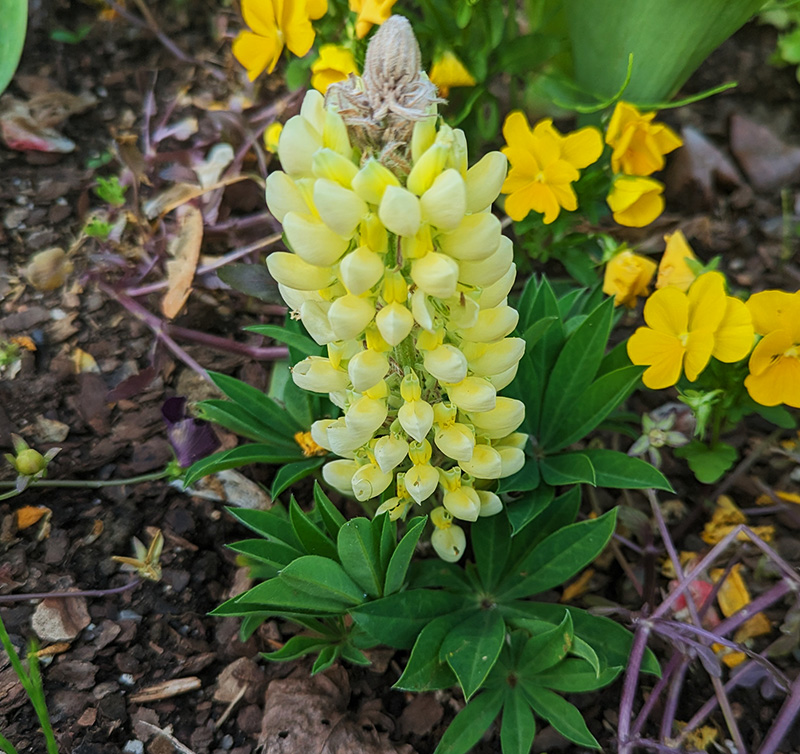
Note on this photograph: clear yellow flowers on a compact herbaceous plant with broad glossy leaflets and a tightly packed spike. That is a Russell-derived dwarf hybrid, most likely from one of the named bedding series, rather than the wild species.
Native to western North America — British Columbia and Alberta south through Washington, Oregon, and California, east to Montana, Idaho, and Nevada. Habitat is streamsides, wet meadows, forest openings, and coastal ground. It prefers cool climates and moist soil.
Introduced and naturalized far beyond that, including eastern North America, across northern and central Europe, New Zealand, and elsewhere. In much of Europe, particularly Finland, Sweden, and the Baltic states, it is an established roadside and meadow invader listed as an invasive alien.
Hardy roughly USDA zones 4–8. Frost-tolerant to about −30 °F. Dislikes heat and humidity — it is a poor performer south of about zone 7.
Field note
Do not eat any part of this plant. Lupinus polyphyllus contains quinolizidine alkaloids toxic to people and livestock. Seeds are the most concentrated part.
Some lupines are grown as food crops — L. albus, L. angustifolius, L. luteus — but those are low-alkaloid selected strains and still require processing before eating. Ornamental and wild lupines are not food.
Lupine is a recognized allergen with cross-reactivity to peanut, and a labeled allergen in the European Union.
Field note
Anyone planting garden lupines in the eastern United States should know this.
Wild lupine, Lupinus perennis, is the eastern native — a smaller plant of sandy oak savanna and pine barrens, and the sole larval host plant of the Karner blue butterfly, a federally endangered species. Karner blue larvae eat L. perennis and nothing else.
L. polyphyllus and Russell hybrids do three things where they escape into eastern habitat: they spread aggressively in some conditions, they displace existing vegetation, and they hybridize with L. perennis. That last one is the serious one. Genetic swamping degrades the host plant the butterfly depends on, and hybrid plants are not reliable hosts.
The nitrogen fixation compounds it. Karner blue habitat is nutrient-poor sandy ground, and enriching that soil opens it to weeds that shade out the wild lupine directly.
None of this makes a bedding lupine in a suburban container an emergency. It does mean that seeding “lupine” into meadows, roadsides, or restoration plantings in the east is a real risk, and that “lupine” in a wildflower mix is almost always polyphyllus or a Russell hybrid rather than the native. If you want lupine in an eastern meadow, source L. perennis specifically and check with your state agriculture department or extension office first.
This site is open for educational use. Teachers and students are welcome to adapt, translate, and reuse this material with attribution.