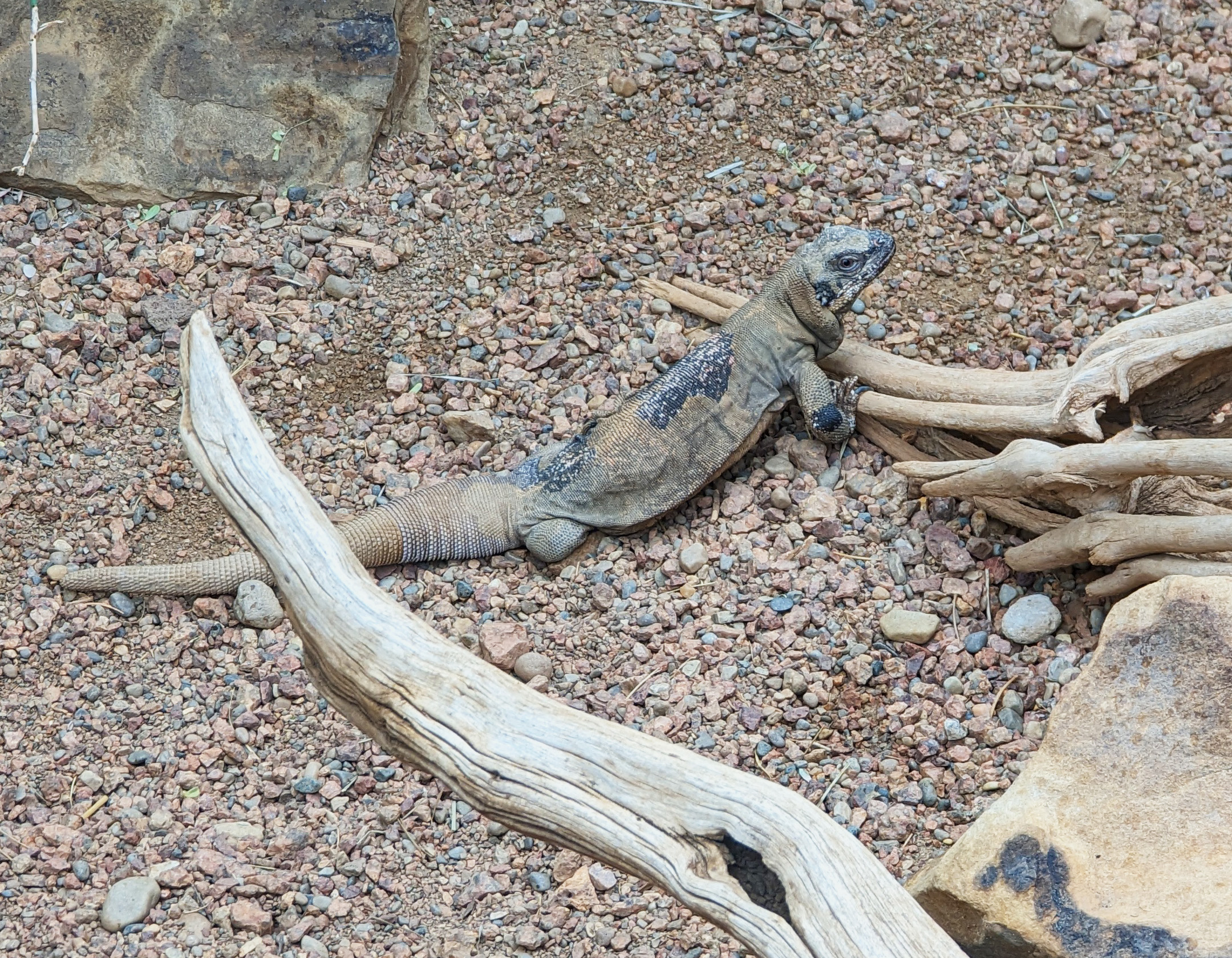
Sauromalus ater
Taxonomy
- Domain: Eukaryota
- Kingdom: Animalia
- Phylum: Chordata
- Class: Reptilia
- Order: Squamata
- Suborder: Iguania
- Family: Iguanidae
- Genus: Sauromalus
- Species: Sauromalus ater Duméril, 1856
- Synonym: Sauromalus obesus (Baird, 1859)
A taxonomic note: every chuckwalla in the United States was formerly split across S. obesus and its subspecies. All of them are now folded into the single species S. ater, and the older name persists in a great deal of published material. Five subspecies are currently recognized within it. If you encounter S. obesus in an older field guide or a museum label, it refers to this animal.
Five species in the genus, several of them island endemics in the Gulf of California — including the San Esteban chuckwalla (S. varius), which reaches 76 cm, roughly twice this animal’s length.
Common Names by Region
- United States: Common chuckwalla, northern chuckwalla, chuckawalla
- Mexico / Spanish: Chacahuala
- Etymology: “Chuckwalla” is a borrowed Indigenous word — from the Shoshone tcaxxwal or caxwal, in the form used by the Cahuilla of southeastern California. It came into English essentially unchanged. Sauromalus is from Greek roots for flat lizard; ater is Latin for black, describing the adult male.
Description
Quick ID
- Body: Broad, heavy, and dorsoventrally flattened — built wide and low rather than round. The flattening is functional and is discussed below.
- Loose skin: Conspicuous folds of baggy skin around the neck, shoulders, and flanks. These are the single most recognizable feature and the mechanism behind the animal’s defense.
- Tail: Thick, wide at the base, blunt at the tip, and smooth-scaled. A spiny tail means a different species.
- Scales: Small and granular over the body, with larger scales protecting the ear openings.
- Size: Total length commonly 40 cm (16 in), occasionally to 51 cm. Weight up to about 900 g (2 lb).
- Coloration varies by population, sex, and age:
- Adult males: black head, shoulders, and limbs, with the midbody light tan speckled with brown — or in some populations reddish-yellow, orange, or pale gray toward the rear
- Adult females: brownish overall with scattered dark red spots
- Juveniles: four or five broad bands across the body and three or four on the tail; males lose these in adulthood, females often retain traces
- Femoral pores on the inner thighs, well developed in males, producing secretions used in territorial marking
Reading this specimen: the animal here shows a mottled and blotched pattern of dark markings on a tan ground, without the solid black head and shoulders of an adult male. That points to a female or a subadult. The retained patterning is consistent with either.
Range
Sonoran and Mojave Deserts of the southwestern United States and northwestern Mexico.
From eastern California, southern Nevada, and southern Utah south through western Arizona into Baja California and Sonora, with populations reported east into New Mexico and parts of Colorado. Also on roughly 30 islands in the Gulf of California.
Elevation from sea level to about 1,400 m.
Habitat & Behavior
- Rock is the requirement. Outcrops, boulder fields, rocky hillsides, and old lava flows. Vegetation matters for food, but crevices matter for survival, and a chuckwalla is rarely far from one.
- Diurnal. Emerges in the morning and basks before feeding, warming to an optimum body temperature around 100–105 °F (38–41 °C) before doing anything else. It remains active at ambient temperatures that would kill most vertebrates — up to about 39 °C air temperature.
- Hibernates in underground burrows and crevices through the winter.
- Males are seasonally and conditionally territorial, defending basking sites and crevices, with the femoral pore secretions doing the boundary-marking.
- Harmless. No venom, no aggression, and the first response to a threat is to run.
The Inflation Defense
Field note
This is what the animal is known for, and the whole body plan is built around it.
A threatened chuckwalla runs into a rock crevice, then gulps air using a gular pump — a throat-pumping mechanism — and inflates its lungs. The body distends, the loose skin folds fill out, and the lizard wedges itself immovably against the rock. It also positions the tail toward the crevice opening and against the body, presenting armored scale rather than soft tissue to whatever is trying to reach in.
The flattened body and the baggy skin exist for this. A round-bodied lizard could not enter the crevice, and a tight-skinned one could not expand once inside.
Extracting a wedged chuckwalla by pulling is effectively impossible for a coyote, a raptor, or a person.
Which is why the counter-technique is worth recording. Native peoples of the Death Valley region hunted chuckwallas by thrusting a bone-barbed hook into the crevice to puncture the lungs, deflating the animal so it could be pulled out. That is a piece of applied biology — a hunting method designed around an anatomical mechanism, and a demonstration that people who lived alongside this lizard understood exactly how the defense worked.
Chuckwallas can also drop the tail as a secondary distraction, though it is less central to their strategy than the crevice.
Diet
- Strict herbivore. Flowers, leaves, fruit, and buds. Insects are ingested only incidentally, riding on the plants.
- Creosote bush flowers, leaves, and fruit are a staple across much of the range.
- Preference runs to annual forbs and grasses, falling back on the leaves of perennial shrubs when annuals are unavailable. Flower heads and moist leaves are favored.
- They get nearly all their water from food. In the Mojave and Sonoran deserts this is not a convenience but a requirement.
- Body size tracks plant diversity. Areas with richer vegetation produce larger individuals — a legible signal of habitat quality read directly off the animal.
The Salt Problem
Eating desert plants for both food and water means taking in a great deal of mineral salt with no water to spare for flushing it. Chuckwallas solve this with a nasal salt gland, concentrating excess salt and expelling it through the nostrils — often by sneezing, which leaves white crusted deposits around the nose and on nearby rock.
It is the same solution marine iguanas and seabirds arrived at for the same underlying problem, reached independently. A functional kidney can only concentrate urine so far; past that point an animal needs a separate excretory organ or it dehydrates.
Reproduction
- Breeding follows spring emergence, with males displaying and defending territory.
- Clutches average around six eggs, laid in summer.
- Hatchlings emerge in late September, banded and patterned.
- No parental care.
- Long-lived for a lizard — well into the teens, and past 25 years in captivity.
Threats / Conservation / Notes
- Least Concern (IUCN). Widely distributed and locally common.
- Habitat degradation reduces populations locally — development, off-road vehicle damage to rock and vegetation, and drought driven by a warming climate.
- Collection for the pet trade has a documented effect, concentrated on populations with attractive patterning — which means the pressure falls hardest on exactly the animals that matter most to local genetic diversity. Collectors also cause secondary habitat damage by prying and overturning rock to reach wedged animals, and a destroyed crevice does not come back.
- Predators include coyotes, foxes, raptors, and snakes, with the crevice defense being the primary answer to all of them.
Additional Notes
Ecology & Significance
- A large herbivore in a system with few of them. Chuckwallas move plant material through the desert food web at a body size most desert vertebrates never reach, and they disperse seed in the process.
- An indicator species. Because body size tracks vegetation quality and the animals are tied to specific rock formations, chuckwalla condition reads as a measure of local habitat health.
- Iguanids in the desert. The family is best known from tropical and island forms, and this is a lineage that adapted to extreme aridity — the salt gland, the water-from-food strategy, and the very high thermal tolerance are all part of that.
In Exhibits
- Rock structure is the exhibit, not the decoration. Crevices, basking platforms, and thermal gradient are the requirements, and an animal without a crevice available is an animal without its primary security behavior.
- High basking temperatures — a surface basking spot well above 100 °F, with cooler retreat space.
- Low humidity and a herbivorous diet of greens, flowers, and limited fruit. Protein-heavy or fruit-heavy feeding causes problems in this species as it does in other desert iguanids.
- The gravel-and-driftwood desert planting shown here is standard husbandry, and the driftwood serves as basking furniture.
- Chuckwallas are frequently on exhibit and are calm animals in captivity — the defensive strategy means they are more inclined to hide than to struggle.
All Cernunnos Foundation materials are free to use for any educational purpose.
Post Views: 97