
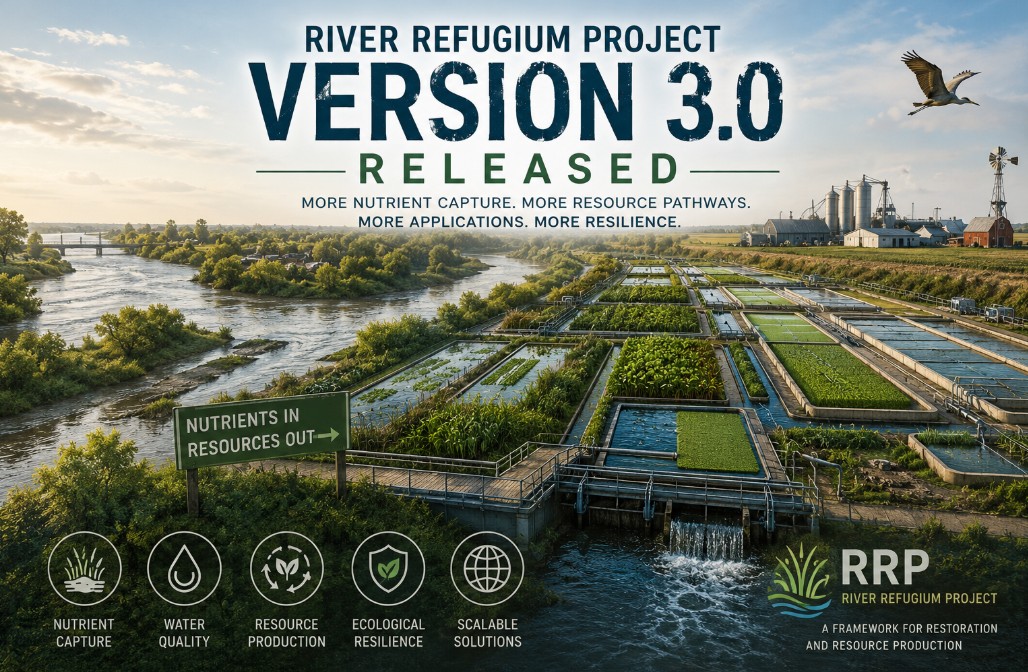
Version 3.0 of the River Refugium Project document series is available now at the project page. Open access, no paywall, reproduction and adaptation permitted.
The structural change is the headline. Version 2.0 ran to eighteen volumes and ten appendices. Version 3.0 is a single consolidated whitepaper and five appendices — the appendix count cut in half, the technical content intact. What came out was duplication.
The five pathway appendices are gone because the thing they described was misnamed. Sequestration, compost, coppice, fiber, and feed were never subsystems. They are configurations of the same greenhouse complex: a species list, a water grade, a growing system, and a disposition protocol installed in a building otherwise identical to the one beside it. Calling them pathways implied five parallel plants. Calling them configurations says what is true — a production house can be reset and reconfigured without touching the node’s architecture. Five documents collapsed into Section 7.4.
That correction produced the argument at the center of this version. Section 7.1 addresses why a framework rooted in permaculture specifies thirteen segregated single-purpose houses. The best biological systems are polycultures; that observation survives every scale and every continent where people have built water-based food systems. Section 7.1 gives six reasons segmentation wins at industrial scale, in descending order of how hard they are to argue with: source-water qualification, redox incompatibility, harvest mechanics, regulatory legibility, containment cost, and failure isolation.
The segmentation sits at the cell boundary. The node as a whole remains the polyculture — the diversity moves up one level, from inside the cell to between cells, where it can be routed, qualified, isolated, and measured. Inside the cells, stacking persists everywhere it can. What contained segmentation buys at a hundred acres is optionality: mutually exclusive biological processes running simultaneously, output streams qualified to different standards, mechanical harvest, and honest A/B experimentation. In a backyard system, containment costs you opportunity. At scale, containment creates it.
Other substantive changes:
The eight-layer revenue stack is retired. Revenue is now indexed to configuration across eight classes, and a node’s profile is the sum of what its installed configurations produce. Licensing revenue on generated intellectual property is withdrawn entirely — it contradicted the open-access commitment.
Section 10.1 formalizes duplicate measurement and retained disagreement. Every parameter exists twice, once logged and once read by a person. When the two disagree, both persist, the disagreement is timestamped, and the resolution enters as a third record. A log entry reading “verified” destroys the information the check was taken to produce.
Section 12.2 states the concentration claim in the form that survives hostile review: concentration converts unrecoverable dispersal into a defined stream with options.
Appendix A now states its scope explicitly. The site selection matrix is a filter for where to build first, not a map of where the framework has application. Appendix D expands and adds a retired-terminology table. Appendix E adds Form D, feed qualification and disposition, because feed is the one output where a documentation failure can injure something.
Japan.
While preparing this release I learned that Japan has been running in-river biological treatment at watershed scale for decades. Gravel contact oxidation builds engineered beds of rounded stone into riverbeds and floodplain margins, where biofilm on the stone performs nitrification and organic load reduction on the mainstem. Taipei imported the method and operates five facilities on three rivers. It is the same physical principle as the aerated river rock channel in Section 7.3, reached independently from a different starting point.
Japan has run it long enough to see its far side. Load reduction in the Seto Inland Sea worked, then carried past the point of benefit into nutrient scarcity — fishery yields down by more than half, cultivated nori failing from nitrogen deficiency. In 2021 the governing law was amended to add nutrient management alongside pollution control, and prefectural authorities now supply nitrogen back to the sea on a seasonal schedule.
Those systems do not harvest. The nitrogen changes form and stays in the basin. No biomass capture, no thermochemical step, no product.
I will study that work thoroughly, most of it in Japanese. Two outcomes are possible. If the methods change the system at the level of the technology — if that much of the treatment train runs in-channel at ambient conditions — the result is a different machine and gets published as a new series under its own name. If it enhances this model, there is a fourth edition, and I know where the change begins.
Version 3.0 stands either way. It is complete, internally consistent, and mature — a fully workable model, ecologically proper, and with attention to crop selection and configuration, profitable. Build it.
Documents
RRP0003 — Consolidated Technical Whitepaper, Version 3.0
RRP0003-apA — Site Selection Matrix
RRP0003-apB — National Watershed Priority Map
RRP0003-apC — Initial Recommended Sites
RRP0003-apD — Master Glossary
RRP0003-apE — Field Documentation Kit
Version 2.0 is superseded in full and remains archived.