Mountain Laurel

Comments:0 Comments

Kalmia latifolia

Taxonomy

Kingdom: Plantae
Clade: Tracheophytes
Clade: Angiosperms
Clade: Eudicots
Clade: Asterids
Order: Ericales
Family: Ericaceae
Subfamily: Ericoideae
Genus: Kalmia
Species: Kalmia latifolia L.

Seven or eight species in the genus, including sheep laurel (K. angustifolia) and bog laurel (K. polifolia). The family also holds Rhododendron, Erica, blueberries, huckleberries, and Indian pipe.

Common Names by Region

Pennsylvania / general: Mountain laurel
Appalachians: Calico bush, ivy bush, ivybush
Historical / craft use: Spoonwood
Southern Appalachia: Laurel, clamoun
Also recorded: Lambkill, sheep laurel — though those names properly belong to K. angustifolia and the confusion has caused real problems in the livestock literature
Etymology: Kalmia honors Peter Kalm, the Swedish botanist and student of Linnaeus who traveled Pennsylvania and the surrounding colonies in the 1740s collecting for the Crown. Latifolia is Latin for broad-leaved.
Calico bush comes from the spotted flower interior, which early colonists thought resembled printed calico fabric. Spoonwood is literal — the wood is hard and close-grained, and both Native peoples and settlers carved utensils from it.


Description

Growth Habit

An evergreen shrub, sometimes reaching small-tree size. Young plants are dense and rounded; old ones become gnarled, open, and picturesquely twisted, with sinuous multiple trunks. In the southern Appalachians it forms nearly impenetrable thickets — the “laurel hells” that shaped where trails could and could not go.

Growth is slow. A large old specimen represents decades.

It also carries basal burls and resprouts vigorously after fire, spreading faster where burns have been more severe.

Size

Height: 2–5 m (7–15 ft) typically; up to 9 m (30 ft) in the southern part of the range
Spread: Roughly equal to height, wider in thickets

Leaves
  • Alternate, simple, entire — no teeth or lobes
  • Elliptical to lance-shaped, 3–12 cm long and 1–4 cm wide, tapering at both ends
  • Evergreen, thick, leathery, glossy dark green above, paler and yellowish beneath
  • Often clustered toward the branch tips
  • Leaves curl and droop in hard cold — a water-conservation response, and one of the ways the plant reads a winter landscape
Stems
  • Young twigs green and flexible, becoming reddish-brown then gray
  • Bark on old trunks shredding in narrow strips, ridged and furrowed
  • Wood is heavy, hard, and close-grained; the burls were prized for pipe bowls and tool handles
Flowers
  • Borne in dense terminal clusters (corymbs) 8–15 cm across
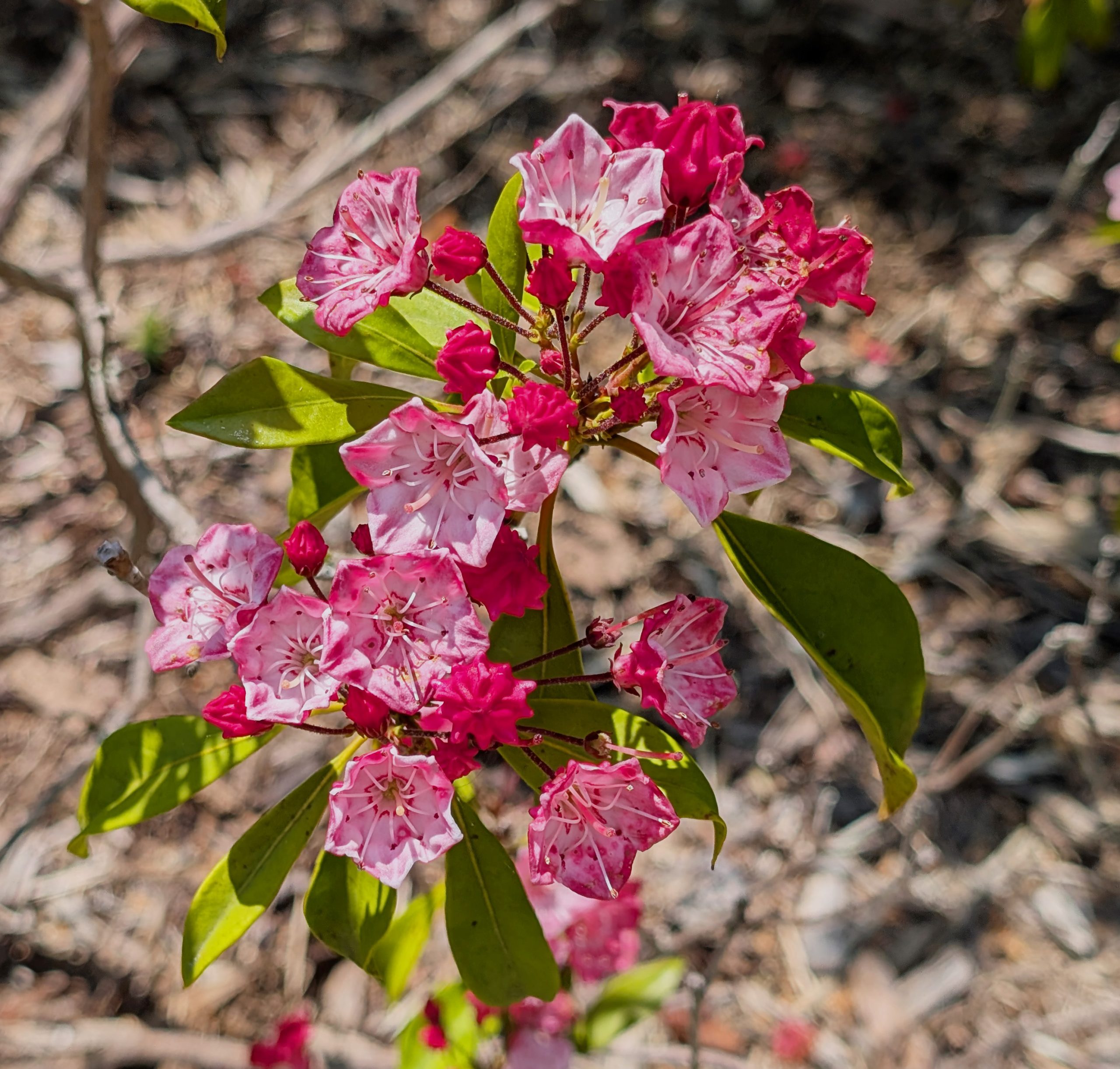
  • Individual flowers cup- or saucer-shaped, 2–3 cm across, appearing five- or six-sided rather than round
  • Buds are the striking part — deeply ribbed, fluted, and far darker than the open flower, like small crimped lanterns. The photograph here catches the full range from tight red bud to open pale corolla.
  • Color from white through pink to deep rose, with a ring of purple or maroon spots and arcs inside the cup
  • Ten stamens, each with its anther tucked into a small pocket in the corolla wall — the critical detail, discussed below
  • Blooms late May into June in Pennsylvania, peaking in early June
Quick ID

Evergreen leathery alternate leaves plus clustered cup-shaped flowers with ribbed buds and spotted interiors. Separates from rhododendron, which has larger leaves and larger bell-shaped flowers, and from sheep laurel, which is smaller with flowers borne below the leaves rather than at the tips.


The Catapult

Field note

This is the reason to stop and look at a mountain laurel rather than walk past it.

As the flower opens, the filaments bend backward and lodge each anther in a pocket in the corolla wall. The growing flower is winding itself up — the filaments hold real tension, like a cocked spring. Ten of them, arranged in a ring.

When a bee lands and pushes into the cup, it releases the catch. The filaments snap forward and fling pollen onto the underside of the insect — measured at distances up to 15 cm, which is enormous relative to a flower this size. The Harvard Gazette called it one of the fastest-moving plants on Earth, and high-speed camera work has been used to track the kinematics.

Lyman J. Briggs spent his retirement on this problem in the 1950s, after directing the National Bureau of Standards. He suspected liquid under negative pressure inside the filament was generating the force. His manuscript was unfinished when he died, and a 2014 reanalysis found his mechanism wasn’t the whole answer. The full biophysics of how the flower stores and releases that energy remains unresolved.

A 2018 study confirmed the ecological payoff: bees are the primary trigger, and insect visitation substantially improves fertilization success.

To see it: find a cluster with unsprung flowers — the anthers still visibly seated in their pockets — and touch the center gently with a grass stem. The flower will fire. It works once per flower.


Known Range

Native to the eastern United States, from southern Maine south to northern Florida and west to Indiana and Louisiana. It is a plant of rocky slopes, ridges, acidic woodland, and mountain forest — often on ground too thin and sour for much else.

State flower of Pennsylvania and Connecticut. Pennsylvania adopted it on May 5, 1933, when Governor Gifford Pinchot signed the bill. Two competing bills were in play; the pink azalea was the other candidate. The Pennsylvania Federation of Women’s Clubs campaigned for the laurel, and the story that Pinchot’s wife favored it has followed the decision ever since.

Local note: the Laurel Highlands of southwestern Pennsylvania are named for this shrub. So are Laurel County, Kentucky, and Laurel, Mississippi. Anyone living in Cambria or Somerset County lives inside a place named after a plant, and the June bloom on the ridges is the reason.

Hardy roughly USDA zones 4–9.


Care / Habitat

  • Light: Part shade is ideal. Full sun works in cool climates with adequate moisture; deep shade reduces bloom substantially.
  • Soil: Acidic — pH 4.5 to 5.5 — and this is non-negotiable. Alkaline soil produces chlorosis and decline. Humus-rich, moist, and sharply drained.
  • Water: Even moisture. Shallow fibrous root system, so it dries out quickly and dislikes standing wet equally. Mulch well.
  • Air movement: Important for foliar disease.
  • Placement: Woodland gardens, shrub borders, naturalized plantings, foundation plantings on the shaded side. Excellent with rhododendron, azalea, and fern, all of which want the same soil.
  • Deer resistant — a consequence of the toxicity rather than a coincidence.

Propagation / Reproduction

  • Cuttings are difficult. Semi-hardwood in late summer with rooting hormone; success rates are modest and slow.
  • Seed is fine and dust-like, requiring light for germination, surface sowing on damp sphagnum, and patience. Seedlings take years.
  • Tissue culture is how the trade does it. At least 75 named cultivars are available, nearly all micropropagated — ‘Olympic Fire’, ‘Pink Charm’, ‘Sarah’, ‘Minuet’ and others selected for color intensity and compactness.
  • Layering works and is the practical home method.
  • Basal burls allow the plant to resprout after fire or cutting, which is why laurel thickets recover so readily.
  • Do not attempt to dig wild plants. The root system is shallow, matted, and does not transplant.

Toxicology

Field note

All parts of this plant are poisonous — leaves, flowers, nectar, twigs, pollen. The active compounds are grayanotoxins, shared with rhododendron and azalea across the heath family.

The mechanism: grayanotoxins bind sodium channels in nerve and muscle cells and hold them open. Symptoms are salivation, vomiting, slowed heart rate, dropping blood pressure, weakness, and in serious cases cardiac collapse.

Livestock losses are real and historically significant. Sheep, goats, cattle, and horses are all susceptible, and browsing animals turned out onto laurel ground in early spring, before other forage is up, are the classic case.

Mad honey. Bees working Kalmia and Rhododendron produce honey carrying grayanotoxins. Xenophon recorded Greek soldiers incapacitated by it in 401 BC, and the phenomenon is still documented in Turkey and Nepal where the honey is deliberately harvested. Honey from areas with heavy laurel bloom warrants caution.

Toxic to dogs, cats, and horses (ASPCA). Do not burn the wood in an enclosed space, and do not use the twigs as skewers — that specific mistake has caused poisonings.


Pests / Diseases / Threats

  • Leaf spot (Cercospora, Phyllosticta) — the common problem, worst in humid still conditions
  • Lace bugs — stippled bleached foliage, worse on plants in full sun
  • Borers on stressed plants
  • Root rot (Phytophthora) in poorly drained ground; the most frequent killer in cultivation
  • Chlorosis from insufficiently acidic soil — a cultural failure rather than a disease
  • Wild populations are secure, though laurel thickets are increasingly affected by the same deer overbrowse pressure that has reshaped eastern forest understory generally. Deer avoid laurel itself, which means heavy browse of everything else can leave laurel dominant — a legible signature of an out-of-balance forest.

Additional Notes

  • Pollinators: Bumblebees and other bees are the primary visitors and the only ones heavy enough to reliably trigger the catapult. The flowers offer nectar, which is itself toxic — the plant is selective about who it feeds and what happens to them.
  • Cultivation history: In cultivation since the early 18th century, and shipped to England as an exotic before Americans grew it deliberately. English nurseries later sold it back across the Atlantic as a potted plant. It was at one point proposed as the national flower of the United States.
  • Wood use: Burls for pipe bowls, and the hard close grain for spoons, tool handles, and small turned objects. The wood also appears in the history of American clockmaking.
  • Fire ecology: The species spreads faster after fire and the rate increases with burn severity, via basal burl resprouting. Fire suppression and fire both shape laurel distribution, in opposite directions.
  • “Laurel hells” — the southern Appalachian term for dense laurel thickets, and not an exaggeration. They are close to impassable, they hold moisture and cold, and they have determined the routes of trails and roads across the southern mountains.
  • A caution on the name: this is not the laurel of laurel wreaths, which is Laurus nobilis, a Mediterranean tree with edible leaves. Mountain laurel leaves are not a substitute for bay leaves. That substitution has poisoned people.

Maintenance / Management

  • Deadhead spent flower clusters where reachable to improve next year’s bloom
  • Prune sparingly and immediately after flowering — buds set on new growth
  • Rejuvenate leggy old plants by cutting a third of the oldest stems to the ground over three years; they resprout well from the base
  • Mulch with pine needles, bark, or leaf litter to hold moisture and maintain acidity
  • Do not fertilize with anything alkaline; use acid-forming amendments where soil pH is drifting up
  • Water through drought, especially in the first three years — the shallow root system offers no reserve
  • Site it once and leave it. Established plants do not move.

This site is open for educational use. Teachers and students are welcome to adapt, translate, and reuse this material with attribution.

Spread the love

Categories:

Leave a Reply