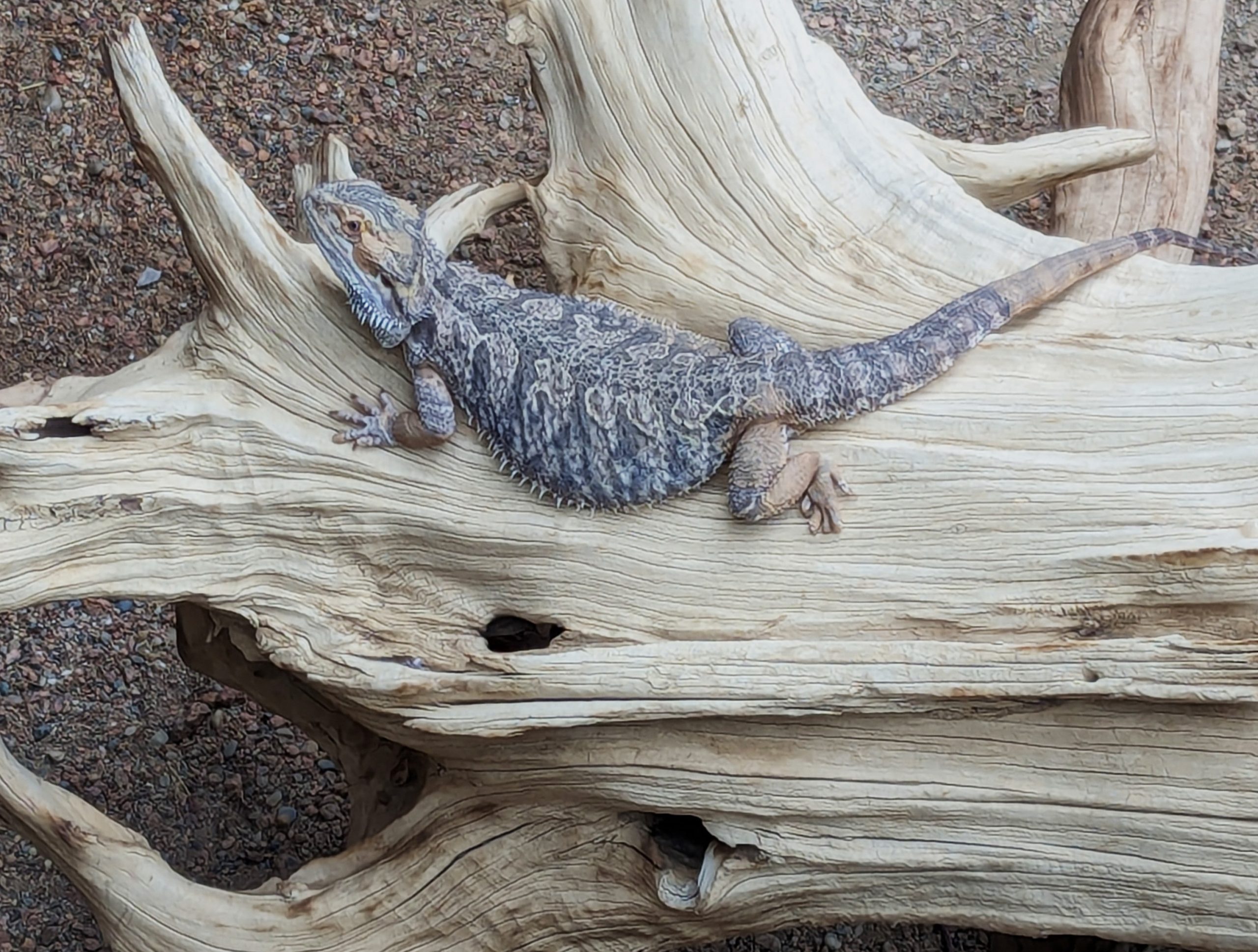
Pogona Vitticeps
Taxonomy
- Domain: Eukaryota
- Kingdom: Animalia
- Phylum: Chordata
- Class: Reptilia
- Order: Squamata
- Suborder: Iguania
- Family: Agamidae
- Subfamily: Amphibolurinae
- Genus: Pogona
- Species: Pogona vitticeps
Common Names by Region
- United States / Canada: Bearded dragon, central bearded dragon, inland bearded dragon; “beardie” in common keeper usage
- United Kingdom: Bearded dragon, central bearded dragon
- Australia (native range): Bearded dragon, central netted dragon (a name also applied to other agamids — regional usage varies)
- Herpetoculture: Pogona vitticeps is the default species meant by “bearded dragon”; seven other Pogona species exist and are rare in collections
Description
Quick ID
- Head: Broad and triangular, wider than the neck, ringed with rows of conical spines along the jawline and around the ear opening.
- Beard: A distensible gular pouch under the chin, carrying heavy spines. Inflates and darkens to black in threat or courtship display. At rest, as here, it sits flat and pale — the spines still visible as a serrated fringe.
- Body: Flattened dorsoventrally, broad and low. Lateral rows of soft spines run along each flank, forming a continuous spiny margin from armpit to hind leg.
- Pattern: Grey-tan ground color with pale reticulated markings across the dorsum — a fine network of cream lines breaking the outline against rock and bark.
- Limbs: Sturdy, sprawling, with five clawed digits per foot. Femoral pores on the underside of the thigh, more prominent in males.
- Tail: Roughly half of total length, tapering, spined along the base, and not autotomous — a bearded dragon that loses its tail does not regrow it.
- Size: 45–60 cm total length. Weight 250–500 g, with substantial variation by sex, condition, and captive line.
Range
- Endemic to the arid and semi-arid interior of eastern and central Australia — Queensland, New South Wales, South Australia, and the southeastern Northern Territory.
- No natural populations exist anywhere else. Every bearded dragon outside Australia is a captive animal or the descendant of one.
Habitat & Behavior
- Occupies dry woodland, scrub, rocky outcrop, and desert edge. Semi-arboreal — perches on stumps, fallen timber, fenceposts, and low branches rather than staying on flat ground.
- Heliothermic. Regulates body temperature by basking and shuttling between sun and shade, and shifts skin color lighter or darker to control heat absorption.
- Visual signaler with a legible vocabulary: head-bobbing asserts dominance, slow arm-waving signals appeasement or submission, the beard flares black with a gaping mouth as a threat, and a flattened body turned broadside makes the animal look larger.
- Enters brumation through the cooler months — a reptilian dormancy with reduced activity and feeding, triggered by temperature and photoperiod.
- Largely solitary outside breeding season, with loose basking hierarchies where perches are limited.
Diet
- Omnivorous, with a lifetime shift in proportion. Juveniles feed heavily on invertebrates to fuel rapid growth; adults move toward plant material as the primary intake.
- Animal component: crickets, roaches, beetles, ants, termites, spiders, and the occasional small lizard or nestling rodent.
- Plant component: leaves, flowers, fruit, and soft succulents — whatever holds moisture in a landscape where standing water is unreliable.
Reproduction
- Oviparous. Females dig a burrow and deposit clutches of roughly 15–30 eggs, and may produce several clutches in a single season.
- Incubation runs approximately 55–75 days depending on temperature. Hatchlings are fully independent from emergence with no parental care.
- Sex determination is unusual and worth stating plainly. The species has a genetic ZZ/ZW system, but incubation temperature overrides it — eggs incubated above roughly 32 °C cause ZZ genetic males to develop as functional, fertile females. The reversed females then lay larger clutches than ordinary ones.
- Wild populations in the warmer parts of the range already show sex-reversed individuals. This makes Pogona vitticeps one of the primary research models for how climate warming interacts with reptilian sex determination.
Threats / Conservation / Notes
- Assessed as Least Concern. The species is widespread and abundant across a large arid range.
- Local pressures include road mortality (the basking habit puts them on warm asphalt), habitat clearing, feral cat and fox predation, and altered fire regimes.
- Australia banned commercial export of native wildlife in the 1960s. Every bearded dragon in the global pet trade descends from stock that left the country before the ban or was smuggled out afterward — a founding population measured in dozens of animals, now numbering in the millions worldwide.
- Captive breeding has produced an extensive range of color and scale morphs — hypomelanistic, translucent, silkback, leatherback, and various color lines. Some carry welfare costs; scaleless and reduced-scale lines in particular have difficulty with thermoregulation and shedding.
Additional Notes
Ecology & Significance
The bearded dragon occupies a specific niche in the arid interior — a mid-sized diurnal omnivore that converts insects and tough desert vegetation into biomass for raptors, goannas, and elapid snakes. Its visual display repertoire is among the most studied of any agamid, and the head-bob and arm-wave sequence is a standard teaching example of ritualized signaling in reptiles.
Its second significance is scientific. The sex-reversal system has made this animal a working laboratory for questions that reach well beyond one lizard: what happens to a genetic sex determination system when environmental temperature can override it, and what that implies for reptile populations across a warming continent. The answer forming in the field data is that the genetic system can be lost entirely within a population once temperature does the job reliably.
Field Note
- Photographed basking on driftwood over a red gravel substrate — the composition and setting are consistent with an exhibit or managed collection rather than a wild Australian encounter.
- Posture is a resting bask: body flattened and pressed to the sun-warmed wood, limbs sprawled, tail extended along the grain, head raised and angled toward the light.
- The beard sits flat and pale, which places the animal in a calm, non-display state. The gular spines remain visible as a serrated edge along the throat even undeployed.
- Muted grey-tan coloration with pale reticulation is standard wild-type expression. No morph line indicated — this is what the species looks like before any of the breeding programs got hold of it.
All Cernunnos Foundation materials are free to use for any educational purpose.
Views: 252