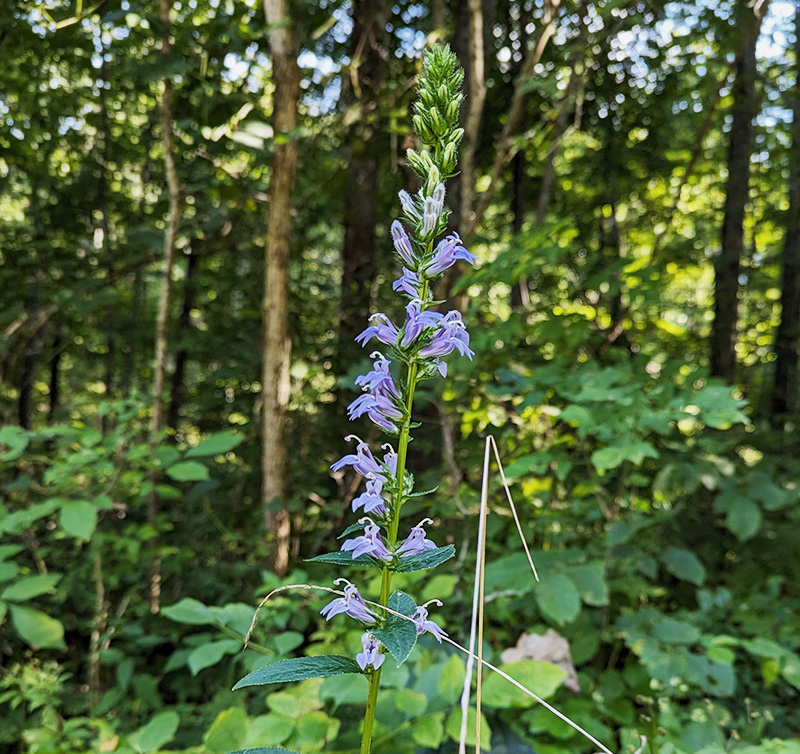
Lobelia siphilitica
Taxonomy
Domain: Eukaryota
Kingdom: Plantae
Subkingdom: Tracheobionta
Superdivision: Spermatophyta
Division: Magnoliophyta
Class: Magnoliopsida
Clade: Eudicots
Clade: Asterids
Order: Asterales
Family: Campanulaceae
Genus: Lobelia
Species: Lobelia siphilitica
Common Names by Region
- United States / Canada: Great blue lobelia, great lobelia, blue cardinal flower, blue lobelia
- General: Great blue lobelia
Description
Quick ID
- Growth form: Erect, unbranched herbaceous perennial, roughly 1–3 feet tall, on a stout leafy stem.
- Flowers: Bright to violet-blue, tubular, two-lipped — a three-lobed lower lip and a two-lobed upper lip — with white striping in the throat. Borne densely in a terminal spike (raceme), opening from the bottom up. Blooms about 1 inch long.
- Floral structure: Like all lobelias, the stamens are fused into a tube around the style — a Campanulaceae/Lobelia signature worth checking.
- Leaves: Alternate, lance-shaped, toothed, stalkless, running up the stem and into the flower spike as leafy bracts.
- Habit note: The whole plant reads as a single blue candle in shaded, moist ground.
Blooming
- Late summer into fall (roughly August–September), a valuable late-season bloomer when much else has finished. This photo catches it mid-bloom with buds still to open up top.
Look-alikes
- Cardinal flower (Lobelia cardinalis): The close native cousin — same genus, same habit and habitat, but brilliant red flowers and hummingbird-pollinated. The two sometimes grow together and can even hybridize.
- Downy lobelia (Lobelia puberula): Similar blue spike but softly hairy, with flowers often more one-sided on the stem.
- Great blue lobelia’s smaller lobelias (L. inflata, L. spicata): Much smaller, paler flowers on a slenderer plant.
Known Range
- Native: Eastern and central North America — from southern Canada through the eastern and midwestern United States. A true native, not an introduction.
- In Pennsylvania: A common and welcome native of moist, shaded ground — stream banks, wet meadows, low woods, seeps, ditches, and woodland edges, including the moist corridors around Johnstown.
Care / Habitat
Light
- Part shade to full sun. Tolerates more sun with enough moisture; happiest in dappled or partial shade.
Soil
- Moist to wet, rich soil high in organic matter. This is a plant of damp ground — it does not want to dry out.
Water
- Consistent moisture is key. Native to seeps and stream banks; struggles in dry sites. A good choice for rain gardens, pond edges, and low wet spots where many plants fail.
Typical Habitat
- Stream banks, wet meadows, seeps, low woods, ditches, marshy edges, and moist woodland borders — cool, damp, partly shaded ground.
Propagation / Reproduction
- Seed: Tiny; surface-sow (needs light to germinate) on moist soil. Self-sows in suitable damp ground.
- Division: Clumps can be divided in spring or fall.
- Basal offsets: Forms small rosette offshoots at the base that can be separated.
- A short-lived perennial that persists in a garden mainly by reseeding, so let some seed heads mature.
Pests / Diseases / Threats
- Largely trouble-free in suitable moist conditions.
- Rust and leaf spot can appear; slugs may browse young growth.
- Root rot in soil that’s wet and poorly drained, or crown rot if planted too dry then stressed.
- No conservation concern — a widespread, secure native.
Additional Notes
Ecology & Use
- A valuable late-season native pollinator plant. The tubular flowers are worked mainly by bumblebees strong enough to force the two-lipped mouth open, and by other long-tongued bees; hummingbirds visit as well.
- A superb choice for rain gardens, native plantings, and wet problem spots — it turns a soggy shaded corner into a column of blue in late summer, when the garden most needs color.
- The name tells an old, mistaken story. The species epithet siphilitica comes from a historical (and unfounded) use of the plant by Native Americans and European colonists as a purported treatment for syphilis. The remedy didn’t work, but the name stuck — a permanent fossil of 18th-century medical hope embedded in the binomial. Like most lobelias, the plant contains alkaloids and is toxic if ingested; it is not a safe home remedy.
- Pairs beautifully with its red cousin, cardinal flower (L. cardinalis), for a red-and-blue native waterside planting.
Management
- Want it to thrive? Give it steady moisture and part shade, and let a few seed heads ripen so it reseeds.
- Want more? Divide clumps or separate basal offsets in spring.
All Cernunnos Foundation materials are free to use for any educational purpose.
Views: 216