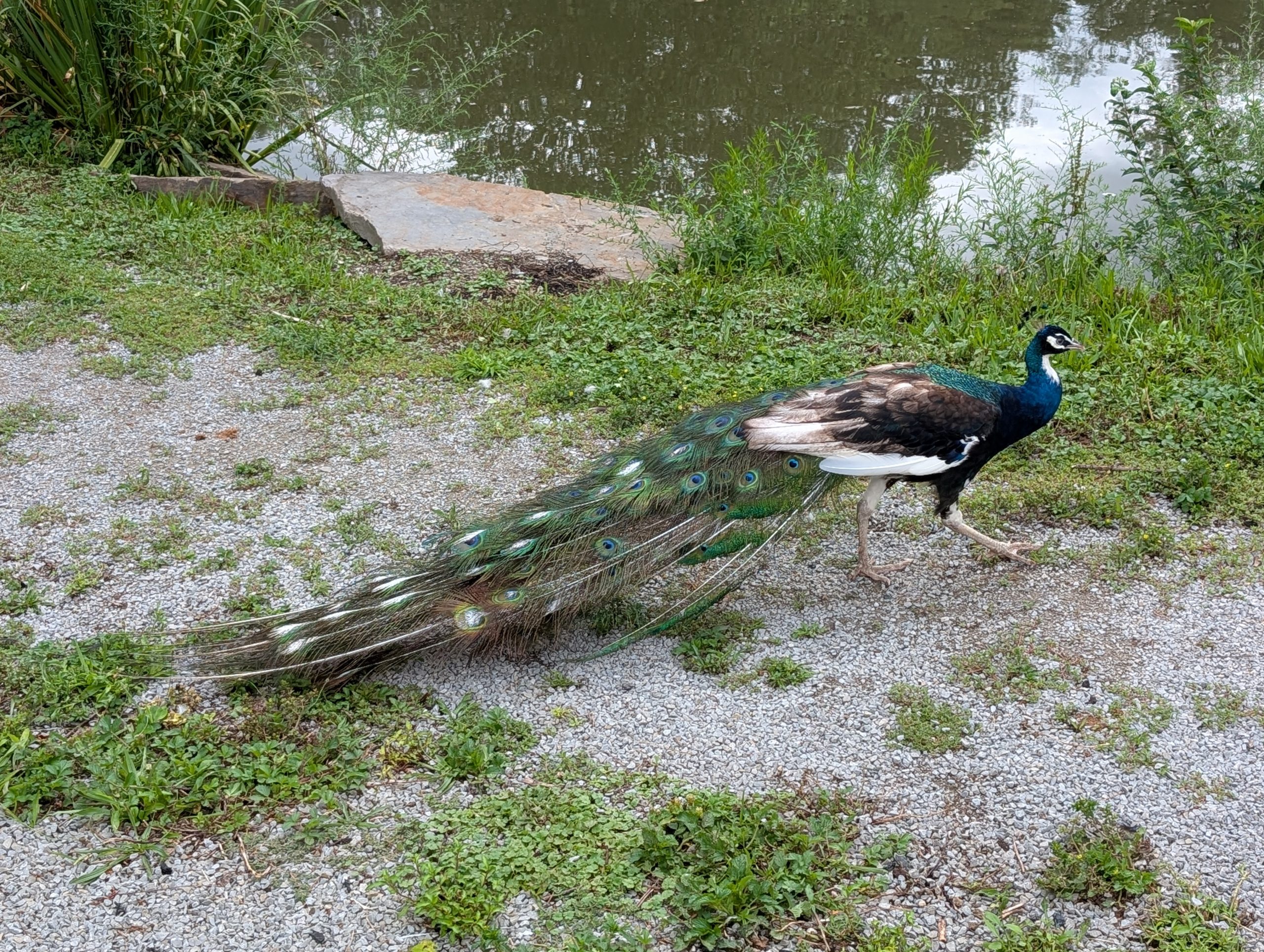
Pavo Cristatus
Taxonomy
- Domain: Eukaryota
- Kingdom: Animalia
- Phylum: Chordata
- Class: Aves
- Order: Galliformes
- Family: Phasianidae
- Subfamily: Phasianinae
- Genus: Pavo
- Species: Pavo cristatus
- Color Form: Pied, black-shoulder complex — a domestic mutation combination, not a wild phenotype
Common Names by Region
- United States / Canada: Peacock (male), peahen (female), peafowl (either); Indian peafowl, blue peafowl
- United Kingdom: Indian peafowl, common peafowl
- India & Sri Lanka (native range): Mor (Hindi), Mayura (Sanskrit), Monara (Sinhala), and many regional names; the national bird of India
- Aviculture: “Pied black shoulder” or “black shoulder pied” — the standard breeder designation for this pattern
Description
Quick ID
- Head and neck: Deep structural blue, iridescent, shifting toward green along the nape. A fan-shaped crest of bare-shafted feathers rises from the crown.
- Face: The ordinary white eye-stripe is present but enlarged and irregular, spreading down the throat as an unbounded white patch — the mark of pied expression rather than normal facial striping.
- Wing shield: In a wild-type male this area is finely barred black and cream. Here the barring has broken down into mottled brown and cream with solid dark blocks intruding — the black-shoulder trait, interrupted by pied.
- Flight feathers: Pure white rather than the usual chestnut, visible as a clean white wedge along the folded wing.
- Legs: Pale pink-grey instead of the standard slate. Leg depigmentation travels with heavy pied expression and confirms the genotype when plumage alone is ambiguous.
- Train: Fully developed, dragging well past the body, carrying the ocellated “eye” feathers. Several feathers show white tips, and at least one ocellus is rendered white — pied influence carried into the train.
- Size: A large ground bird. Body roughly 100–115 cm; the train adds another 140–160 cm in a mature male. Weight 4–6 kg.
- Age: Three years or older. A peacock does not grow a full train until its third season.
Range
- Native to the Indian subcontinent — India, Sri Lanka, Pakistan, Nepal, Bangladesh, and Bhutan — in dry deciduous forest, scrub, farmland edge, and village margin.
- Moved worldwide for at least three thousand years as an ornamental bird. Feral populations are established in Florida, coastal and southern California, Hawaii, the Gulf South, the Bahamas, New Zealand, and parts of Australia.
Habitat & Behavior
- A ground bird that roosts in trees. Forages by day across open ground and forest floor, flies up to high branches at dusk.
- The male’s display raises the train into the familiar fan and vibrates it — a rattling shiver that produces low-frequency sound below human hearing along with the visible shimmer.
- Highly vocal. The carrying may-AWE call travels well over a mile and is the first thing any neighborhood learns about a resident flock.
- Habituates readily to people. A bird that walks past an observer at close range without altering pace, as this one does, is living around human traffic.
- Loose social structure — males hold display areas, females and young move in small parties.
Diet
- Omnivorous ground forager. Seeds, grain, fallen fruit, flower heads, and green shoots make up the bulk.
- Also takes insects, spiders, and small vertebrates — lizards, frogs, small snakes including young venomous species, and the occasional small rodent.
- Around settlements, readily supplements with agricultural grain, garden plantings, and handouts.
Reproduction
- Polygynous. Males gather at traditional display grounds; females select among them and depart to nest alone.
- The nest is a shallow ground scrape in cover. Clutch of 4–8 eggs, incubated roughly 28 days by the hen alone.
- Chicks are precocial — mobile and feeding within hours — and follow the hen for several months.
- The train is not permanent. It is molted and regrown annually after each breeding season.
Threats / Conservation / Notes
- Globally Least Concern. The wild population is stable across a wide native range, and the bird is legally protected in India under the Wildlife Protection Act of 1972.
- Local pressures in the native range include habitat conversion, poisoning at agricultural sites, and poaching for feathers and meat.
- Outside the native range the issue reverses — feral flocks become a civic management problem. Roosting on vehicles and rooftops, dawn calling audible across neighborhoods, defended nest sites in yards, and municipalities discovering they have no ordinance category for a bird nobody voted to introduce.
Additional Notes
Genetics
Two separate recessive traits are stacked in this individual.
Black shoulder (nigripennis) is a simple autosomal recessive that replaces the barred wing shield with solid dark coverts. It appeared in European collections in the nineteenth century and was briefly described as its own species before breeders demonstrated it as a mutation. Darwin took an interest in it as an example of a “sport” arising in captivity.
Pied sits at a separate locus governing white expression and produces irregular unpigmented patches across the plumage, along with the pale legs.
The two loci segregate independently. A bird showing both is carrying doubled recessives at two positions at once, which does not happen by accident in a wild population. This is stock from a managed line — an aviculturist’s cross or the descendant of one, whether or not the flock it belongs to is still under anyone’s management.
Ecology & Significance
The train is the standard textbook illustration of sexual selection — a costly ornament that offers no survival benefit and considerable survival cost, maintained because females choose it. Darwin used the peacock to argue exactly this point when the tail seemed to contradict his own theory.
Ornamental mutation breeding pushes that logic further than the wild ever would. White flight feathers on a ground-nesting bird are a signal flare to every predator in the county. A feral population founded from mutation stock is running an unplanned experiment in what happens when selection is handed back to the landscape — and over generations, wild-type tends to reassert itself as the recessives grow rarer through outbreeding. An individual like this one is a record of the moment before that correction.
Field Note
- Photographed walking a gravel margin at a pond’s edge, train dragging, no display posture and no alarm response to the observer’s position. Feeding or transiting.
- The combination of collapsed wing barring, white primaries, asymmetrical white throat patch, and pale legs identifies the pied black-shoulder complex with confidence.
- The white-tipped train feathers raise a further question — whether they reflect pied carried into the train or a separate white-eyed line — which a spread-train frame would settle.
All Cernunnos Foundation materials are free to use for any educational purpose.
Views: 154