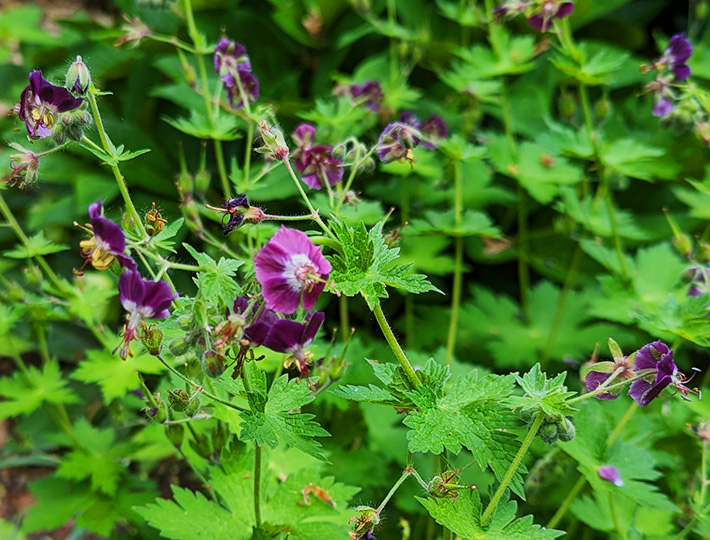
Geranium phaeum
Taxonomy
Kingdom: Plantae
Clade: Tracheophytes
Clade: Angiosperms
Clade: Eudicots
Clade: Rosids
Order: Geraniales
Family: Geraniaceae
Genus: Geranium
Species: Geranium phaeum L.
Common Names by Region
General / English: Dusky Crane’s-bill, Dusky Cranesbill
United States / Canada: Mourning Widow, Dusky Geranium
United Kingdom / Ireland: Dusky Crane’s-bill, Black Widow
Germany: Brauner Storchschnabel
Croatia / Balkans: Smeđa iglica
Horticultural trade: Mourning Widow Geranium
Etymology: Geranium from the Greek geranos, crane — a reference to the long beaked seed capsule. Phaeum is Greek for dusky or dark, describing the near-black flowers of the wild type.
Description
Growth Habit
A clump-forming herbaceous perennial that builds slowly outward from short rhizomes and fills in further by self-seeding. Foliage forms a low rounded mound; flowering stems branch above it and carry the blooms in loose, airy sprays rather than a tight head. Unlike most garden geraniums, this one is a shade plant — it holds up in conditions where the bloodred and sanguineum types thin out.
Size
Height: 45–75 cm (18–30 in) in flower
Spread: 30–45 cm (12–18 in), wider in established colonies
Leaves
- Palmately lobed with five to seven divisions, rounded in overall outline
- Margins jaggedly toothed rather than smoothly scalloped
- Soft-textured and matte green; many plants carry brown or maroon blotching at the leaf junctions, and some cultivars show a continuous dark band
- Basal leaves are long-stalked and largest; stem leaves reduce upward
Stems
- Slender, upright, finely hairy
- Branched in the upper third, holding flowers well clear of the foliage
- Flexible — they nod and sway rather than standing stiff
Flowers
- Five petals, roughly 2–3 cm (¾–1¼ in) across
- Petals swept sharply backward (reflexed) away from the center — the single most reliable field mark for the species
- Petal edges crinkled and pointed at the tip
- Color runs from the deep maroon-black of the wild type through violet and magenta-purple in garden forms, usually with a pale to white eye at the base
- Stamens and style project forward in a conspicuous dark beak from the center of the reflexed cup
- Nodding presentation — flowers face outward and downward
- Bloom period late spring into early summer, roughly May through July, with scattered rebloom after
Quick ID
Reflexed petals plus a protruding central column plus a white eye is the whole diagnosis. No other commonly grown Geranium holds its petals backward like this. The nodding, downward-facing carriage separates it at a glance from the flat, upward-facing blooms of G. sanguineum, G. maculatum, and the G. × cantabrigiense group.
Note on this photograph: these blooms read magenta-purple with a clean white center rather than the near-black of the type. That places them in the lighter garden forms — the ‘Lily Lovell’ / var. lividum end of the range — not the wild-type dusky phase. Structure is identical either way.
Known Range
Native to southern, central, and western Europe, extending into western Asia. Its native habitats are damp woodland, woodland margins, hedge banks, and moist montane and subalpine meadows.
Widely cultivated across temperate gardens, and naturalized well outside its native range — north into Scandinavia, across the British Isles, and in scattered populations in the northeastern United States and eastern Canada. In North America it is a garden escape rather than an established wildland species, and it is not currently treated as invasive.
Hardy roughly USDA zones 4–8.
Care / Habitat
- Light: Part shade to full shade. One of very few geraniums that will flower reliably in deep shade. Full sun is tolerated only where summers stay cool and soil stays moist.
- Soil: Moist, humus-rich, well-drained. Adaptable to most garden soils; dislikes standing wet in winter.
- Water: Even moisture preferred. Established plants take short dry spells but foliage suffers.
- Heat: The weak point. Foliage declines and browns in hot, humid summers — a real consideration in Pennsylvania. Shade placement mitigates it.
- Companions: Woodland underplanting, shade borders, hosta and fern beds, cottage gardens, wild-garden margins. The dark flowers read best in front of pale or white-flowered plants.
Propagation / Reproduction
- Division: Early spring or fall. The standard and fastest method. Lift the clump and separate rooted sections.
- Seed: Effective but slow — germination is notoriously drawn out and many seeds carry dormancy. Fall sowing outdoors lets natural chilling break it.
- Self-seeding: Readily, sometimes heavily, where soil is bare and moist. Deadhead before capsules ripen if you don’t want volunteers.
- Dispersal: Capsules dehisce explosively, flinging seed several feet from the parent — the standard Geranium mechanism.
Pests / Diseases / Threats
- Substantially pest and disease free
- Occasional powdery mildew in crowded, poorly ventilated plantings
- Deer and rabbit resistant
- Chief threat is cultural rather than biological: heat and drought stress causing midsummer foliage collapse
Additional Notes
- Pollinators: Bees work the flowers steadily. The reflexed petal architecture leaves the nectaries and projecting stamens fully exposed, so the flower is open to a broad range of short-tongued visitors rather than specialized to one.
- Shade performance: This is the practical reason the species persists in cultivation. Most of the hardy geranium trade is sun-adapted; G. phaeum fills the shaded end of that shelf, and it does it with the longest bloom window of any woodland-tolerant member of the genus.
- Cultivar range: ‘Samobor’ (dark leaf band), ‘Album’ (pure white), ‘Lily Lovell’ (large violet flowers, white eye), ‘Our Pat’ (RHS Award of Garden Merit). Cultivars cross freely and seedlings from mixed plantings rarely come true.
- Not toxic to people or pets, unlike the buttercups and many woodland ornamentals it is planted alongside.
- Naming caution: “Geranium” in common speech usually means Pelargonium, the tender bedding plant. This is a true Geranium — hardy, perennial, and unrelated in habit.
Maintenance / Management
- Cut flowering stems back after the main bloom to trigger fresh basal foliage and a possible second flush
- Shear tired foliage to the ground in midsummer if heat has browned it; it regrows clean
- Divide every three to four years to keep clumps vigorous
- Deadhead before seed set where volunteers are unwanted
- Cut back or leave standing in late fall as preferred; the plant is fully hardy either way
This site is open for educational use. Teachers and students are welcome to adapt, translate, and reuse this material with attribution.
Post Views: 161