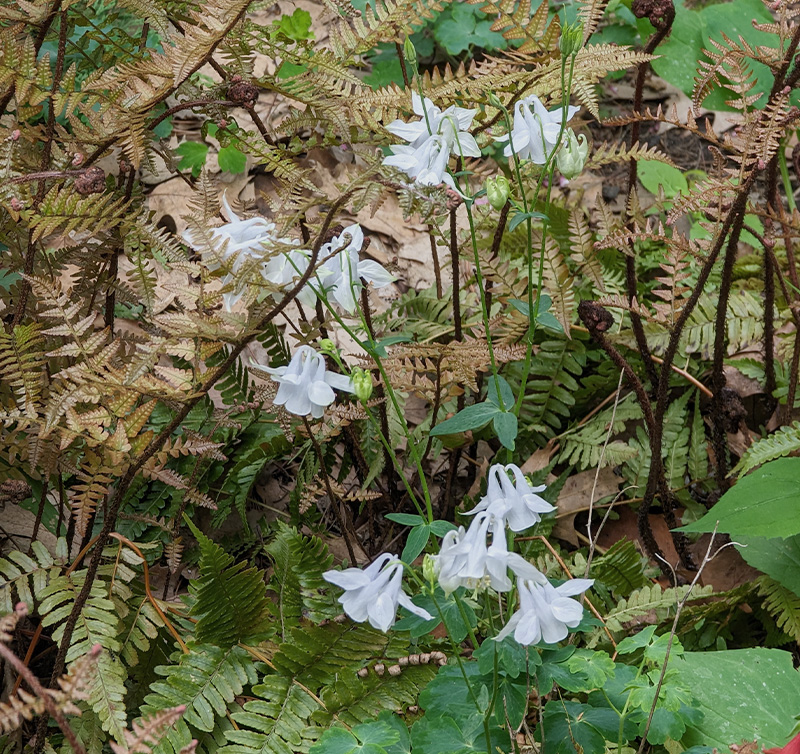
White Columbine
Taxonomy
Kingdom: Plantae
Clade: Tracheophytes
Clade: Angiosperms
Clade: Eudicots
Order: Ranunculales
Family: Ranunculaceae
Genus: Aquilegia
Species: Aquilegia vulgaris L.
Form: White-flowered garden form (the alba / ‘Nivea’ end of the species’ color range)
Common Names by Region
General / English: Columbine, Common Columbine, European Columbine
United States / Canada: Columbine, European Crowfoot, Granny’s Bonnet
United Kingdom / Ireland: Granny’s Bonnet, Granny’s Nightcap, Columbine
Germany: Gemeine Akelei
France: Ancolie commune
Etymology: Aquilegia is generally read from the Latin aquila, eagle — the five hooked spurs suggest a set of talons. “Columbine” comes from columba, dove: viewed from above, the same five spurs read as a ring of doves around a dish. Same flower, two birds, depending on which end you’re looking at.
Description
Growth Habit
A clump-forming herbaceous perennial that throws slender, branching flower stems well above a low mound of foliage. The stems arch at the tips so the flowers hang. It reseeds freely and drifts through a planting over time rather than staying where it was put — the colony in this frame, threading through fern, is characteristic of how it behaves once it settles in.
Individual plants are relatively short-lived, often three to five years. The population persists by seed, not by longevity.
Size
Height: 45–90 cm (18–36 in) in flower
Spread: 30–45 cm (12–18 in)
Leaves
- Biternate — each leaf divides into three groups of three leaflets, giving nine parts per leaf
- Leaflets rounded and shallowly three-lobed at the tips, with scalloped margins
- Medium green above, distinctly glaucous (blue-gray waxy) beneath
- Basal leaves long-stalked and larger; stem leaves reduce and simplify upward
- Foliage often tatty by midsummer and can be cut to the ground for a fresh flush
Stems
- Thin, upright, branched, finely hairy
- Arching at the tips so flowers nod or hang horizontally rather than facing up
- Wiry enough to hold the flowers clear of surrounding vegetation without staking
Flowers
- Up to 5 cm (2 in) across, borne singly at the ends of branched stems
- Structure is two-layered: five spreading sepals flared outward, and five tubular petals behind them, each drawn back into a nectar spur
- Spurs are short and hooked — curving inward and ending in small knobs. This is the single most reliable mark of A. vulgaris against most other columbines.
- Prominent yellow stamens project forward in a central boss, extending past the petal mouths
- Species color runs blue to violet; garden forms cover white, pink, red, and bicolors. This is the clean white form.
- Bloom period late spring into early summer — May and June in most of the range, with the display over in a few weeks
Quick ID
Nodding flower, five flared sepals, five short incurved and knobbed spurs, biternate leaves glaucous underneath. The hooked spur is the decider. Long straight spurs point instead toward the North American species and the long-spurred hybrids sold in seed mixes.
Note on this photograph: filed as A. vulgaris, white form, and the spur shape supports it. Worth flagging that columbines hybridize with abandon — any Aquilegia growing in or near a garden is potentially crossed, and self-sown seedlings frequently drift away from the parent in color and spur length. A white columbine in a mixed planting is a color form and a probable hybrid until proven otherwise.
Known Range
Native to Europe, from the British Isles through central and southern Europe, in woodland, woodland edge, hedge banks, and open calcareous ground.
Widely grown in temperate gardens worldwide, and naturalized across parts of eastern North America as a garden escape. It moves into woodland margins, old homesites, roadsides, and shaded banks. Not classified as invasive, but persistent where established.
Hardy roughly USDA zones 3–8.
Care / Habitat
- Light: Full sun to part shade. In warmer regions afternoon shade is preferable; a woodland setting like the one photographed suits it well.
- Soil: Any reasonable garden soil with drainage. Tolerates a wide range including thin and alkaline ground. Extremes of wet or dry are the limits.
- Water: Moderate. Established plants take short drought; standing winter wet kills them.
- Placement: Woodland gardens, shaded borders, cottage gardens, naturalistic and wild plantings. Works well interplanted with ferns and spring ephemerals, which cover for it when the foliage declines.
- Maintenance level: Low. Once sited it largely runs itself.
Propagation / Reproduction
- Seed is the practical method and the plant’s own strategy. Sow fresh in fall for natural cold stratification, or chill before spring sowing.
- Self-seeding is prolific. Expect volunteers wherever soil is open, and expect them to shift in color if other columbines are anywhere nearby.
- Division is possible but poorly tolerated — columbines resent root disturbance and often sulk or die after being lifted. Let them seed instead.
- Seed capsules are erect, five-parted follicles that split at the top and shake seed out as the stem moves.
- Cultivars do not come true from seed in mixed plantings. To hold a specific form, isolate it or reintroduce fresh stock.
Pests / Diseases / Threats
- Columbine leaf miner (Phytomyza spp.) — the common one. Pale winding trails across leaf surfaces. Cosmetic; the plant tolerates it. Remove damaged leaves if the look bothers you.
- Columbine sawfly — larvae can strip foliage quickly in spring. Hand removal works on garden-scale plantings.
- Powdery mildew in crowded, still, humid conditions
- Aphids and gall midges occasionally
- Generally deer and rabbit resistant
Toxicology
Field note
All parts of the plant contain compounds that are toxic if ingested in quantity — a family trait shared with the buttercups, hellebores, and monkshoods in Ranunculaceae. Seeds and roots are the most concentrated.
The flowers have a documented history of use as an edible garnish, and the plant appears in old herbals. Neither of those is a recommendation. Treat Aquilegia as ornamental and leave it off the plate.
Additional Notes
- Pollination: Bumblebees are the primary visitors, and the short hooked spurs of the European species are matched to their tongue length. Long-tongued bees work the spur legitimately; short-tongued bees and some wasps bypass the entrance entirely and bite through the spur wall to reach nectar directly — nectar robbing, visible as a small puncture near the spur tip if you look.
- Spur evolution: Aquilegia is a standard textbook case in the study of pollinator-driven speciation. Spur length across the genus tracks the tongue or bill of the local pollinator — short for bees, long for hawkmoths, intermediate for hummingbirds. Eurasian columbines vary little in spur length; North American ones vary enormously, and the split lines up with which pollinators were available on each continent.
- Hybridization: The genus crosses freely, both in gardens and in the wild where ranges overlap. This makes columbine seed strains unstable and makes any single garden plant a poor voucher for a species determination.
- Cultural history: Associated with fertility deities in the classical Mediterranean, and a recurring emblem in medieval and Renaissance European art, where the dove reading of the flower carried religious weight. It appears in illuminated manuscripts and in tapestry borders across several centuries.
- The white form reads differently from the colored ones in a shaded planting — it holds visibility in low light after the blues have gone flat, which is the practical argument for using it in a woodland setting.
Maintenance / Management
- Deadhead before capsules split to control the seeding rate; leave a few if you want the colony to continue
- Cut foliage back to the crown after bloom if it declines; fresh growth follows and often persists into winter
- Do not disturb the roots unless you have to
- Replace or refresh from seed every few years as individual plants age out
- To hold a color form, remove off-type seedlings as they flower
This site is open for educational use. Teachers and students are welcome to adapt, translate, and reuse this material with attribution.
Post Views: 142