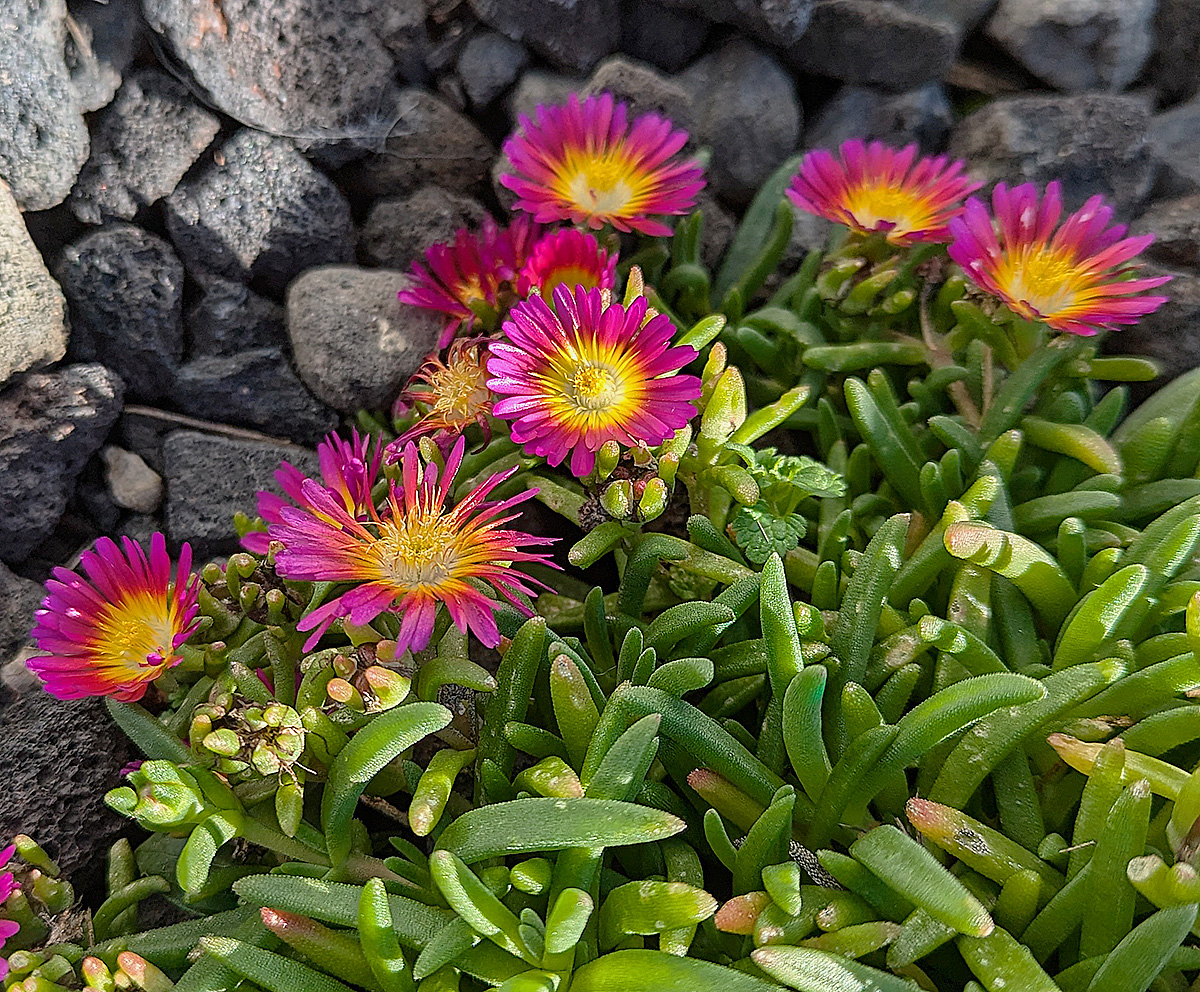
Delosperma cooperi (and hybrids)
Taxonomy
Domain: Eukaryota
Kingdom: Plantae
Subkingdom: Tracheobionta
Superdivision: Spermatophyta
Division: Magnoliophyta
Class: Magnoliopsida
Clade: Eudicots
Order: Caryophyllales
Family: Aizoaceae
Genus: Delosperma
Species/Group: Delosperma cooperi and modern garden hybrids
Common Names by Region
- United States / Canada: Ice plant, hardy ice plant, trailing ice plant, cooper’s ice plant
- South Africa (native range): Vygie (Afrikaans — the general name for the region’s many mat-forming Aizoaceae)
- General: Ice plant, hardy iceplant
Description
Quick ID
- Growth form: Low, spreading, mat-forming evergreen succulent groundcover, only a few inches tall, trailing across the ground and over rock. Forms a dense living carpet.
- Flowers: Showy, daisy-like (though not a true daisy — the “petals” are many narrow, shimmering staminodes), 1–2 inches across, in vivid magenta/fuchsia with a bright yellow-to-orange center, as here. They open in sun and close in shade and at night.
- Leaves — the key trait: Short, cylindrical to finger-like, fleshy succulent leaves storing water. Their surface carries tiny glistening bladder cells that catch light like frost or ice crystals — the source of the name “ice plant.”
- Setting: Thrives spilling over rock, gravel, and lava stone — the sharp-drained, hot, sunny niche it’s built for, exactly as pictured.
Blooming
- Late spring through summer, often into fall, in repeated flushes during warm sunny weather. A long, generous bloom season.
Look-alikes / Name Confusion
- Highway iceplant (Carpobrotus edulis): A completely different, much larger ice plant — big triangular succulent leaves and huge flowers — and a serious invasive on the U.S. West Coast. Not this plant. The small mat and short leaves here are Delosperma, the well-behaved hardy garden type.
- Lampranthus and Malephora: Other Aizoaceae “ice plants,” generally more tender and shrubbier than the ground-hugging hardy Delosperma.
- True daisies (Asteraceae): Superficially similar flower shape, but those have ordinary flat leaves — the fleshy succulent foliage instantly separates ice plant.
Known Range
- Native: South Africa and the surrounding region, in dry, rocky, sun-baked habitat.
- In cultivation: Grown worldwide as an ornamental groundcover. Delosperma cooperi and its modern hybrids are notably cold-hardy (roughly USDA zones 5–9), which is what separates them from the tender ice plants and makes them plantable in colder gardens — including Pennsylvania rock gardens, where most succulents won’t overwinter.
Care / Habitat
Light
- Full sun. Needs strong sun to flower and to stay compact; the blooms literally open to the sun.
Soil
- Sharp, fast drainage is non-negotiable. Gravelly, sandy, rocky, lean soil is ideal. Rich or heavy soil, and especially wet soil in winter, is the one thing that kills it.
Water
- Very drought-tolerant — a true xeric succulent. Water sparingly; it stores its own in those fleshy leaves. Overwatering and winter wet are the main causes of failure.
Typical Habitat (when cultivated)
- Rock gardens, gravel gardens, dry stone walls, slopes, borders, green roofs, and hot dry banks — anywhere with blazing sun and perfect drainage. A go-to for spots that are too hot and dry for anything else.
Propagation / Reproduction
- Cuttings: Extremely easy — stem pieces root readily where they touch soil, and the trailing stems often self-layer.
- Division: Established mats divide simply.
- Seed: Species types grow from seed; named hybrids are propagated vegetatively to stay true.
Pests / Diseases / Threats
- Root and stem rot from overwatering or poor drainage — by far the leading killer, and almost always a drainage problem rather than a pest.
- Aphids and mealybugs occasionally; usually minor.
- The hardy Delosperma types are not invasive in cold climates (winter wet and cold keep them in check) — unlike their West Coast Carpobrotus relative.
Additional Notes
Ecology & Use
- A standout pollinator plant in hot dry gardens — bees and other insects work the sun-open flowers heavily through the bloom season.
- A premier xeriscape and green-roof groundcover: it covers hot, dry, poor ground that defeats most plants, holds soil on slopes, needs almost no water, and blooms brilliantly while doing it.
- The “ice” in the name is optical, not thermal: the glittering bladder cells on the leaves and stems refract light so the plant looks dusted with ice crystals or frost even in full summer heat — a neat adaptation that helps reflect sun and reduce water loss.
- Its hardiness is the modern breeding story: classic ice plants were frost-tender, and the development of cold-hardy Delosperma selections opened this South African succulent up to cold-winter gardeners who could never grow it before.
Management
- Want it to thrive? Full sun, gritty fast-draining soil, and restraint with the hose. Drainage matters more than anything else.
- Want more? Take cuttings or divide — it’s one of the easiest plants to propagate you’ll grow.
All Cernunnos Foundation materials are free to use for any educational purpose.
Views: 280