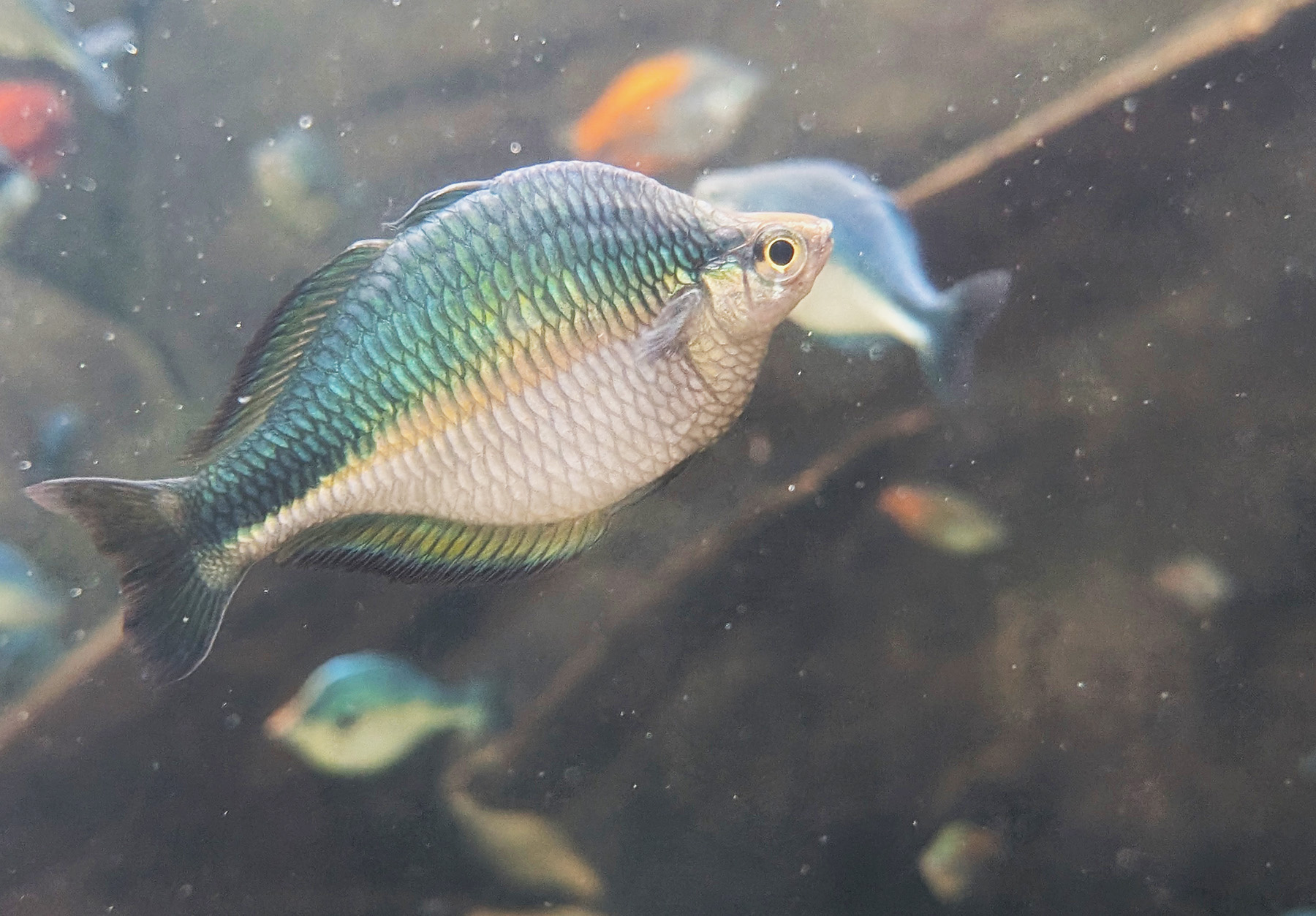
Melanotaenia lacustris
Taxonomy
- Domain: Eukaryota
- Kingdom: Animalia
- Phylum: Chordata
- Class: Actinopterygii
- Order: Atheriniformes
- Family: Melanotaeniidae
- Genus: Melanotaenia
- Species: Melanotaenia lacustris Munro, 1964
Melanotaeniidae is a family of small freshwater fishes restricted to Australia, New Guinea, and a few nearby islands. Melanotaenia is the largest genus in it.
Common Names by Region
- United States / aquarium trade: Lake Kutubu rainbowfish, turquoise rainbowfish, blue rainbowfish
- General: Turquoise rainbow
- Etymology: Melanotaenia combines the Greek melano, black, with taenia, band or ribbon — a reference to the dark lateral stripe running through the middle scale row, visible in most members of the genus. Lacustris is Latin for “of the lake,” and in this case the name is precise rather than descriptive. There is one lake.
A note on the trade names: “blue rainbowfish” and “turquoise rainbowfish” are used loosely across several species. If provenance matters, ask for the binomial.
Description
Quick ID
- Body: Deep, strongly compressed laterally, with a sharply arched back — the classic rainbowfish diamond profile. Adults are noticeably taller through the body than most of the genus.
- Color: Turquoise to green-blue over the upper half, grading down to silvery white or gold on the belly. The gradient runs top to bottom.
- Lateral line: A dark or silver band along the middle scale row.
- Fins: Two dorsal fins — a small one set forward, a long one behind. Fins carry a blue tinge with black edges, which intensifies during spawning.
- Eye: Large, a family trait.
- Size: 11–13 cm (4.5–5 in).
- Sexes: Males are larger and deeper-bodied with far more intense turquoise, and develop reddish or orange tones in the fins. Females stay slimmer and paler. Juveniles of both sexes look alike and look like neither adult.
Separating it from Boesemani rainbowfish (M. boesemani), the species most often confused with it in mixed displays: Boesemani’s color divides front to back — blue over the head and forebody, orange or gold over the rear half, with a hard break at midbody. M. lacustris divides top to bottom. Different axis, easy once you know to look for it.
Range
Lake Kutubu and the Soro River, its outlet, in the Kikori River drainage of the Southern Highlands Province, Papua New Guinea. That is the entire range.
Lake Kutubu is the second-largest lake in Papua New Guinea, sitting at roughly 800 m elevation. It is fed largely by underground springs filtering through limestone, which produces unusual water: very clear, hard, and strongly alkaline at pH 8.5–9.0. Most tropical freshwater fish come from soft acidic water. This one does not, and the difference matters in captivity.
The lake holds thirteen endemic fish species — the Kutubu tandan (Oloplotosus torobo) and the Kutubu hardyhead (Craterocephalus lacustris) among them. Together with Lake Sentani it forms a WWF Global 200 ecoregion, and the lake was designated a Ramsar Wetland of International Importance in 1998.
Habitat & Behavior
- Clear, still to slow-moving water with aquatic vegetation, submerged roots, and fallen logs. The fish congregate in the middle and upper water column rather than near the bottom.
- Schooling and highly active. These are strong, fast swimmers that cover distance continually.
- Peaceful, though the speed and size can unsettle slower or smaller tankmates.
- Rapid color change. This separates M. lacustris from most of its relatives: it shifts color in a matter of seconds and cycles through several distinct patterns over the course of a day. Dominance displays, spawning readiness, stress, and time of day all register. A photograph of this fish captures one moment of an animal that does not hold still chromatically.
Diet
- Omnivorous. In the lake, small invertebrates, insects, and plant material.
- In captivity, an algae- or spirulina-based flake or small pellet as the staple, rotated with frozen and live foods — daphnia, Artemia, mysis, bloodworms in moderation.
- Small portions once or twice daily. Overfeeding costs water quality, and in an alkaline high-pH system water quality is less forgiving than usual.
Reproduction
- Egg scatterers. Adhesive eggs are deposited among fine-leaved plants or into spawning mops, typically at first light.
- Spawning occurs over an extended period rather than in a single event — a female releases eggs over days or weeks.
- Males intensify in color and display to females during spawning, with fin edges darkening.
- No parental care. Eggs and fry are at risk from the adults.
- Fry are small and require infusoria or comparable first food before graduating to brine shrimp nauplii.
- Growth to adult coloration is slow, which is directly connected to the trade problem below.
Threats / Conservation / Notes
- Endangered (IUCN), upgraded from Vulnerable. The core problem is arithmetic: a single lake and its outlet, and no refuge anywhere else.
- The oilfield. Papua New Guinea’s first commercial oilfield, the Kutubu Oil Project, began production in 1992 at one end of the lake. The direct industrial footprint is one issue; the indirect one is larger. Employment drew population into the area, and with it came gill nets, outboard motors, overfishing, deforestation, and pollution — several pressures arriving at once on a lake that had been largely undisturbed.
- Introduced carp are an additional and ongoing pressure.
- Aquarium collection contributed to the wild decline historically, though captive breeding now supplies most of the trade.
- Conservation status of the lake itself is better than it might be. The Ramsar designation is real, and WWF and partner organizations have worked on preserving the lake in something near its natural state. The Kikori Basin is among the more biodiverse and endemic-rich freshwater systems on the planet.
Additional Notes
The Juvenile Problem
The blue fish in the photographs is not the fish in the shop tank.
M. lacustris is nearly always sold as a juvenile, and juveniles are drab — silvery, unremarkable, and giving no indication of what the adult becomes. They move as “blue rainbowfish” or “turquoise rainbowfish” on a label that describes a color the animal in the bag does not yet have.
The consequence is that most people who see this species for sale walk past it, and most people who buy it are buying on faith. It also means that a shopper comparing tanks side by side will reliably choose a more colorful and less interesting fish.
If you want the adult, buy the juvenile and wait. There is no shortcut, and the wait is measured in many months.
Ecology & Significance
- A textbook single-lake endemic. Thirteen fish species evolved in this one body of water and exist nowhere else. Lake Kutubu is doing on a small scale what Madagascar did on a large one — isolation producing lineages with nowhere to retreat to.
- The alkaline anomaly. Limestone-filtered spring water at pH 8.5–9.0 is unusual for a tropical freshwater community, and the endemic fish are adapted to it. This is also the most common husbandry failure in the species: keepers give it the soft acidic water that suits most tropical fish, and it does poorly.
- The 1955-to-1983 gap between the first collection and the second is a useful reminder of how recently, and how thinly, some of these systems have been documented at all.
In Exhibits and Aquaria
- Long tanks, not tall ones. These fish swim horizontally and continuously. A minimum of 30 gallons for a small group, 55 gallons or more for a school of adults.
- Groups of six or more. Solitary rainbowfish do poorly and color up poorly.
- Hard, alkaline, clean, well-oxygenated water with steady parameters.
- Do not mix with other Melanotaenia species where breeding is intended — the genus hybridizes readily, and hybridized stock degrades the value of captive populations as a genetic reserve.
- Compatible in a community setting with similarly sized peaceful fish: tetras, rasboras, danios, barbs, corydoras, and larger catfish.
- Source captive-bred stock. For an Endangered single-lake endemic, this is not a preference.
All Cernunnos Foundation materials are free to use for any educational purpose.
Post Views: 92