
Kingdom: Plantae
Clade: Tracheophytes
Clade: Angiosperms
Clade: Eudicots
Order: Caryophyllales
Family: Droseraceae
Genus: Drosera
Subgenus: Drosera subg. Drosera
Section: Drosera sect. Drosera
Species: Drosera intermedia Hayne, 1800
Droseraceae also holds the Venus flytrap (Dionaea) and the waterwheel plant (Aldrovanda) — three genera, three entirely different trap mechanisms, one family. The order Caryophyllales additionally contains the pitcher plants of the Old World tropics (Nepenthes), making it the order where carnivory has evolved most.
General / English: Spoonleaf sundew, oblong-leaved sundew, spatulate-leaved sundew, narrow-leaved sundew, water sundew
United Kingdom: Oblong-leaved sundew
Etymology: Drosera comes from the Greek droseros, dewy — a direct description of the glistening droplets on the leaves. Intermedia means intermediate, and what it is intermediate between has never been satisfactorily explained. Botanical references consistently note the reference as obscure. Hayne named it in 1800 and the reasoning did not survive.
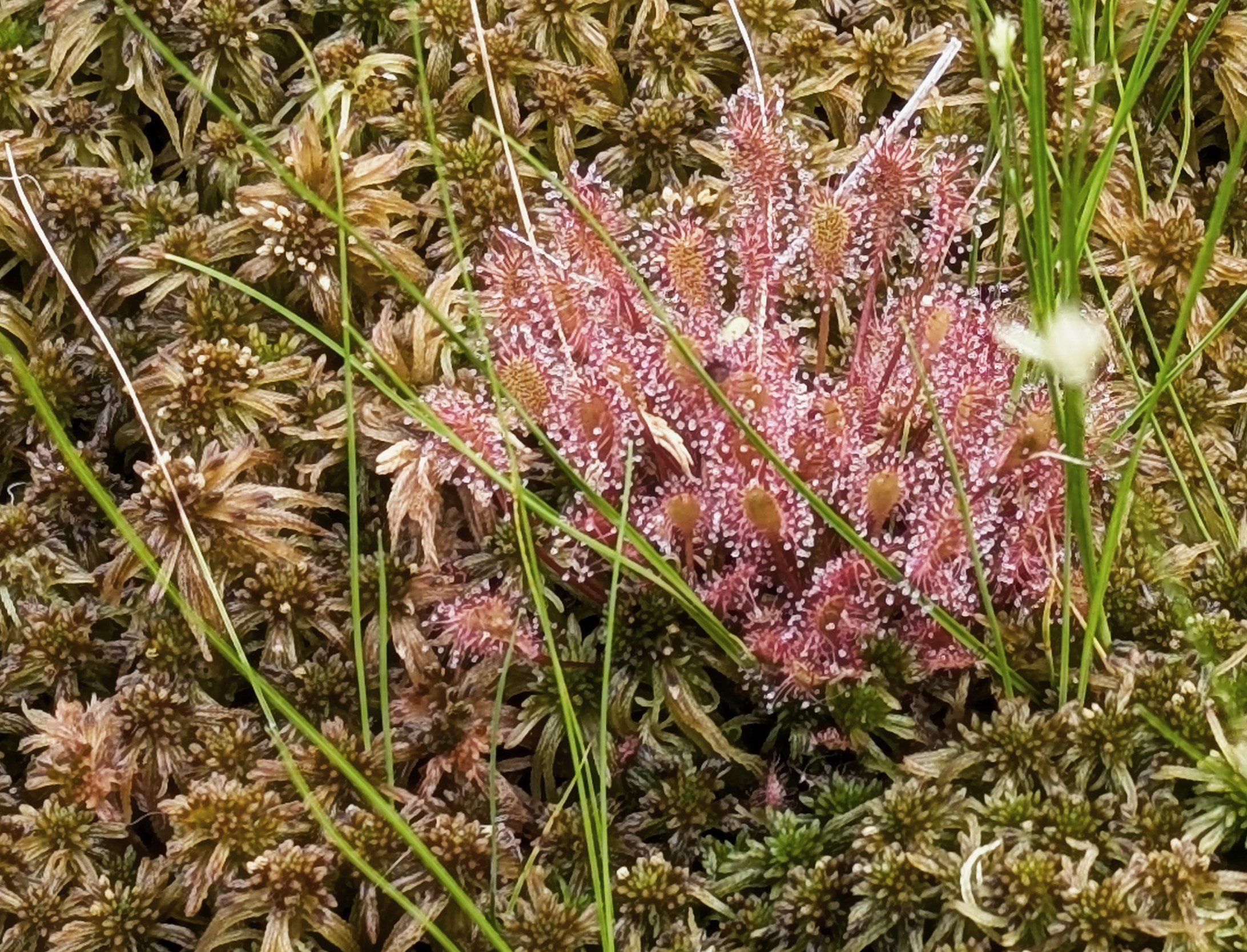
A small perennial forming a basal rosette, usually low and easily overlooked. Vigorous plants produce a short, elongated, leafy stem, lifting the rosette slightly above the moss surface — a habit that separates it from its close relatives and that is visible in this specimen.
Perennial, though reports on longevity conflict; growers describe it as short-lived even under good conditions, while wild colonies persist for years. In practice a bog population continues while individual plants turn over.
Height: 5–20 cm (2–8 in), including the flower stalk
Rosette diameter: Typically 3–6 cm
Spoon-shaped red leaves covered in glistening droplets, in sphagnum, with the flower stalk emerging from the side. Separates from roundleaf sundew (D. rotundifolia), which has circular blades held flat and a central scape, and from threadleaf sundew (D. filiformis), which has long linear leaves and pink flowers.
Field note
The droplets are the whole apparatus, and they are not dew.
Each tentacle is a stalked gland secreting mucilage — a viscous, sugary, enzyme-bearing solution. The sugar draws insects in. The viscosity holds them. A small fly landing on a leaf finds its feet stuck, struggles, and contacts more tentacles, which increases the adhesion.
Then the plant moves. Tentacles surrounding a captured insect bend inward toward it over minutes to hours, bringing more glands into contact and drawing the prey toward the center of the leaf. In many captures the leaf blade itself curls around the insect. This is slow motion — nothing snaps, and there are no trigger hairs. That is the Venus flytrap, a relative with a completely different mechanism, and the two get conflated constantly.
Digestive enzymes then break the insect down and the leaf absorbs the products directly.
Why any of this exists: sphagnum bogs are extremely nutrient-poor and acidic. Nitrogen in particular is scarce. Research on D. intermedia found the plants derive roughly half their nitrogen from captured insects. The carnivory is not a curiosity; it is how the plant makes a living in ground that cannot supply what roots normally provide.
Darwin worked on this genus extensively, publishing Insectivorous Plants in 1875 after years of experiments feeding sundews meat, glass, and various solutions to determine what triggered a response and what the plant could actually digest. It remains one of the more thorough pieces of botanical experimentation of the period.
Circumboreal through the northern hemisphere — Europe, Asia Minor, and northern North America — with an additional distribution down the Atlantic coastal plain and along the Gulf Coast, and disjunct occurrences at higher elevations in Cuba and northern South America.
In Pennsylvania, found in the eastern part of the state.
Western North American occurrences are sparse and isolated. In Idaho the species is known from only two entirely separate areas — the Selkirk Mountains in Boundary County and the Sawtooth Valley in Custer County — a pattern typical of a bog specialist stranded in refugia.
Classified as an obligate wetland species (OBL) — it does not occur outside continually wet ground.
On the sphagnum: the moss is not incidental. Sphagnum actively acidifies its surroundings, holds enormous quantities of water, and locks up nutrients as peat. It builds and maintains the conditions the sundew is adapted to. The two in this photograph are not simply neighbors — the moss is manufacturing the habitat.
Common associates include roundleaf sundew, cotton grass, cranberry, pitcher plants, and various bog sedges.
Suitable for bog gardens, troughs, and containers.
Never collect from the wild. Bog populations are fragile, slow to recover, and legally protected in many jurisdictions. Nursery-propagated plants are widely available and inexpensive.
Peat bogs are also carbon stores of considerable size, and their destruction has consequences well beyond the plants living on them.
This site is open for educational use. Teachers and students are welcome to adapt, translate, and reuse this material with attribution.