
Taxonomy
Kingdom: Plantae
Clade: Tracheophytes
Clade: Angiosperms
Clade: Eudicots
Clade: Rosids
Order: Rosales
Family: Rosaceae
Subfamily: Rosoideae
Genus: Rosa
Species: Rosa carolina
Binomial Name: Rosa carolina L. (1753)
Common Names by Region
Pasture Rose (English, general)
Carolina Rose (English, general)
Low Rose (English, regional)
Prairie Rose (English, midwestern usage — note that this name is also applied to Rosa arkansana and Rosa setigera, and is unreliable)
Rosier de Caroline (French, Canada)
Habit
A low, suckering, colony-forming shrub, generally 1 to 3 feet tall and rarely exceeding waist height. It spreads by underground rhizomes rather than by arching canes, so a stand tends to appear as a loose scattered patch running through grass rather than as a dense thicket. Canes are slender, green to reddish, and do not climb.
Armature
Straight, slender, needle-like prickles, paired at the nodes and often scattered along the internodes as well. This is the most reliable field character in the genus for this species — the prickles are essentially straight, not hooked. The distinction carries the identification.
Leaves
Alternate and pinnately compound, usually with 5 to 7 leaflets (occasionally 3 or 9). Leaflets are elliptic to oblong, sharply and simply serrate, dull to slightly shiny above, paler beneath. Stipules are narrow and flat with spreading tips, not rolled inward — another separator from the swamp rose. Fall color runs to dull yellow and red.
Flower
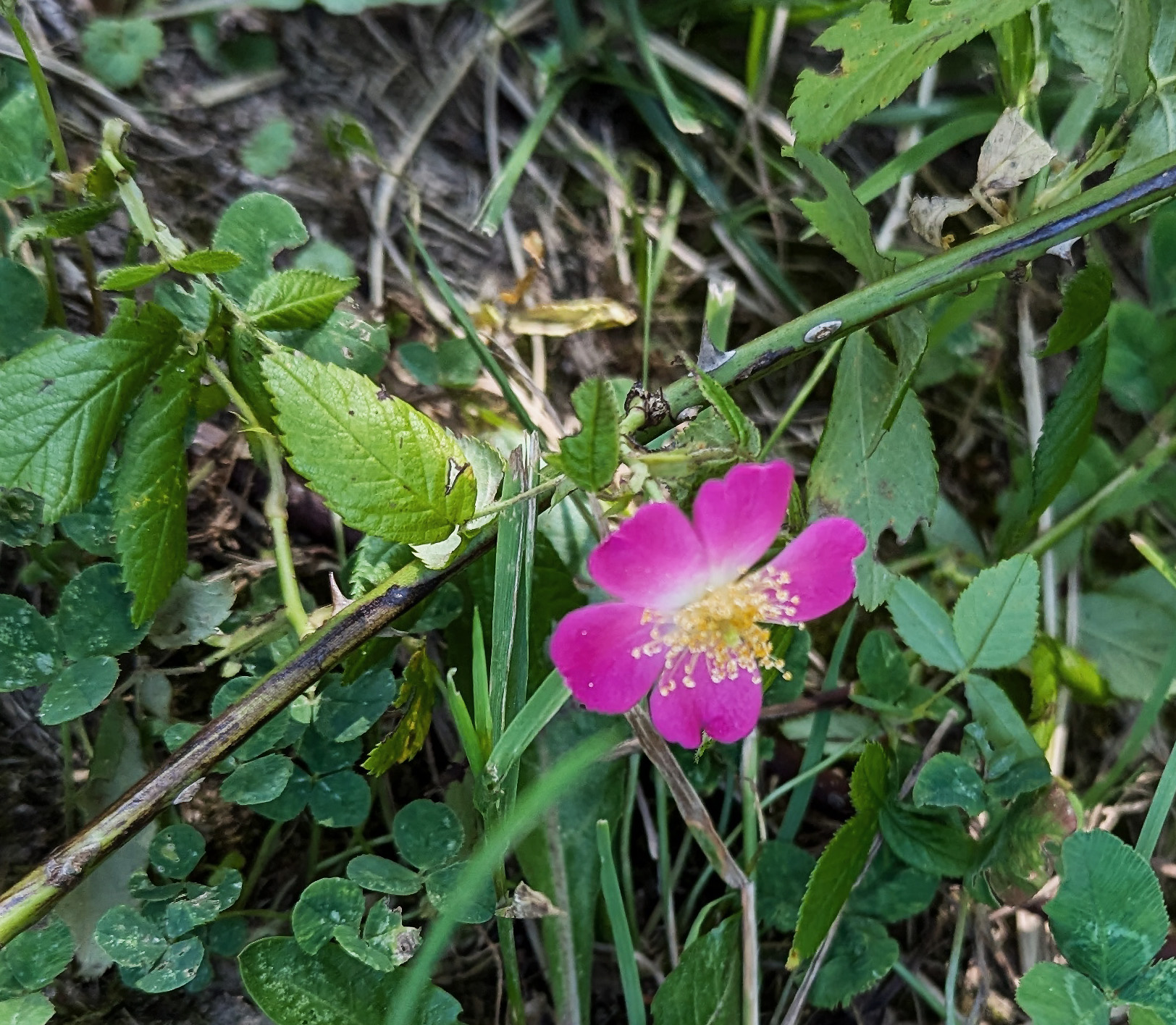
Solitary at the ends of short lateral shoots — occasionally two or three, but the single flower is characteristic. Five broad pink petals, notched at the tip, ranging from pale to deep rose, around 2 to 2.5 inches across. The center is a dense boss of numerous yellow stamens. Sepals are long, narrow, and tipped, with glandular hairs, and reflex after opening, then drop from the maturing hip. Lightly fragrant. Flowering runs from late May through July, peaking in June, with occasional scattered later bloom.
Fruit (Hip)
A small round to slightly flattened red hip, roughly a third of an inch across, covered in fine glandular bristles that give it a faintly sticky feel. Hips ripen in late summer and persist through fall and into winter, holding color on bare canes long after leaf drop.
Quick ID
Low shrub, generally under 3 feet, spreading by suckers through open grassy ground
Solitary pink five-petaled flower with a yellow center — not clustered, not white
Straight needle-like prickles, paired at the nodes — the key separator
Narrow flat stipules with spreading tips, not inrolled
Small glandular-bristly red hips persisting into winter
Dry, open, often poor or rocky ground — not wetland
Distinguishing from Similar Roses
Multiflora rose (Rosa multiflora) — the abundant invasive across Pennsylvania. White flowers in large branched clusters, arching canes to 10 feet or more, and fringed comb-like stipules. Not confusable once seen.
Swamp rose (Rosa palustris) — pink and similar in flower, but taller, found in saturated ground, with stout curved prickles and stipules rolled inward into a near-tube.
Virginia rose (Rosa virginiana) — pink, but with glossy leaflets, curved prickles, and strong red fall color; generally taller and more robust.
Prairie rose (Rosa arkansana) — western, densely bristly canes, flowers usually in clusters.
Known Range
Eastern and central North America, from Nova Scotia and Ontario south to Florida and Texas, west to Nebraska and Kansas. Common and secure throughout Pennsylvania and the Appalachians. Frequent along road banks, field edges, and old pasture across the region.
Habitat
Dry to mesic open ground: pastures, old fields, roadsides, railroad embankments, rocky banks, open woods, savanna, barrens, and thin poor soil generally. It tolerates drought, poor fertility, and rocky substrate well and is often found where more demanding plants fail. Full sun to partial shade, though flowering falls off sharply in shade. Not a wetland species — standing water rules it out and points toward swamp rose instead.
Life Cycle / Reproduction
A long-lived perennial shrub reproducing both sexually and vegetatively. Flowers are insect-pollinated, offering pollen rather than nectar; hips develop through late summer and are dispersed by birds and mammals that eat the fruit and pass the achenes. Seed requires cold stratification and often takes two winters to break dormancy.
The more important reproductive mode in practice is rhizomatous spread. A single plant will send out underground runners and establish a clonal patch over years, which is why pasture rose so often occurs as a scattered low colony rather than a specimen shrub. Flowering occurs on new wood, and the species tolerates being mowed, browsed, or burned back — it resprouts readily from the rhizome.
Ecological Role / Wildlife Value
Pollen source for native bees, especially bumblebees and solitary bees that work the open stamen boss; also visited by syrphid flies and beetles. Host plant for a substantial suite of Lepidoptera — native Rosa supports well over a hundred species of butterflies and moths in eastern North America, including several hairstreaks and a range of leaf-mining and leaf-rolling moths.
Hips are eaten by grouse, wild turkey, cedar waxwings, mockingbirds, thrushes, foxes, skunks, and small mammals, and are one of the fruits that persist into hard winter when little else is available. The low thorny colony structure gives nesting and escape cover for songbirds, rabbits, and small mammals, and the rhizome mat holds soil on cut banks and erodible slopes.
Human Uses
Hips are edible and high in vitamin C, usable for tea, syrup, and jelly, with the irritating internal hairs strained out. Petals are edible and have been used for flavoring and in preserves. The species has a long history in horticulture as a tough low native rose and appears in the ancestry of some garden cultivars. No serious toxicity concerns.
Threats / Conservation
Globally secure and locally common. Pressures are habitat-level rather than species-specific: loss of open field and savanna habitat to development and to woody succession, mowing regimes that eliminate flowering, herbicide use along roadsides and rights-of-way, and displacement by aggressive invasives — multiflora rose above all, which occupies the same edge habitat and outcompetes the natives that belong there. Rose rosette disease, spread by eriophyid mites and now widespread through multiflora populations, also affects native roses.
Supporting This Species
Pasture rose is an argument for restraint on marginal ground. It thrives on the poor, dry, rocky soil that frustrates most planting — road banks, thin slopes, the strip of ground nobody wants to deal with. Plant it there and leave it alone. No irrigation, no fertility amendment, no supplemental anything; enriched soil actually works against it.
Give it full sun. Let it sucker — a colony is the natural form of the plant, and confining it to a single crown defeats the purpose. Mow around a stand rather than through it, or if a patch is in a mowed area, cut it after hips have dropped rather than in June.
For anyone dealing with multiflora rose, pasture rose is the direct replacement. Same tough edge habitat, same wildlife function, a fraction of the aggression, and it belongs here. Removing multiflora and putting nothing back simply leaves the ground open for the next invasive; putting a native rose in its place closes the gap.
Additional Notes
Linnaeus described Rosa carolina in Species Plantarum in 1753, making it one of the earliest formally named North American roses.
The genus Rosa is notoriously difficult at the species level. Native roses hybridize freely, vary considerably across their range, and were historically split into a large number of segregate species and varieties that have since been consolidated. Field identification relies on a small set of stable characters — prickle shape, stipule form, flower arrangement, habit, and habitat — rather than on flower color or size, both of which vary widely within a single population.
The common name is honest about where the plant is found. This is the rose of the fence line, the grazed field, the cut bank, and the old pasture going back to brush — a species that occupies ground people have already used and moved on from.
Field Notes (CF Observation)
Photographed in bloom on a dry mossy bank, a single deep-pink flower held low among grass, clover, and mixed field growth with old canes running through the tangle. The plant was not standing above the surrounding vegetation; it was threaded into it, which is the usual way this species presents itself and the reason it goes unnoticed until it flowers.
Identification rests on the solitary flower, the five broad notched pink petals with a dense yellow stamen center, the compound serrate leaflets, the low sprawling non-climbing habit, and the straight slender prickles on the canes. The dry rocky substrate rules out swamp rose. The solitary pink flower rules out multiflora, which would be white and heavily clustered.
Worth noting for anyone scanning the frame: the surrounding ground cover is dense — clover, grasses, plantain, and assorted volunteers. The rose occupies perhaps a tenth of the visible area. This is what a native rose looks like in the field, as one participant among many, rather than as a planted specimen.