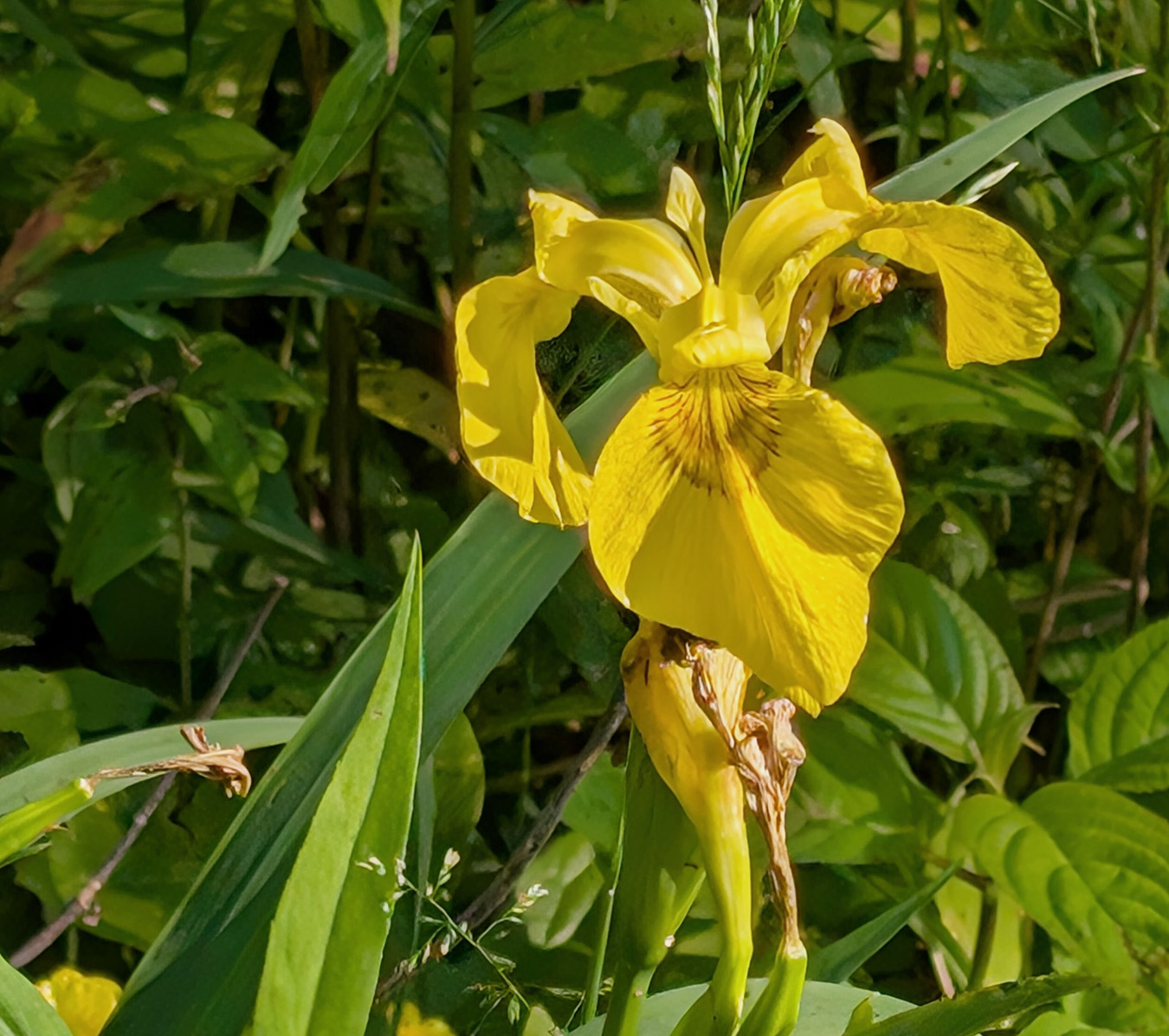
Iris pseudacorus
Taxonomy
Domain: Eukaryota
Kingdom: Plantae
Subkingdom: Tracheobionta
Superdivision: Spermatophyta
Division: Magnoliophyta
Class: Liliopsida (monocots)
Clade: Monocots
Order: Asparagales
Family: Iridaceae
Genus: Iris
Species: Iris pseudacorus
Common Names by Region
- United States / Canada: Yellow flag, yellow flag iris, yellow iris, water flag
- United Kingdom / Ireland: Yellow flag, yellow iris, water flag, “segg,” “Jacob’s sword”
- Continental Europe (native range): Local-language equivalents — e.g., German Sumpf-Schwertlilie (“swamp sword-lily”)
- General: Yellow flag
Description
Quick ID
- Growth form: Robust, clump-forming waterside perennial, 2–4 feet tall, growing from thick spreading rhizomes at the water’s edge.
- Flowers: Bright yellow, classic iris form — three drooping falls (the down-curved outer petals) marked with faint brownish-purple veining near the throat, and three smaller upright standards. Several blooms open in succession per stalk.
- The regional giveaway: It is the only tall yellow-flowered iris growing wild in wet ground across most of North America. A yellow iris in a marsh or ditch is pseudacorus almost by default — the native wild irises here are blue-purple.
- Leaves: Long, erect, flattened, sword-shaped, blue-green, rising in fans from the base — often as tall as the flower stalk.
- Seed: Large three-parted capsules holding rows of corky seeds that float.
Blooming
- Late spring into summer (May–July). This photo catches it in bloom with a fresh flower up top and spent blooms drying below.
Look-alikes
- Northern blue flag (Iris versicolor) and southern blue flag (I. virginica): The native wild irises of the same wet habitat — same overall form and setting, but blue-violet, not yellow. Where you see the two, blue is native and yellow is the introduction. (Blue flag is profiled elsewhere in this guide as the native companion.)
- Sweet flag (Acorus calamus): Shares the wet ground and sword-like leaves and the old name “flag,” but is not an iris and bears no showy flower — hence pseud-acorus, “false acorus,” the species name noting the resemblance of its leaves to sweet flag.
Known Range
- Native: Europe, western Asia, and North Africa — where it is a cherished and ecologically well-behaved wild iris of riverbanks, marshes, wet meadows, and pond margins.
- Introduced: Widely planted worldwide as an ornamental water-garden and pond-edge plant, and naturalized well beyond its home range, including across North America. In Pennsylvania it turns up on stream banks, ditches, pond margins, and wet ground, including the moist corridors around Johnstown.
Care / Habitat
Light
- Full sun to part shade. Flowers best in sun; tolerates partial shade.
Soil / Water
- A true wetland and marginal-aquatic plant. Thrives in permanently wet soil, shallow standing water, and pond and stream edges. Remarkably tolerant — it handles flooding, drought once established, a wide pH range, and even brackish and pollution-stressed water, part of why it’s so vigorous.
Typical Habitat
- Water’s edge: riverbanks, marshes, wet meadows, ponds, ditches, and swampy ground. Wherever land meets slow or standing fresh water.
Propagation / Reproduction
- Rhizomes (primary): Spreads by thick branching rhizomes into dense clonal colonies — the main way it expands along a shoreline.
- Seed: Floating, corky seeds are carried by water to new ground downstream, which is how it jumps between wetlands.
- Both routes are vigorous; a single planting at a pond edge readily becomes a stand.
Pests / Diseases / Threats
- Tough and largely trouble-free.
- Mildly toxic: the rhizome and sap contain irritant compounds; the sap can irritate skin, and the plant is unpalatable and slightly poisonous to livestock — one reason it goes ungrazed and spreads.
- Where introduced, its vigor is the concern: outside its native range it can form dense monocultures along shorelines that crowd out native wetland plants and alter the water’s edge (see notes).
Additional Notes
Ecology & Significance — A Right Plant in the Wrong Place
- Yellow flag is worth understanding as a plant that is exactly right where it belongs, and a gorgeous nuisance where it doesn’t. In its native European and North African wetlands it is a valued, well-mannered member of the community — a nectar plant for long-tongued bees and hoverflies, cover for waterfowl and invertebrates, and one of the most beloved wild flowers of the riverbank, woven through European art, heraldry, and folklore for centuries.
- It is widely cited as a leading candidate for the original fleur-de-lis — the stylized iris of French royalty and heraldry traces plausibly to this very flower on the banks of European rivers.
- It even has a practical use in its own right: yellow flag is effective at absorbing nutrients and heavy metals from water, and is used deliberately in constructed wetlands and water-treatment plantings — a genuine ecological service.
- The trouble is purely one of place. Carried outside its native range as a garden ornamental, the same vigor that makes it a robust, self-sufficient wild iris at home lets it dominate a shoreline abroad, where the native plants and the insects and animals that co-evolved with them aren’t equipped to share space with it. Nothing about the plant changed; only the address did. It’s a clean lesson in how “invasive” describes a relationship between a plant and a place, not a flaw in the plant.
Management
- In its native range: enjoy it — a signature wildflower of the water’s edge.
- Where introduced: admire it in the wild, but don’t plant it near natural water. To hold an existing stand, remove rhizomes (wearing gloves for the irritant sap) and cut seed capsules before they float away. For a yellow-flowering iris in a North American water garden, the native blue flags — or native yellow-flowered wetland plants — fill the same role without the risk.
All Cernunnos Foundation materials are free to use for any educational purpose.
Views: 242