
Taxonomy
Kingdom: Animalia
Phylum: Arthropoda
Class: Insecta
Order: Lepidoptera
Family: Lycaenidae
Subfamily: Miletinae
Tribe: Spalgini
Genus: Feniseca
Species: Feniseca tarquinius
Binomial Name: Feniseca tarquinius (Fabricius, 1793)
Common Names by Region
Harvester (English, general)
Harvester Butterfly (English, expanded)
Wanderer (English, older literature — now largely disused)
Le moissonneur (French, Canada)
Adult / Upperside
Small and compact, with a wingspan of roughly 1 to 1.4 inches (25–35 mm). The upper surface is deep orange, blotched with heavy dark brown-black patches and bordered in the same brown, giving a two-tone effect that reads as tortoiseshell at a distance. Males and females are similar, with females averaging slightly larger and somewhat more extensively dark.
Underside / Camouflage
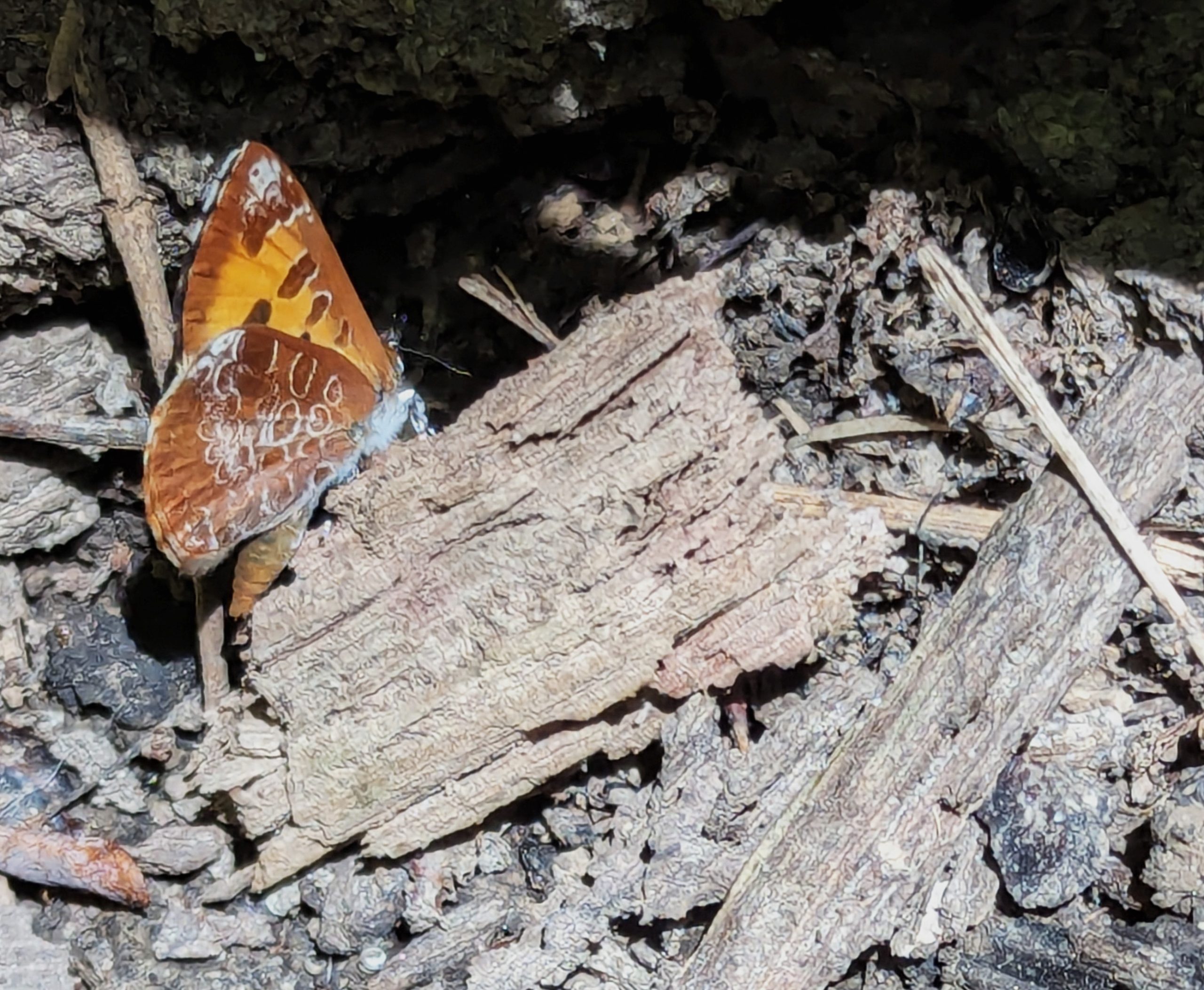
The underside is where the species announces itself. Orange to rust-brown ground color, overlaid across the entire hindwing with a dense field of small white-outlined circles, rings, and irregular closed loops — a pattern frequently described as fingerprint-like or map-like. No other butterfly in eastern North America carries this. Against damp bark, wood chips, and leaf litter the effect is a fine-grained disruptive camouflage rather than a leaf mimic. The antennae are banded black and white; the wing margins and fringe carry a pale frosted edge.
Caterpillar (Larva)
Slug-like, flattened, and small — under about 2 cm at maturity — gray to greenish-brown with pale bumps, brown lateral lines, and tufts of gray hairs sprouting from yellowish tubercles. And it is a predator. The larva pierces woolly aphids with its mouthparts and drains the body fluids, then frequently silks the drained husks and waxy fluff of its prey onto its own back, wearing the colony as a disguise. The camouflage is aimed at least as much at the ants that farm and guard the aphids as it is at birds.
Egg & Chrysalis
Eggs are flat gray-green discs, laid singly on or beside an active woolly aphid colony rather than on any host plant. The chrysalis is small and brown, and is routinely described in the literature as looking like a monkey’s face — a small vertebrate skull rendered in miniature. This is the overwintering stage.
Quick ID
Small orange-and-brown butterfly; underside covered in white-ringed circles and closed loops — the diagnostic mark, unlike anything else in its range
Dark forewing blotches sit as separate patches, not a connected band
Black-and-white banded antennae
Found on damp ground, mud, sap runs, dung, and carrion — almost never on flowers
Flight is fast, low, and erratic, often compared to a ricocheting bullet; perches head-down and holds still once settled
Known Range
Eastern North America, from the Canadian Maritimes and southern Ontario west to Manitoba and Minnesota, south to central Texas and central Florida. Rated globally secure, but local and patchy in practice — populations rise and fall with the aphid colonies that support them, and the species can be genuinely scarce toward the edges of its range.
Habitat
Wet deciduous and mixed woodland, especially along streams, seeps, swamp margins, and alder thickets. The butterfly tracks its prey, not a nectar source, so it is found wherever woolly aphids congregate on alder, beech, witch hazel, and ash. Adults favor damp shaded ground, mudholes, sap flows, and rotting material, and are frequently overlooked because they do not appear where people watch for butterflies.
Life Cycle / Reproduction
Two to four broods a year depending on latitude, with adults on the wing from roughly mid-May into October in the north. The larval stage is remarkably compressed — about ten to twelve days from hatch to pupation, among the shortest of any North American butterfly, an adaptation to a food supply that is dense, defended, and short-lived. The species overwinters as a chrysalis. Adults are not strong dispersers and tend to stay near the colonies that produced them.
Diet / Host Plants
This is the only butterfly in North America with a carnivorous caterpillar. The larval “host plants” are not plants at all: woolly aphids in the genera Prociphilus, Neoprociphilus, Pemphigus, and Schizoneura, and occasionally scale insects or treehoppers. Those aphids feed on alder, witch hazel, ash, beech, hawthorn, and wild currant — the trees matter only as the address of the prey.
Adults are equally unusual. The Harvester’s proboscis is proportionally the shortest of any North American butterfly, too short to work a flower. It feeds instead on aphid honeydew, tree sap, carrion fluids, dung, and minerals drawn from wet soil. A Harvester will spend its entire life cycle without touching a blossom.
Predators / Threats
Birds, spiders, predatory insects, and parasitic wasps and flies take adults, larvae, and eggs. The larva’s defense is borrowed rather than manufactured — the waxy aphid debris it wears is unpalatable and, more importantly, chemically masks it from the ants tending the colony. No formal conservation concern, though the species is doubly vulnerable in practice: it needs both the host trees and the aphid populations on them, and broad-spectrum insecticide use aimed at aphids removes the entire basis of its existence.
Supporting This Species
Leave the woolly aphids alone. That is nearly the whole of it. Alder along a wet edge, a witch hazel, a beech or an ash, and a tolerance for the white fuzzy colonies that show up on their branches — that combination is what a Harvester requires. Skip the systemic and broad-spectrum insecticides entirely; treating an aphid colony as a pest problem eliminates the only food this butterfly’s larvae can eat. A damp seep or mud patch and an untidy woodland edge with logs and litter will hold adults. This is a species best supported by restraint.
Additional Notes
The genus name Feniseca derives from the Latin for mower or haymaker; the epithet tarquinius recalls Tarquin the Proud, the last Roman king, expelled for cruelty. The full name amounts to something like “the cruel reaper,” and for once the taxonomy is not exaggerating.
The Harvester is the sole North American representative of the Miletinae, a mostly Old World tropical subfamily of gossamer-winged butterflies built around aphid predation and, in some lineages, outright parasitism of ant nests. Its presence here is a fragment of a tropical strategy stranded in temperate woodland.
Its rarity is partly an artifact of how people look for butterflies. Search flowers and you will never find one. Harvesters turn up unexpectedly, one or two at a time, on mud and rotting wood — which is precisely where this individual was found.
Field Notes (CF Observation)
Photographed June 11, 2024, settled wings-up on damp shredded bark and woody litter at the shaded base of a bank — dark, wet, decaying ground with no flowers anywhere in the frame. Fitting habitat for a butterfly that has no use for them.
A note on the image: this photograph has been deliberately desaturated to bring out structure. The white-ringed loops and circles on the underside of the hindwing carry the identification, and pulling the color back makes that pattern legible against the surrounding wood. In life this insect is considerably brighter — the forewing orange runs hot, closer to marmalade than the muted rust shown here. Consider the published image a diagnostic plate rather than a portrait.
Identification confirmed by the ringed and looped underside pattern, the separate dark forewing blotches, the banded antennae, the small size, and the substrate. Nothing else in eastern North America is marked this way.