
Taxonomy
Kingdom: Animalia
Phylum: Arthropoda
Class: Insecta
Order: Lepidoptera
Family: Nymphalidae
Subfamily: Nymphalinae
Genus: Polygonia
Species: Polygonia interrogationis
Binomial Name: Polygonia interrogationis (Fabricius, 1798)
Common Names by Region
Question Mark (English, general)
Violet-tip (English, older regional name — for the violet wing edging)
Anglewing (English, group name shared across Polygonia)
Le point d’interrogation / Polygone point-d’interrogation (French, Canada)
Adult / Upperside
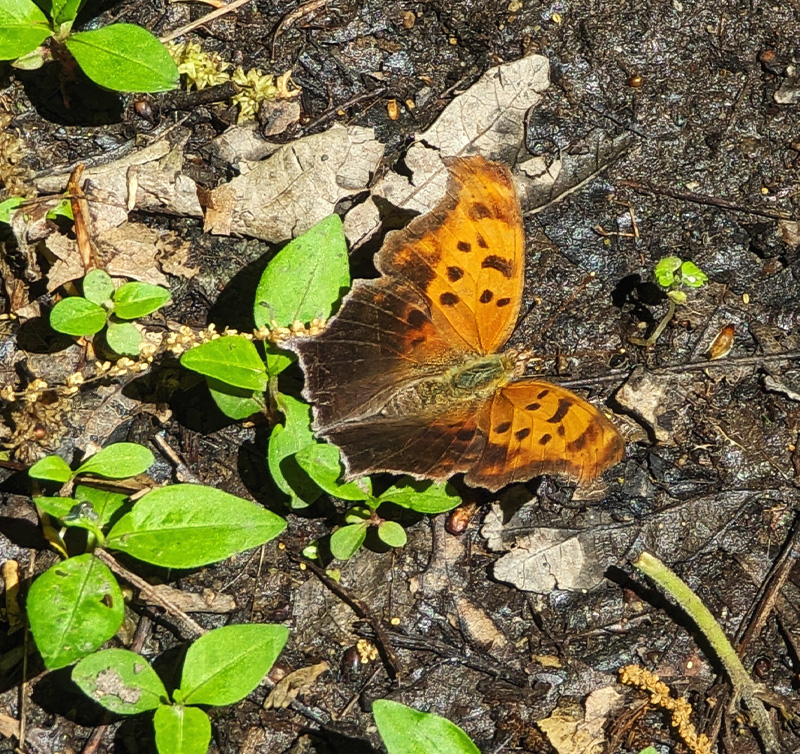
Orange-russet wings marked with black spots, the forewing drawn out to a hooked, sickle-like tip. A small extra dark bar high on the forewing separates it from the closely related eastern comma. The species runs in two seasonal forms: the fall (“winter”) form shows more orange on the hindwing and a longer, violet-tipped tail, while the summer form has a darker, nearly black hindwing and a shorter tail. This is the largest of the North American anglewings, with a wingspan of 2.25–3 inches (5.7–7.6 cm).
Underside / Camouflage
The underside is mottled light brown, barred and streaked to read as a dead leaf. With the wings closed and the ragged margins drawn in, a resting adult disappears against bark and leaf litter. The center of the hindwing carries the silvery mark that names the species — a curved comma alongside a separate round dot, together forming a “?”.
Caterpillar (Larva)
Spiny, armed with branching dorsal spines, the color ranging from reddish-orange through black, often broken by pale lines. Full-grown larvae reach about 1.4 inches and feed alone on the host plant.
Egg & Chrysalis
Eggs are green and vertically ribbed, laid singly or stacked in short columns — often on plants near the host rather than on it, so the hatchling has to find its own food. The chrysalis is tan to brown, angular, and hangs disguised as a curled dead leaf.
Quick ID
Hooked, ragged-edged orange wings with black spots — a dead-leaf shape in flight and at rest
Silvery “?” (a comma plus a dot) on the brown underside of the hindwing — the diagnostic mark
Extra small dark bar high on the forewing, absent in the similar eastern comma
Fall form: more orange hindwing and a longer violet-tipped tail; summer form: darker hindwing, short tail
Largest anglewing in its range; fast, erratic flight; often basking on damp ground, bark, or fruit
Known Range
Eastern North America, from southern Canada south through the eastern and central United States into Mexico, reaching west to about the Rocky Mountains. Common and secure across that range, and most abundant in wooded country, woodland edges, and suburbs, usually near moisture.
Habitat
Open woods, forest edges, wooded streams and trails, city parks, gardens, and suburban yards — wherever trees and damp ground meet. Adults favor sunlit clearings and bask on bare soil, trunks, and logs. The dead-leaf underside lets resting adults melt into bark and litter.
Life Cycle / Reproduction
Two broods a year across most of the range. Overwintered adults emerge and breed in spring; their offspring become the dark summer form (“umbrosa,” roughly late June through August), and that generation in turn produces the more orange fall form (“fabricii,” late August through October). Fall adults either migrate south or overwinter in place, tucked into tree cavities, under loose bark, or in woodpiles, then resume in spring. Males hold afternoon territories from a perch, darting out to investigate passing insects — and sometimes birds — before returning to the same spot.
Diet / Host Plants
Adults visit flowers only occasionally. They feed on tree sap, rotting fruit, dung, carrion, and minerals drawn from wet ground (mud-puddling). Larval host plants run mostly to the elm and nettle groups: American and slippery (red) elm, hackberry, true nettles, false nettle, and hops, including Japanese hop.
Predators / Threats
Birds, spiders, predatory insects, and small mammals take both adults and larvae, while parasitic wasps and flies attack the eggs and caterpillars. Camouflage is the main defense — the dead-leaf underside and broken outline. As a common, adaptable butterfly it carries no conservation concern, though it shares the broad pressures of habitat loss and pesticide use that weigh on insects generally.
Supporting This Species
Leave a few host plants standing — elm and hackberry seedlings, a patch of nettle or false nettle in a damp corner, or a hop vine. Skip the broad-spectrum insecticides. A shallow mud or damp-sand puddling spot, a dish of overripe fruit, and an untidy edge with logs and leaf litter will draw adults in and give them somewhere to overwinter. This is a butterfly that rewards a little planned wildness.
Additional Notes
The genus name Polygonia comes from the Greek for “many angles,” describing the jagged wing outline shared across the anglewings; the epithet interrogationis points straight at the silver “?” on the hindwing. The eastern comma (Polygonia comma) is the closest look-alike — its underside mark is a plain comma with no dot, and it lacks the question mark’s extra forewing bar. The two seasonal forms long caused taxonomic confusion, since the dark summer adults and orange fall adults read as different insects. Its dead-leaf disguise makes it one of the clearest demonstrations of cryptic camouflage among backyard insects.
Field Notes (CF Observation)
Photographed locally in the Terre Haute, Indiana area, basking wings-open on damp dark ground scattered with old leaves and low green seedlings. The fall form’s orange hindwings and violet-edged margins caught the dappled light, and the hooked, ragged forewings read as a curled leaf until the wings opened flat. The wet bare soil is a classic puddling site, where the butterfly draws up minerals. Identification confirmed by the hooked forewing with its extra dark bar, the orange violet-tipped hindwing of the fall form, and the size — the largest anglewing it could be.
All images and written content published on this site are provided freely for educational and artistic use. Attribution appreciated but not required. Knowledge grows when shared.