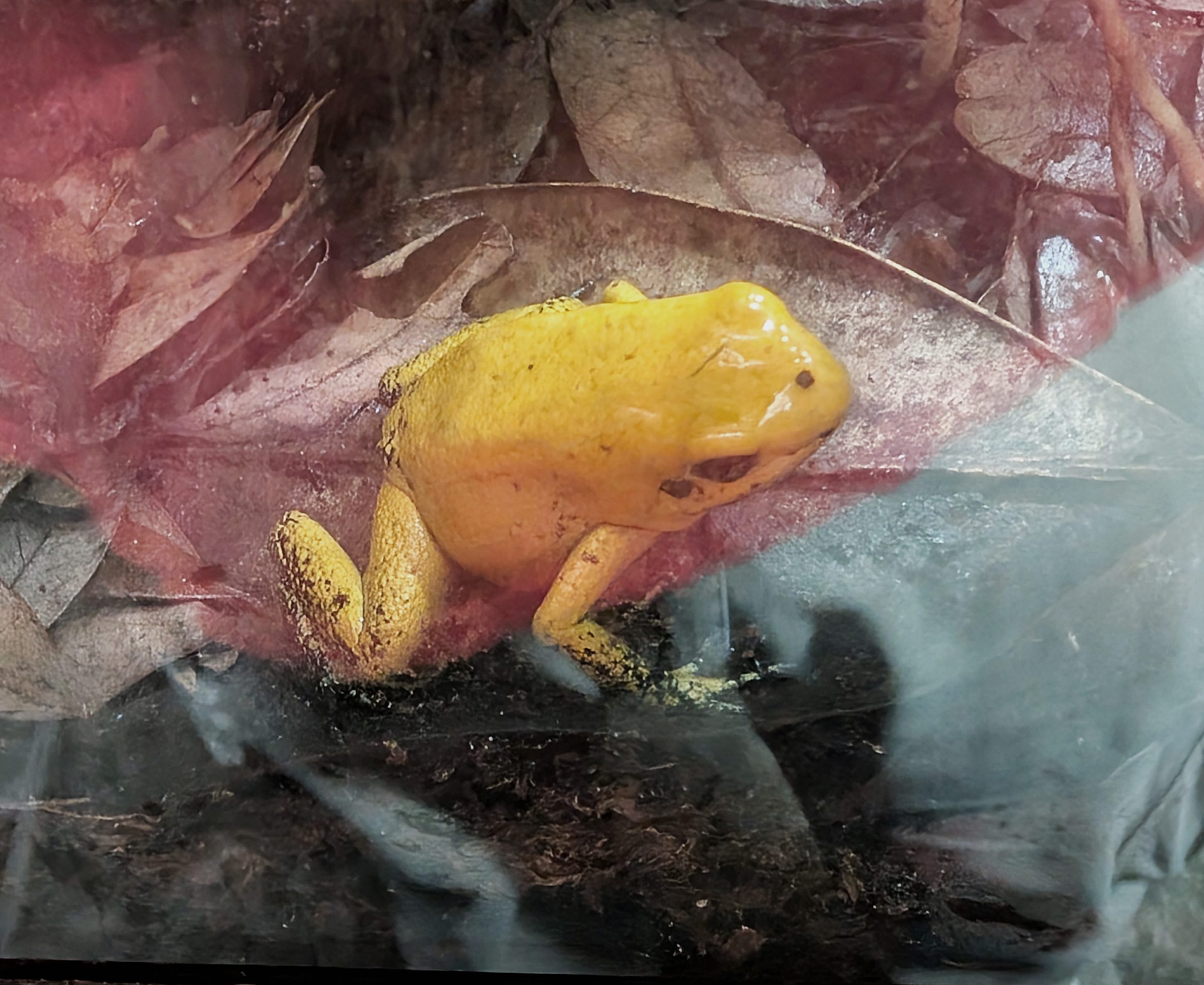
Phyllobates terribilis
Taxonomy
- Domain: Eukaryota
- Kingdom: Animalia
- Phylum: Chordata
- Class: Amphibia
- Order: Anura
- Family: Dendrobatidae
- Subfamily: Dendrobatinae
- Genus: Phyllobates
- Species: Phyllobates terribilis
Common Names by Region
- United States / exhibit & hobby trade: Golden poison frog, golden poison dart frog, golden poison arrow frog, terribilis
- Colombia (native range): Rana dorada (“golden frog”); known and used by the Emberá people
- General: Golden dart frog
Description
Quick ID
- Color: Uniform, brilliant golden-yellow (some populations orange or pale mint-green), with no pattern — a solid, unbroken warning color. That aposematic (warning) coloration is the point: it advertises toxicity to predators.
- Skin: Smooth and slightly glossy, not warty.
- Size: Large for a dart frog — up to about 2 inches, among the biggest of the poison frogs and noticeably chunkier than the small Dendrobates species.
- Build: Rounded snout, sturdy body, unwebbed toes with expanded tips for climbing. Females run slightly larger than males.
- Behavior: Diurnal and bold — it doesn’t hide the way cryptic frogs do, because its color and toxicity mean it doesn’t have to.
Range
- Native to a very small range on the Pacific coast of Colombia, in lowland rainforest of the Chocó region — one of the wettest places on Earth. Its wild distribution is genuinely tiny, which is part of why it’s threatened.
Habitat & Behavior
- A frog of the humid rainforest floor, living among leaf litter in warm, extremely wet lowland forest.
- Diurnal, terrestrial, and social compared with many frogs — active by day, moving openly across the litter.
- Highly territorial; males call to defend space and attract mates, and both sexes can be aggressive toward their own kind.
- Devoted parental care, as in many dart frogs (see reproduction) — a striking trait for an amphibian.
Diet
- Insectivorous, taking tiny prey: ants, termites, mites, springtails, small beetles, and other leaf-litter invertebrates.
- This diet is the source of the poison. The frog doesn’t manufacture its toxin — it sequesters batrachotoxin from specific wild prey (chiefly certain ants and beetles). Remove that diet and the frog cannot make the poison at all (see notes).
Reproduction
- Males call and defend territory; after courtship the female lays a small clutch of eggs in a moist, sheltered spot on the forest floor.
- A parent (in Phyllobates, typically the male) guards the eggs, keeps them moist, and — once they hatch — carries the tadpoles on its back to water, depositing them in small pools to develop.
- Attentive parental investment across the whole cycle is a hallmark of the family.
Threats / Conservation / Notes
- Classified as Endangered. The main pressures are deforestation and habitat loss across its already tiny Chocó range, plus historical over-collection.
- Captive-breeding programs in zoos and among dedicated keepers help maintain the species outside the wild and reduce collection pressure.
- Toxicity — handle the facts carefully:
- The wild golden poison frog is regarded as the most poisonous vertebrate known. A single wild animal carries enough batrachotoxin — a potent nerve poison — to be lethal, and the toxin acts by locking open the body’s sodium channels. It is not something to ever handle in the wild.
- The Emberá people historically used the frog’s secretions to poison blowgun darts — the origin of the “poison dart frog” name — and terribilis is one of the very few species actually used that way.
- Captive-bred frogs raised on a controlled diet of crickets, fruit flies, and springtails are effectively non-toxic, because they never acquire the dietary precursors for the poison. This is why they can be kept and displayed safely, and it’s the single most misunderstood fact about the species. The poison is borrowed from the wild food web, not built by the frog.
Additional Notes
Ecology & Significance
- A textbook case of aposematism — warning coloration so effective the frog can forage openly by day while cryptic species hide. The bright gold says “don’t,” and predators that have learned the lesson leave it alone.
- A landmark animal in neuroscience and toxinology: batrachotoxin is a key research tool for studying how sodium channels work, so a tiny Colombian frog sits at the center of a large body of physiology.
- The diet-dependent nature of its poison is one of the clearest natural demonstrations that some animals are only as dangerous as what they eat — a genuinely useful teaching point about how toxicity moves through a food web.
In Exhibits
- Kept in warm, humid, planted vivariums with leaf litter, live plants, and a shallow water feature — the mossy, leaf-strewn setup pictured here. Fed a controlled invertebrate diet that keeps captive animals non-toxic.
- A popular display and dedicated-keeper species precisely because captive stock is safe, hardy, boldly diurnal, and spectacularly colored — but one that still demands stable heat, high humidity, and clean conditions to thrive.
All Cernunnos Foundation materials are free to use for any educational purpose.
Views: 263