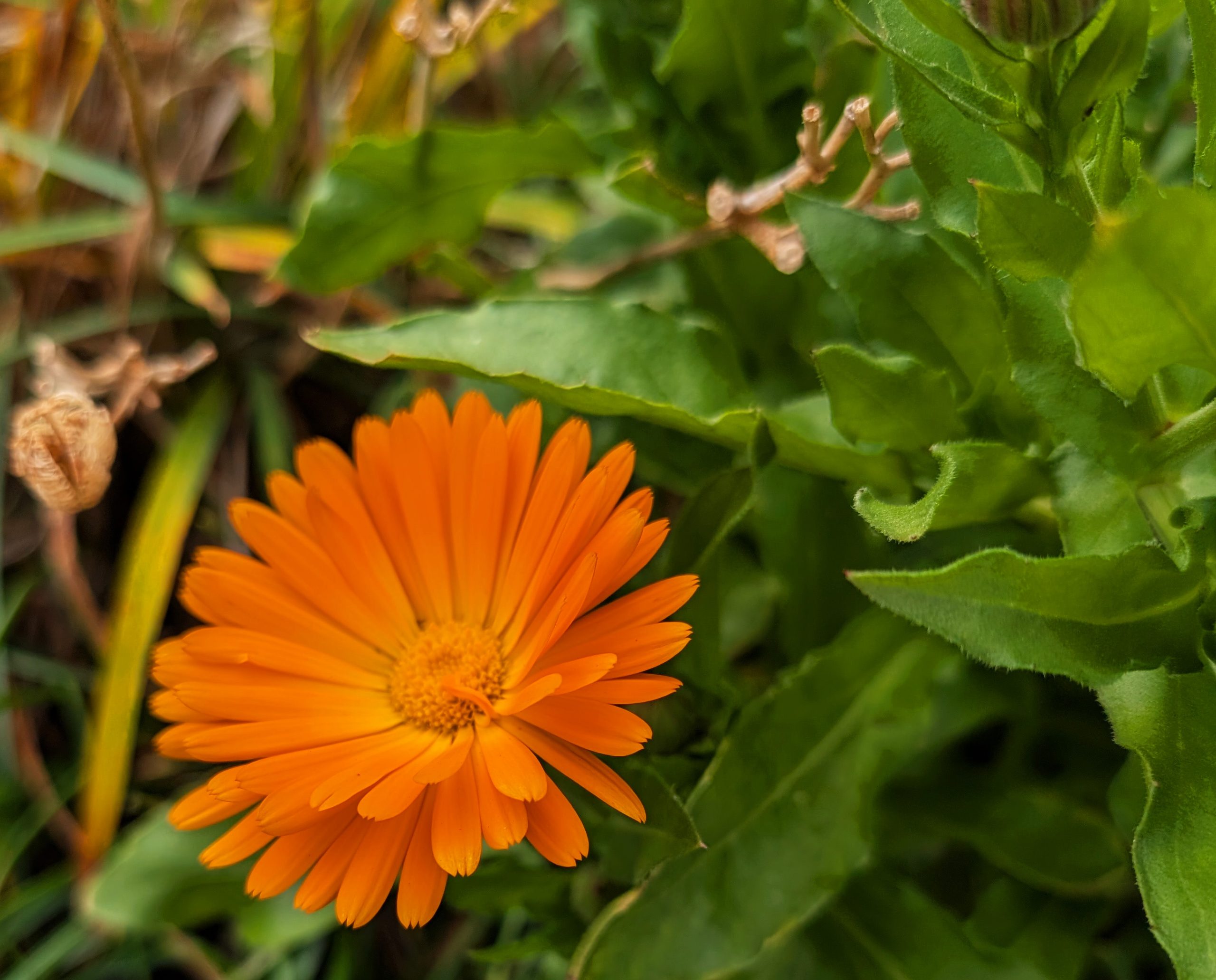
Calendula officinalis
Taxonomy
Domain: Eukaryota
Kingdom: Plantae
Subkingdom: Tracheobionta
Superdivision: Spermatophyta
Division: Magnoliophyta
Class: Magnoliopsida
Clade: Eudicots
Clade: Asterids
Order: Asterales
Family: Asteraceae
Genus: Calendula
Species: Calendula officinalis
Common Names by Region
- United States / Canada: Pot marigold, calendula, English marigold, common marigold, ruddles
- United Kingdom / Ireland: Pot marigold, marigold, Scotch marigold
- Continental Europe: Local-language equivalents — e.g., German Ringelblume (“little ring flower,” for the curled seeds), French souci
- General: Calendula
Description
Quick ID
- Growth form: Bushy annual (sometimes short-lived perennial in mild climates), roughly 1–2 feet tall, on branching, slightly sticky, hairy stems.
- Flowers: Daisy-like composite heads roughly 2–3 inches across. This is a single form — a ring of strap-shaped orange ray florets around a slightly domed orange-yellow disc. Colors range from pale yellow through gold to deep orange across cultivars.
- Seed head — the namesake feature: Seeds are curved, ridged, and arranged in a distinctive curled ring or crescent, like a little crown or clock face. The drying ring at the upper left of this photo is exactly that — the “calendar” the genus name refers to.
- Leaves: Oblong to spoon-shaped, slightly hairy, aromatic, and clasping the stem. Softly sticky to the touch.
- Habit note: Flowers respond to light — heads open in the sun and close in dull weather and at night.
Blooming
- Long season, late spring through fall, and famously persistent — it often flowers right up to hard frost, and in mild winters barely stops. The old genus lore held that it bloomed on the calends (first) of every month.
Look-alikes
- “Marigolds” of the genus Tagetes (French and African marigold): The big source of confusion. Those are the pungent bedding-plant marigolds with ferny, strongly scented, divided leaves and tight double pompons. Calendula is a different genus — milder-scented, simpler-leaved, and the one used in the kitchen and apothecary. Same common word, unrelated plant.
- English daisy, gazania, and other orange composites: Separated by Calendula’s clasping hairy leaves and, decisively, that curled ring of seeds.
Known Range
- Origin: Southern Europe and the Mediterranean; the wild ancestor isn’t cleanly known, as it’s been in cultivation so long. Not truly wild anywhere in the modern sense.
- In cultivation: Grown worldwide as a garden annual, culinary herb, and medicinal plant. Common throughout the United States, including Pennsylvania gardens. It self-sows readily and can persist as a garden escape on disturbed ground, but it doesn’t aggressively naturalize here.
Care / Habitat
Light
- Full sun for best flowering; tolerates light shade.
Soil
- Undemanding. Well-drained average soil is plenty; tolerates poor ground. Dislikes soggy roots.
Water
- Moderate. Reasonably drought-tolerant once established.
Cool-season note
- Calendula is a cool-weather flower. It does its best work in spring and fall and often sulks or stops in high summer heat, picking back up as things cool — which is why it’s a signature late-season bloomer.
Typical Habitat (when cultivated)
- Vegetable gardens, herb beds, borders, containers, and cottage plantings. A traditional companion plant among vegetables.
Propagation / Reproduction
- Seed, and easy from it. Direct-sow in spring (or fall in mild areas); germinates readily in cool soil.
- Self-sows freely — one planting usually returns on its own year after year.
- Deadheading extends bloom and keeps the plant tidy; leaving heads to dry gives you both seed and the ornamental curled rings.
Pests / Diseases / Threats
- Powdery mildew in humid, crowded conditions; aphids and whiteflies on new growth.
- Occasional fungal leaf spot in wet spells.
- Otherwise tough and trouble-free. Not weedy or invasive.
- Sometimes planted deliberately as a trap crop — aphids and other pests will gather on the calendula and spare nearby vegetables.
Additional Notes
Ecology & Use
- A strong pollinator plant with a long bloom season; the open single forms (like this one) feed bees and hoverflies far better than tight doubles do.
- Culinary: the petals are edible — the original “poor man’s saffron,” used to color and flavor butter, cheese, rice, soups, and custards, and scattered fresh over salads.
- Medicinal: one of the oldest and best-known herbal plants. Calendula-infused oils, salves, and washes have a long tradition for soothing skin, minor wounds, and inflammation, and the plant remains a staple of modern herbalism and natural skincare. (The species epithet officinalis literally marks it as a plant “of the apothecary.”)
- Dye: the flowers yield a yellow dye for cloth.
- A genuine multi-purpose cottage-garden plant: ornamental, edible, medicinal, and pollinator-friendly all at once.
Management
- Want more? Deadhead through the season, then let a few heads dry and drop seed — it’ll reseed itself.
- Want the best of it? Grow it in the cool shoulders of the season, spring and fall, when calendula is at its happiest.
All Cernunnos Foundation materials are free to use for any educational purpose.
Views: 237