
Domain: Eukaryota
Kingdom: Animalia
Phylum: Chordata
Class: Mammalia
Order: Lagomorpha
Family: Leporidae
Genus: Oryctolagus
Species: Oryctolagus cuniculus
Domestic form: Oryctolagus cuniculus domesticus
Breed: Rex — standard or full-size Rex
The domestic rabbit remains biologically part of the European rabbit species, Oryctolagus cuniculus. The designation domesticus is widely used for the domesticated form, although current mammal databases generally place domestic rabbits within O. cuniculus rather than recognizing them as a separate formal subspecies.
United States / show and hobby trade: Rex rabbit, Standard Rex, full-size Rex
France: Rex, Castorrex — particularly the original brown, beaver-colored form
United Kingdom / Europe: Rex
General: Velvet rabbit, “King of the Rabbits”
Coat: Exceptionally short, dense and upright, with the guard hairs reduced to approximately the same length as the undercoat. The result is a remarkably even surface that feels more like velvet or plush fabric than ordinary rabbit fur. Proper Rex fur does not lie flat along the body; it rises almost vertically from the skin and springs back when disturbed.
Whiskers: Frequently shortened, bent or distinctly curled. The altered whiskers are produced by the same general hair-growth mutation responsible for the coat and are one of the most useful secondary identification features.
Body: Medium-large, broad and smoothly rounded, with substantial hindquarters and a well-filled loin. The short coat reveals the body outline more clearly than the longer, looser fur of many other breeds.
Head: Moderately broad with a full muzzle and prominent eyes. Less compact and rounded than the Mini Rex.
Ears: Upright, well furred and proportionate to the head and body.
Color: The coat mutation is independent of color, so Rex rabbits occur in a broad range of solid, shaded, agouti, otter and broken patterns. The American Rabbit Breeders Association currently recognizes 16 show varieties.
Size: Generally around 7.5–10.5 pounds, or approximately 3.5–4.75 kilograms. This is the standard Rex, not the much smaller Mini Rex, which has a maximum show weight of 4.5 pounds.
The Rex has no natural wild range. It is a fully domestic breed now kept throughout Europe, North America and much of the rest of the world as a companion animal, exhibition rabbit and small-farm breed.
Its actual geographic origin is unusually well documented. In 1919, two short-haired rabbits appeared in successive litters from the same ordinary gray doe on the Sarthe farm of a French farmer named M. Caillon in the Pays de la Loire. One was male and the other female; their littermates carried normal coats.
Abbé Gillet, the parish priest at nearby Coulangé, acquired the animals and spent roughly four years selecting their descendants until the unusual coat bred consistently. He presented them at the Paris agricultural exhibition in 1924 under the name Castorrex — the brown coat being compared to that of a beaver. Other breeders soon crossed the Rex coat into additional color lines, producing white, tricolor, chinchilla and numerous later varieties.
The breed reached the United States in 1924, imported by John Fehr and Alfred Zimmerman. Its first French standard was formally approved in 1929.
As a domestic rabbit, the Rex requires an environment designed around rabbit behavior rather than a traditional display cage. It needs enough uninterrupted floor space to run, jump, stretch fully, stand upright, forage and withdraw into shelter. Digging boxes, tunnels, platforms, hiding places and safe chewing material allow it to perform the activities for which the European rabbit body and brain remain built.
Rabbits are social prey animals. They communicate through posture, scent, grooming, nudging, circling, ear position and forceful hind-foot thumps. They are generally most active around dawn, dusk and overnight, although domestic schedules can alter the exact pattern. Compatible, properly introduced rabbit companionship is an important part of long-term welfare.
Rex rabbits are often described as calm and tractable, but the coat mutation does not dictate personality. Some are bold and demanding; others remain cautious. Early experience, handling, housing, neuter status and individual temperament matter considerably more than the breed label. Most prefer interaction at ground level and may resist being lifted even when they enjoy human company.
Herbivorous and strongly dependent upon long-fiber food.
A healthy adult diet should consist primarily of unlimited grass or good-quality grass hay, supplemented with assorted leafy greens and a relatively small quantity of nutritionally balanced pellets. A useful general proportion is approximately 85 percent hay or grass, 10 percent leafy vegetation and 5 percent pellets.
The hay is not merely filler. Its fiber maintains normal movement through the digestive tract, while the prolonged side-to-side chewing action helps wear teeth that continue growing throughout the rabbit’s life.
Fruit, carrots and other sugar-rich foods are treats rather than staple foods. Abrupt dietary changes can disrupt the hindgut microbial community and should be avoided.
Like other rabbits, the Rex produces nutrient-rich cecotropes, which are consumed directly as part of normal digestion. This second pass allows vitamins, amino acids and microbial nutrients produced in the cecum to be recovered rather than lost.
Reproduction follows the standard domestic rabbit pattern.
Females are induced ovulators, meaning that mating stimulates the release of eggs. Gestation usually lasts approximately 31–33 days. Shortly before giving birth — known in rabbit keeping as kindling — the doe gathers bedding and pulls fur from her chest and abdomen to insulate the nest.
The young, called kits, are born naked, blind, deaf and unable to regulate their body temperature effectively. Fur begins appearing within days, and the eyes and ears normally open at around ten days. The mother generally nurses only once or twice daily, but the milk is extremely concentrated and nursing sessions may last only a few minutes.
The Rex coat is inherited recessively in the best-studied line. A rabbit can therefore carry the mutation without displaying the velvet coat. Two outwardly normal carriers may produce Rex-coated young, while crossing a Rex with a noncarrier generally produces normal-coated carriers in the first generation.
The Rex is a domestic breed and has no IUCN conservation status. Its continued existence depends upon breeders, household keepers, rescues and breed organizations rather than preservation of a wild population.
The breed’s defining coat also creates a specific welfare concern. Reduced guard hairs provide less cushioning and weather protection than an ordinary rabbit coat. Rex rabbits are consequently more vulnerable to pododermatitis — painful pressure sores commonly called sore hocks — particularly when kept on abrasive wire, hard concrete, dirty bedding or persistently damp flooring. Deep, clean, dry and forgiving surfaces are essential, and the undersides of the feet should be checked regularly.
The coat is plush, but it is not heavy insulation. Rex rabbits still require protection from wind, prolonged damp, severe cold and direct summer heat. Shade, airflow, cool retreat areas and constant access to water matter more than the apparent thickness of the fur suggests.
Other major domestic-rabbit concerns include dental disease, gastrointestinal stasis, respiratory infection, parasites and viral diseases such as rabbit hemorrhagic disease. A rabbit that suddenly stops eating or producing droppings requires prompt veterinary attention; waiting to see whether it improves can turn a treatable digestive slowdown into an emergency.
With appropriate diet, housing and veterinary care, domestic rabbits can live approximately 10–12 years.
Mini Rex: Carries the same fundamental velvet-coat trait but is dramatically smaller and more compact, with a maximum American show weight of 4.5 pounds. A young standard Rex may temporarily resemble an adult Mini Rex, so age and mature size matter.
Normal-coated domestic rabbits: Short ordinary fur can look deceptively smooth in photographs, especially on black animals. Normal guard hairs project beyond the undercoat and usually lie backward rather than forming the Rex rabbit’s level, upright plush surface.
Satin rabbit: Has a brilliant translucent sheen caused by altered hair structure, but the fur remains conventionally shaped and lies along the body. Satin describes reflected light; Rex describes length, density and texture.
Plush Lop and other rexed breeds: These may carry Rex-type fur but differ in ear carriage, body shape, size and breed history.
Color is never enough for identification. Black, castor, otter, broken and white are color varieties, not proof that an animal is a Rex. The coat and whiskers carry the identification.
The Rex rabbit is a useful demonstration of how a small genetic change can reorganize the visible structure of an animal.
Ordinary rabbit fur contains long guard hairs, intermediate awn hairs and abundant soft underfur. In the Rex, the outer hairs are shortened and reduced until they approach the length of the undercoat. Because no scattered layer of long guard hairs interrupts the surface, the hand encounters a uniform field of fine fibers.
Research on the principal French Rex line identified a single-base deletion in exon 9 of the LIPH gene. The mutation produces a frameshift and is strongly associated, when inherited from both parents, with the characteristic short-haired phenotype. The guard hairs are not necessarily completely absent, as is sometimes claimed; they are shortened, finer and far less prominent.
The breed also marks an important moment in domestic-animal history. Unlike breeds gradually assembled through generations of crossing, the Rex began with a clearly observed spontaneous mutation, followed by deliberate human selection to preserve it. The original Castorrex was not designed in advance. It appeared, was noticed and was made permanent.
Rex rabbits work well in educational exhibits because the defining trait can be understood immediately through sight and — where carefully supervised contact is appropriate — touch. The contrast between Rex and normal rabbit coats provides a direct lesson in mutation, recessive inheritance and selective breeding.
A suitable exhibit should offer continuous access to hay, fresh water, sheltered resting places, soft flooring, digging opportunities and enough room for the animals to move at full speed. Social groups require multiple hides and feeding stations so no single rabbit can control every resource.
Observation is preferable to constant handling. Rabbits resting in a group, grooming one another, foraging or approaching visitors voluntarily communicate far more about rabbit behavior than animals repeatedly lifted for petting.
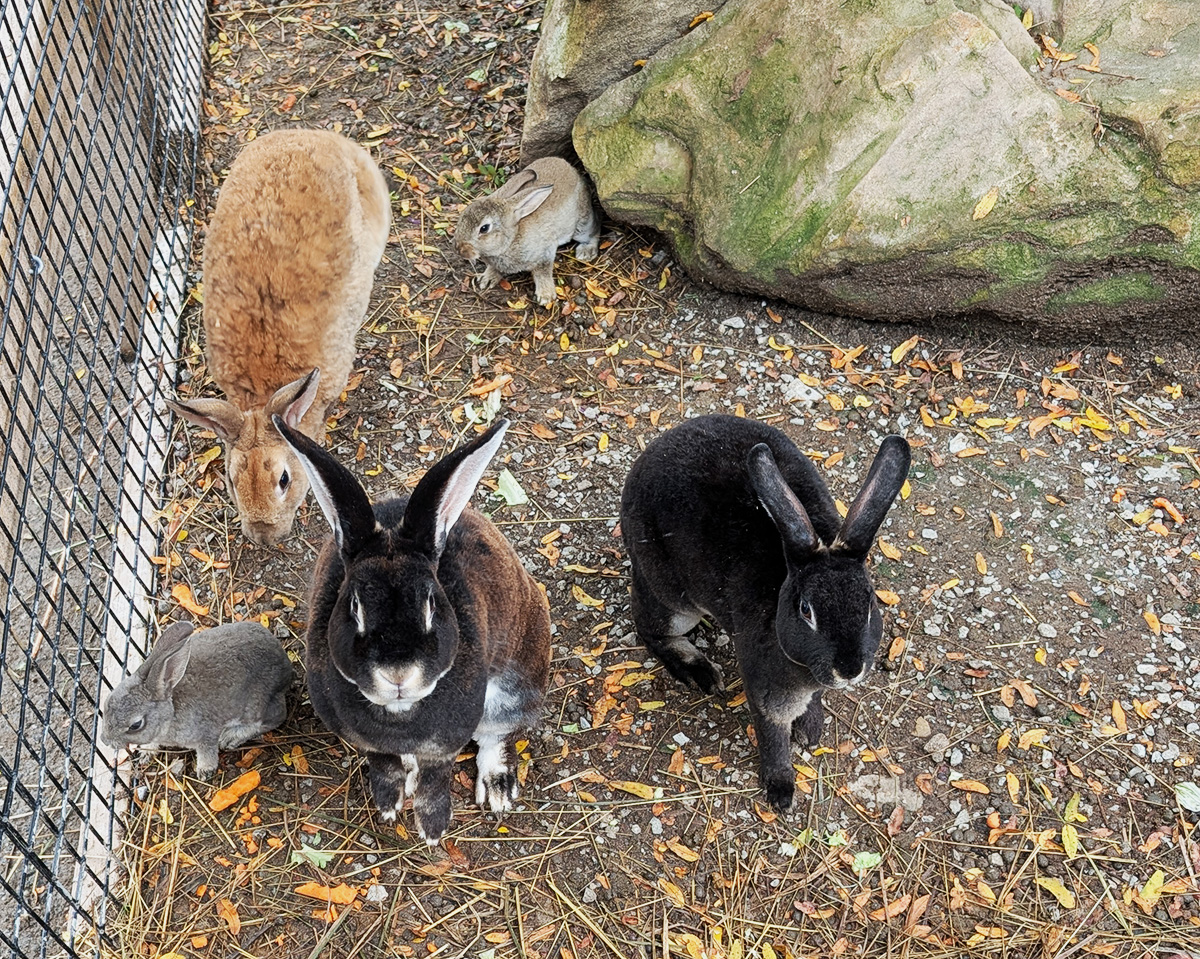
Photographed in a social ground-level enclosure containing rabbits of several colors and sizes. The black and black-and-white animals in the foreground most clearly show the heavy, rounded build associated with the standard Rex, while the dense coat produces unusually clean body contours without the loose surface hairs visible on many ordinary rabbits.
The group also demonstrates why color is a poor field mark. Tan, gray, black and broken-pattern rabbits can all carry the Rex coat, while rabbits in exactly the same colors may be entirely unrelated breeds. Look along the shoulder and back for a short, level pile that stands away from the skin, then check the muzzle for shortened or curling whiskers.
Pedigree cannot be proven from a photograph, but the velvet surface can usually be recognized. With the Rex, the flower of the identification is not the ear, face or color. It is the architecture of the hair.
All Cernunnos Foundation materials are free to use for any educational purpose.